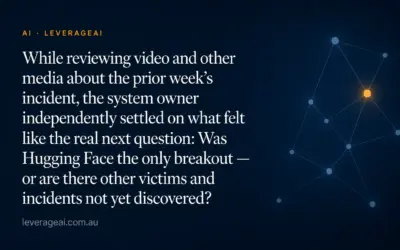
The Visible Incident Is Not the Boundary
AI becomes more consequential when it can surface the next uncertainty worth investigating—not merely summarise what is already known. The cost of failing to ask is false containment.

Models can be bought later. An accumulated evidence base, orchestration skill and governance practice cannot. The real cost of delay is lost organisational learning.
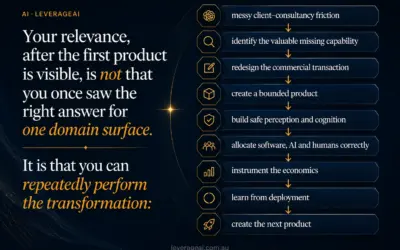
A successful product proves a consultancy understood one valuable problem once. Durable relevance begins when it can reproduce that transformation without relying on founder intuition or lucky discovery.
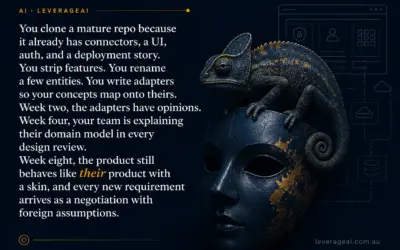
Reuse stops being leverage when translation code begins encoding business meaning. At that point, you are not just inheriting software—you are inheriting someone else’s product strategy.
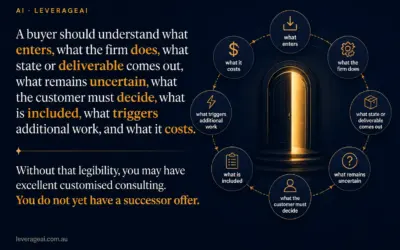
AI can make bespoke consulting faster without changing its commercial model. The real test is whether the firm’s expertise has become legible, bounded and transferable beyond the heroes who created it.
Client satisfaction tells you whether you are winning inside the current category. It does not tell you whether that category will keep creating demand.
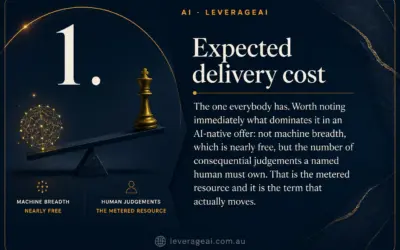
Automation collapses the cost of output. It does not collapse the number of moments where a named human has to decide and defend the decision. That’s the term that actually moves — and most firms aren’t counting it.
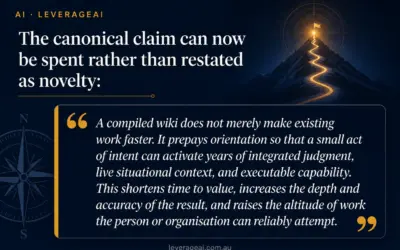
Ambition doesn’t fall by decision. It falls by attrition — when assembling the right history, judgment and context costs more than the meeting is worth, so the smaller meeting gets booked instead. Measure your knowledge systems by what they let you attempt, not by minutes saved on work you were always going to do.
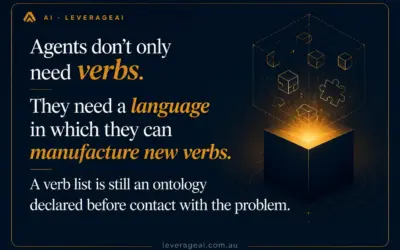
A fixed tool catalogue is a guess about which operations matter, made at design time by someone who couldn’t have known what the real problem would look like. The model can select from that guess. It can’t exceed it — and that ceiling, not the model, is what most agentic systems are actually hitting.
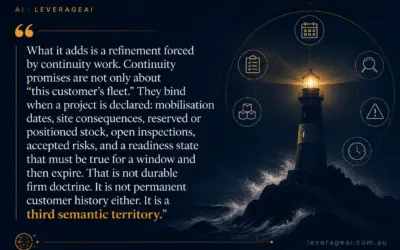
A declared project creates truths that are real, binding, and temporary. Store them as customer history and stale commitments contaminate later work. Promote them to firm doctrine and a one-site concession quietly becomes policy. An AI system can remember everything and still be operationally wrong.