
A fixed price. A defined question. A board that can decide.
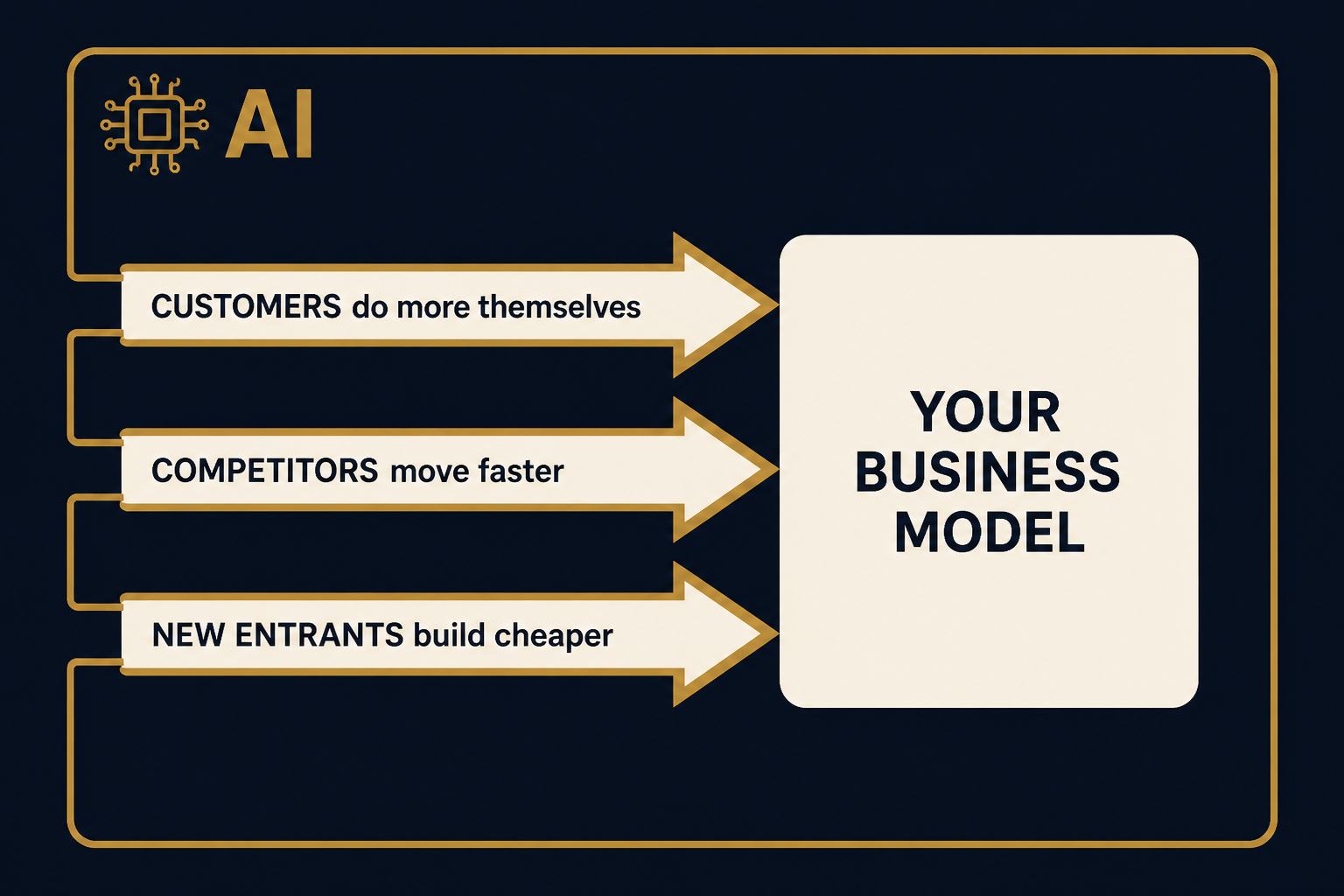
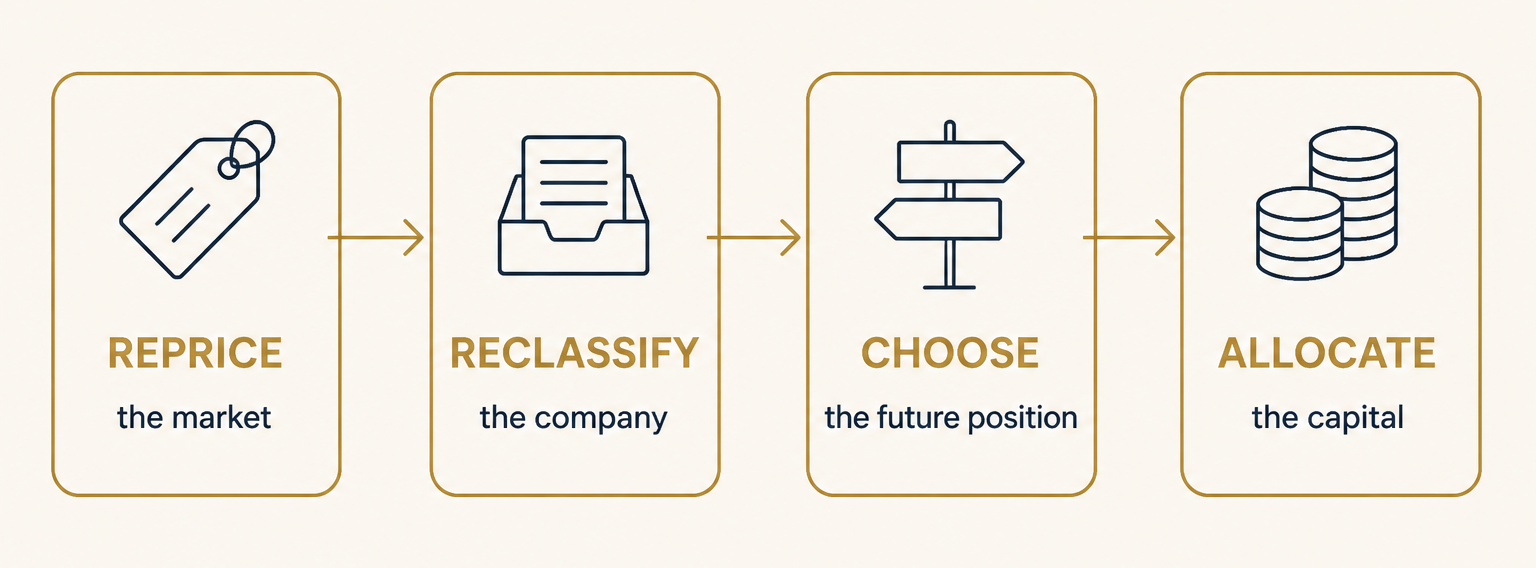
Over six to eight weeks, we determine whether your firm’s current economics remain viable as AI compresses demand, delivery effort, team size and rates. We identify where margin becomes exposed, classify which assets are stranded, convertible or compounding, and leave the board with an evidence-backed Harvest–Migrate–Construct decision and one successor-offer candidate ready for ninety-day construction. The price is fixed, and it buys the decision, not attendance.
The important words are determine whether. This is a genuine review, not a disguised sales funnel — it is allowed to conclude:
What the review actually settles
We arrive with the structural model: how firms shaped like yours make and lose money under AI repricing. Your team supplies the coefficients — realised rates, utilisation by practice, pipeline coverage and age, proposal cost by role, delivery leakage, cost-adjustment lag. The model shows where relatively modest joined pressure turns profit into loss, and how much runway the current shape has. Disagreement stops being assertion versus assertion; it becomes a discussion about measured coefficients.
Every material asset is classified by its behaviour under improving AI: what yields from a scarcity that is dissolving (stranded), what holds information that can now be read and compiled (convertible — usually the client archive nobody counts), and what appreciates as AI improves (compounding — evidence, machinery, compiled judgment). The same taxonomy is applied to roles and capabilities: which are stranded as currently shaped, which convert, which compound. Roles are classified for conversion, not people for exit — the register shows the bench a successor model can economically sustain, and the paths into it.
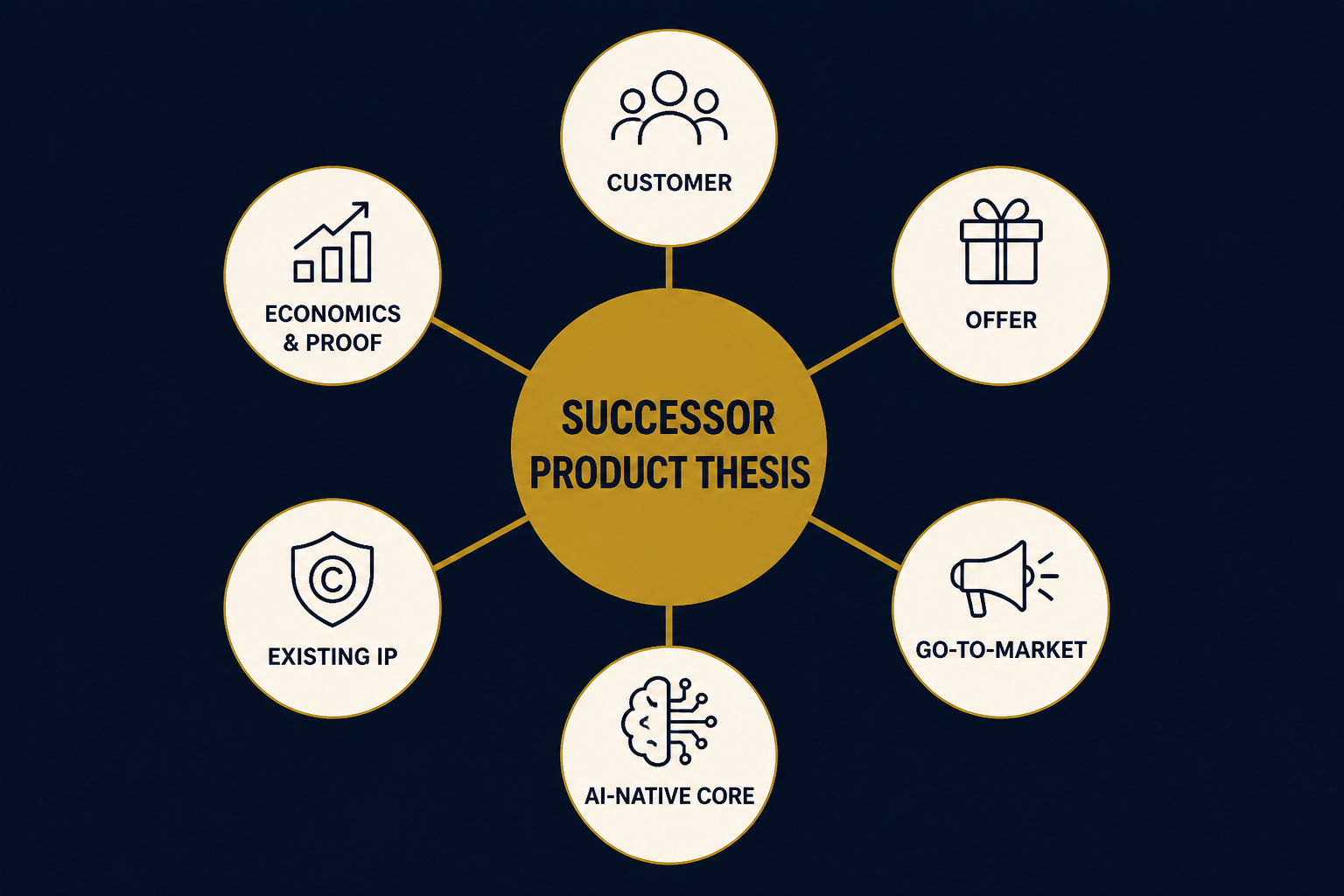
One named candidate: its buyer, its bounded promise, the old labour-priced unit it compresses, its pricing unit, the machinery it needs, an installed-base proof account, and explicit kill conditions. Plus one credible alternative, and stand-pat — each able to win on the evidence. This is the shape of the future offer, not its construction: building it is a separate, later purchase, priced from this review’s own findings.
The Future Value Decision Pack — eight artifacts, no filler
-
01
Economic Fault-Line Model — the live stress model over your own numbers — kept, and re-runnable
-
02
Value Migration Map — what clients pay you for today, split into scarcities that are dissolving and scarcities that are intensifying
-
03
Future Value Asset Register — stranded / convertible / compounding — assets and capabilities, with the re-allocation recommendation
-
04
Workforce & Capability Transition Map — the current bench shape against the shape the successor model sustains — with migration paths, not a redundancy plan
-
05
Successor Offer Decision — one candidate, one alternative, stand-pat — each costed, each with kill conditions
-
06
Question Ledger — every claim tested, its evidence, the alternatives rejected, the gaps that remain, and the triggers that would reopen the decision
-
07
Harvest / Migrate / Construct allocation — the capital decision itself, in the taxonomy your CFO already speaks
-
08
Ninety-Day Construction Charter — sponsor, team, capital, proof account, evidence gates, kill conditions — ready to execute or shelve
The Question Ledger is what makes the recommendation challengeable without turning every disagreement into a political referendum. “I don’t like this” becomes “add these three questions and re-run.” And the board doesn’t have to concede anything today — the Ledger records the observable evidence that would prove the case, checked quarterly.
The models and the Ledger are yours, and they appreciate — every quarter of new data sharpens them. They are the first compounding-class assets on your own register: the review ends, the instrument stays.
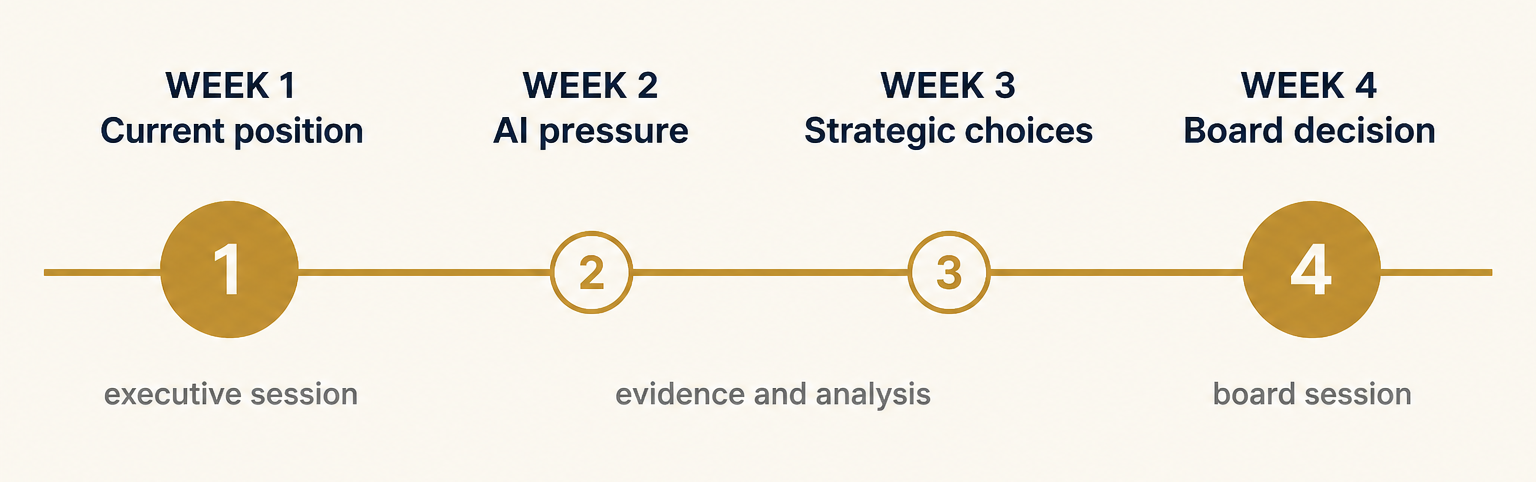
Seven weeks. Mornings, not offsites.
A two-day offsite forces executives to speculate about numbers that exist somewhere else in the building. This programme runs the other way: executive mornings, evidence afternoons, machine-compiled overnights — each session opens from a sharper position than the last closed, and the platform question is answered from your own spreadsheets, not from rhetoric.
CEO and CFO separately. The parent question, the engagement boundary, financial definitions, the data request, confidentiality and AI-use controls, alternative diagnoses, explicit kill conditions.
Service-line economics, pipeline and backlog, paid-capacity model, rate and team-size trends, proposal burden, leakage, cost-adjustment lag. Structural and competitive analysis alongside — with competing explanations developed, not one favourite conclusion.
Each functional leader, individually: mechanisms and exceptions. Their evidence enters the model on their terms — the synthesis may surprise; the raw claims will not.
The doctrine taught against your own numbers as the case material. Every exercise produces evidence into the Decision Pack — nothing is theatre. Afternoons stay free for client work and coefficient sprints; overnight, the evidence system compiles, attacks the emerging conclusion, and prepares the next morning’s decision surface.
Three real paths — Defend & Harvest, Migrate the model, Construct the successor — each run through financial, commercial, workforce and delivery tests. Stand-pat must be able to win.
The Decision Pack presented; the recommendation able to survive without us in the room — evidence, rejected alternatives and reasoning your board can carry into its own conversations.
What a fixed price means when it’s honest
A fixed price without a theory of uncertainty is hidden time-and-materials with the downside transferred to someone. This one is configured: explicit inclusions, explicit client responsibilities, and typed outcomes for the questions that cannot be closed. Unknowns are deliverables, not embarrassments.
- ✓One corporate entity; agreed service-line grouping
- ✓CEO and CFO preflight; data specification
- ✓Up to eight executive interviews
- ✓Four facilitated executive mornings
- ✓Financial stress model, asset and workforce mapping
- ✓Successor-offer analysis; one developed candidate
- ✓One consolidated board session
- ✓The eight-artifact Decision Pack; one revision round
- •A named CEO or board sponsor
- •CFO ownership of the evidence model
- •Nominated analysts for data extraction — the CFO validates; analysts pull
- •Timely access to agreed records
- •Executive availability for interviews and mornings
- •One consolidated feedback route
- •Disclosure of material data limitations
- •Additional business entities
- •Major changes to data definitions mid-engagement
- •Inaccessible records requiring reconstruction
- •A materially wider interview population
- •Additional board or partner rounds
- •A second fully-developed successor candidate
Each priced as a written variation before work proceeds — never absorbed, never surprise-billed.
We do not promise omniscience. We promise that the important unknowns become typed, visible and decision-bearing — and “not observed” never quietly becomes “doesn’t exist.”
A$225,000 — priced on the question it answers.
The question under this review is what your firm is worth in three years if nothing changes — for a mid-market practice, a seven-or-eight-figure exposure. The price sits against that question, not against effort. There is no pyramid behind it and no day rate to reverse-engineer: the commercial unit is the Decision Pack, and the fee is the same whether the finding is “construct” or “stand pat.”
For scale: it is typically less than a year of the unpaid proposal cognition the review will measure inside your own pipeline — senior hours spent scoping and pricing work that was never won. That number comes out of your own spreadsheets in week two.
This is also how the review will recommend you price what comes next: fixed, value-anchored, configured scope, variations in writing. The pricing of this engagement is the first exhibit.
Who this is for — and who it isn’t
- ✓A knowledge or service business whose value lives in the judgment, history and trust of its people — consulting and professional-services firms first
- ✓A CEO or board sponsor with authority to examine the business model itself
- ✓A CFO willing to own the evidence model
- ✓Access to commercial and workforce information
- ✓Genuine willingness to hear Harvest, Migrate, Construct — or stand-pat
- ×An AI ideas workshop, an innovation sprint, or a use-case discovery exercise
- ×A technology assessment or vendor selection
- ×A pitch with a predetermined conclusion — stand-pat can win, and sometimes should
- ×Available as “show us some clever AI, but don’t examine our pricing, workforce or pipeline” — that constraint removes the product
The three objections we’d raise too
“A$225,000 — for one person?” ▸
“Is this a funnel for a bigger sale?” ▸
“Couldn’t we run this ourselves?” ▸
If the finding is “construct”
Where the board decides to build, a separate engagement exists: the Successor Offer Build — the chosen offer made real. It completes only when four things exist together: the commercial offer a client can buy, the working delivery system behind it, one account proven end-to-end, and the launch package your salespeople can quote without us in the room. If a construction engagement produces only designs, workshops and a roadmap, it has failed its own definition.
Fixed price, quoted from the review’s own evidence — never sold beside the review, only manufactured by it.
An evidence-backed board decision
One sellable offer + the working system behind it, proven on a real account
The repeatable capability: new offers on a cadence, without us
Forty-five minutes. A thesis you can kill.
The first meeting costs nothing and sells nothing. We table a structural thesis about your firm’s economics — public receipts, named unknowns, a stated kill condition — and you try to break it. Either outcome is worth the time.