
A firm I spoke with had automated roughly 70% of the production work in a fixed-price engagement. Drafting, analysis, first-pass modelling, documentation — all of it faster and cheaper than the year before. Margin was flat.
Nobody could explain it, because everyone was counting the wrong thing.
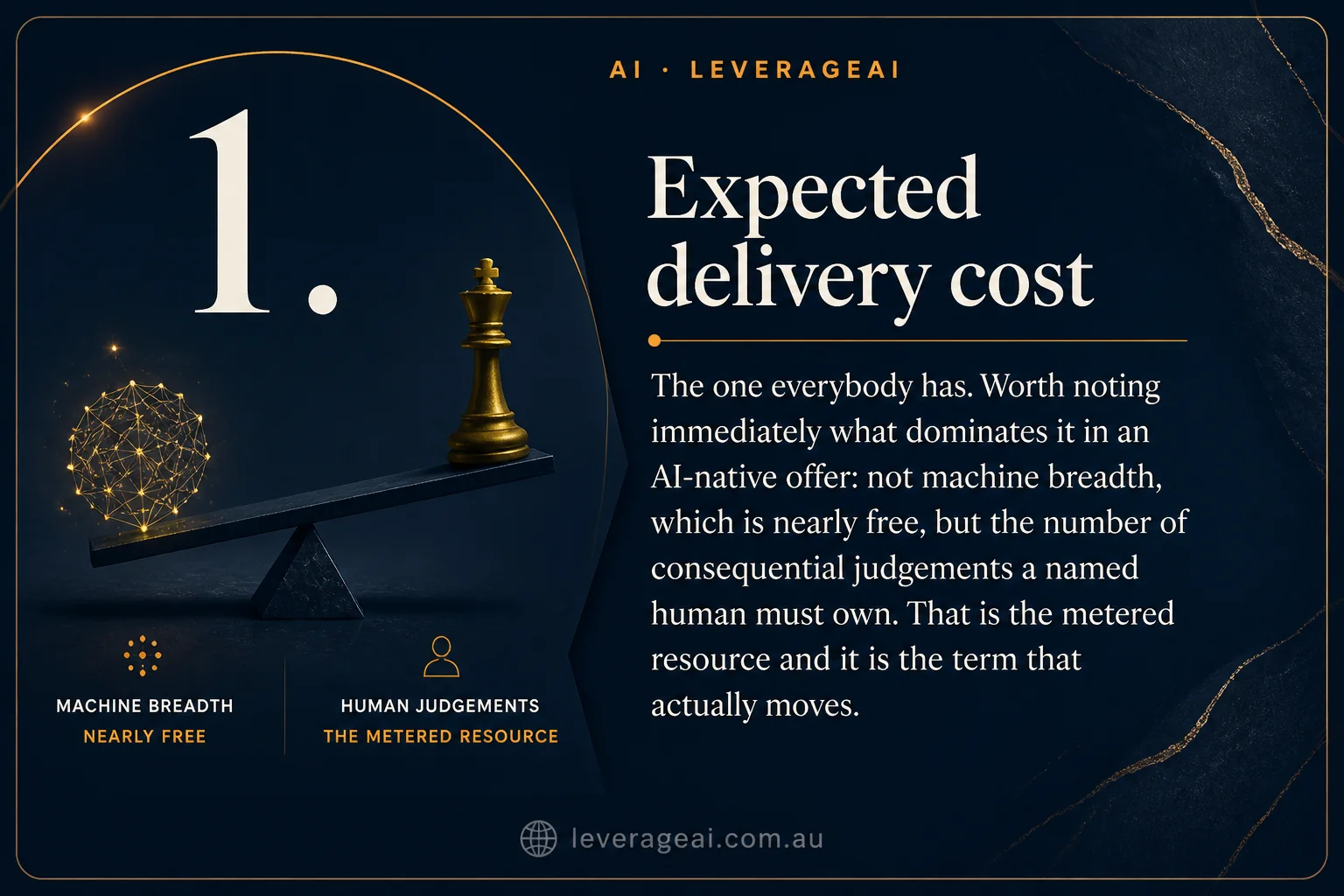
Automation collapsed the cost of output. It did not collapse the number of moments where a named human had to look at something, decide, and be prepared to defend that decision later. Those moments didn't move. In some cases they went up, because there was more output to look at.
That's the awkward arithmetic of a fixed price. You quoted a number before you knew what the work would demand. Every consequential judgement between signature and delivery is where the variance lives — where scope shifts get adjudicated, where a call turns out to be wrong, where someone senior has to stop and think rather than review. Machine throughput doesn't touch any of it. It just arrives at those moments sooner.
So the useful question when you price a fixed-fee engagement is not "how much of this can we automate." It's: how many decisions in this work will still require a person to own the outcome? Count those. That's your cost base. That's your exposure. That's the term that actually moves when you change how you deliver.
Firms that get this wrong don't fail loudly. They win the work, deliver it, and quietly discover their most automated engagements have their thinnest margins — because they priced the volume of work instead of the weight of the judgement inside it.
The scarce resource was never compute. It's the small number of people in your firm whose signature means something.
Discover more from Leverage AI for your business
Subscribe to get the latest posts sent to your email.