
Your giant reusable prompt isn't memory. It's a guess that can't be right.
You know the artefact I mean. The 4,000-word block of context about your business — products, tone, policies, exceptions, history — pasted at the top of every AI task because it's the only way the model "knows who you are."
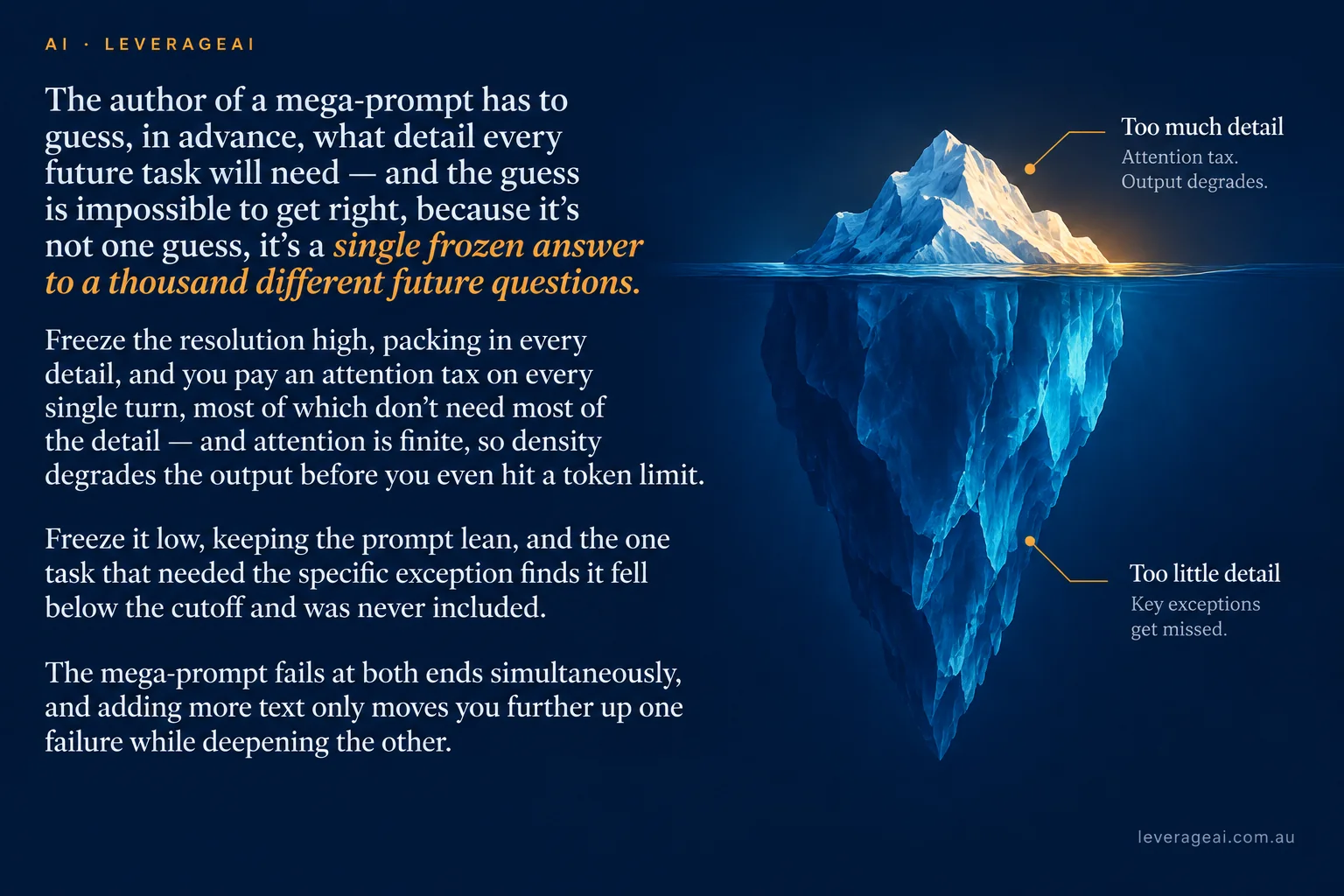
The problem isn't length. Token limits are a red herring. The problem is that one frozen document has to answer a thousand different future questions, and every one of them needs a different level of detail.
So you pick a resolution and you lose either way.
Pack everything in, and every single task pays an attention tax on detail it doesn't need. Attention is finite. Density doesn't just waste tokens — it degrades the judgement of the output. The model is reading about your refund policy while trying to write a supplier email.
Keep it lean, and the one task that hinged on the obscure exception discovers the exception fell below the cutoff and was never in the prompt at all. Confidently wrong, no way to tell.
Adding more text moves you further up one failure while deepening the other. That's not a tuning problem. That's the architecture telling you it's the wrong shape.
Real organisational context isn't a block of text you freeze once. It's something you own and maintain, and compile down — per task, at the resolution that task actually needs. The supplier email gets the supplier context. The refund decision gets the policy exceptions. Neither carries the other's baggage.
Which is why prompt engineering stalls out as a discipline. You can polish the frozen answer forever. You cannot make it stop being frozen.
If your AI's understanding of your business lives in a document nobody wants to touch because it's too long to reason about — you don't have a prompt problem. You have a missing tier in your architecture.
Discover more from Leverage AI for your business
Subscribe to get the latest posts sent to your email.