
Your AI can't tell you what it read from what it worked out.
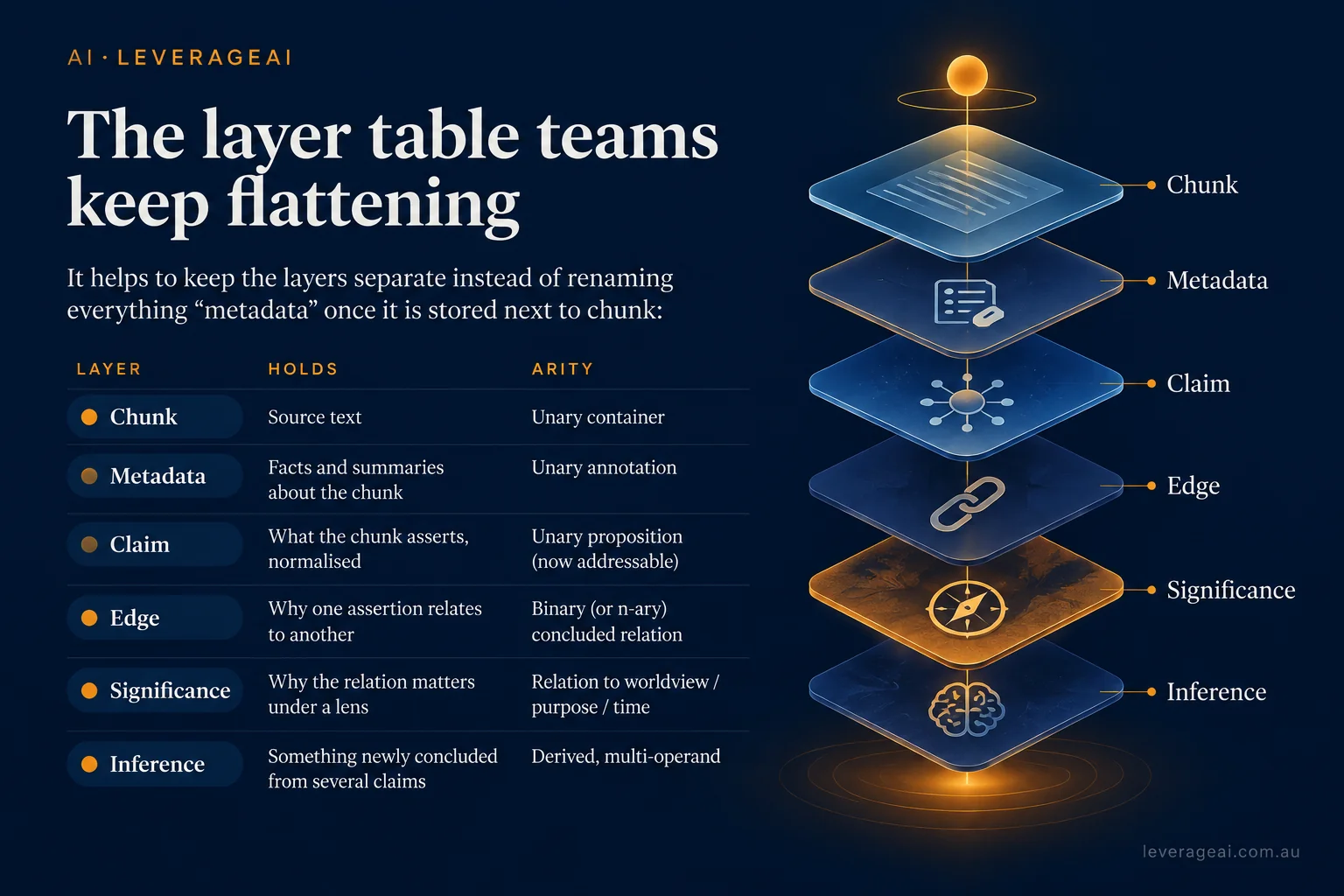
Most knowledge systems store source passages as chunks, then attach everything else to them and call the whole pile "metadata". What the passage asserts. How two assertions relate. Why that relation matters for your business. What the system concluded from several assertions together.
All of it in the same bucket, because it all lives in the same place.
Proximity in storage doesn't make different things equivalent. A claim is something your source said. An inference is something your system decided using several sources. Those have completely different standing. One you can go and check. The other you can only check if you know which assertions it rests on.
Flatten them and you lose the ability to ask the only question that matters when an answer gets challenged in a board paper or a regulator's letter: is this in our documents, or did the machine put it together?
There's a second thing that quietly disappears. Why a relationship matters isn't a fact about the passage — it's a fact about your purpose, your worldview, and the moment you're asking in. Stored as just another annotation, it gets treated as permanently true. It isn't. It's true under a lens.
Normalising a claim makes it addressable. It doesn't make it correct. Those are different achievements, and systems that blur the layers tend to quietly take credit for the second while only delivering the first.
The test for your team isn't how much context you've attached to your documents. It's whether you can point at any conclusion the system produced and trace which assertions support it.
If you can't, you don't have a knowledge system. You have a confident one.
Discover more from Leverage AI for your business
Subscribe to get the latest posts sent to your email.