
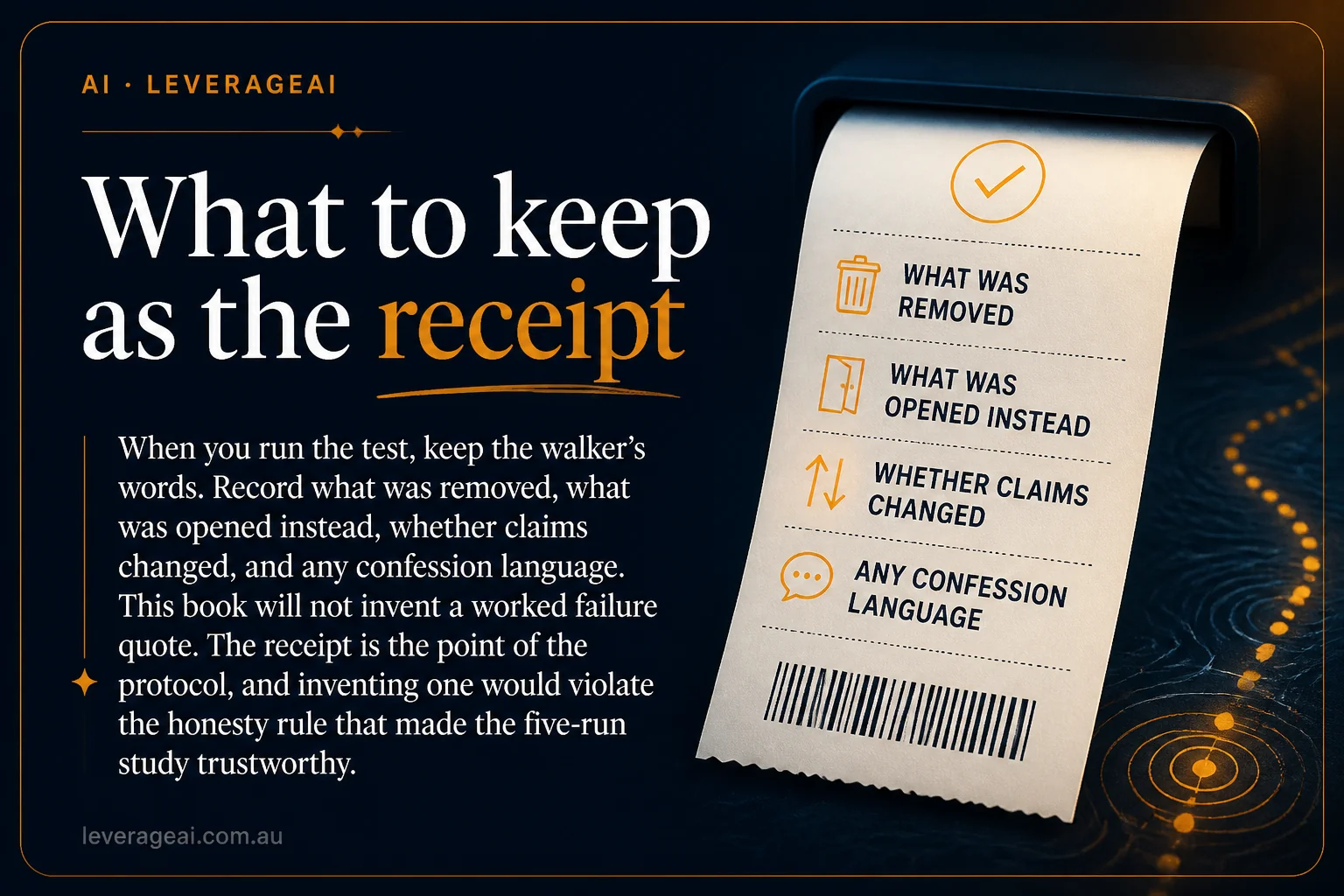
There is a moment in every AI evaluation where you are tempted to make up the example.
You have designed the test properly. Take away the source the agent leaned on, and watch what it does. Does it find another route? Does it qualify the claim? Does it say, plainly, that it can no longer support the answer? Or does it hand you the same confident paragraph as before, now resting on nothing but the model's priors?
That last case is the one you're hunting. It's also the one you cannot demonstrate until it happens.
So the temptation arrives: write a plausible version. A tidy little confession. Something that shows the reader what the failure looks like. Everyone does it. It reads well. It is also, precisely, the failure you were testing for — a fluent answer with no evidence underneath it. Faking the receipt to prove your detector works means your detector has already caught you.
The consequence executives miss is that this isn't editorial restraint. It's architecture. If your evaluation process can quietly manufacture the evidence it hoped to observe, your governance is decorative. The audit trail only means something if it is allowed to come back empty.
Most AI assurance work I see reports what the system produced. Almost none preserves what the system did when the ground was pulled out from under it.
That second record is the one a board should be asking for.
Discover more from Leverage AI for your business
Subscribe to get the latest posts sent to your email.