
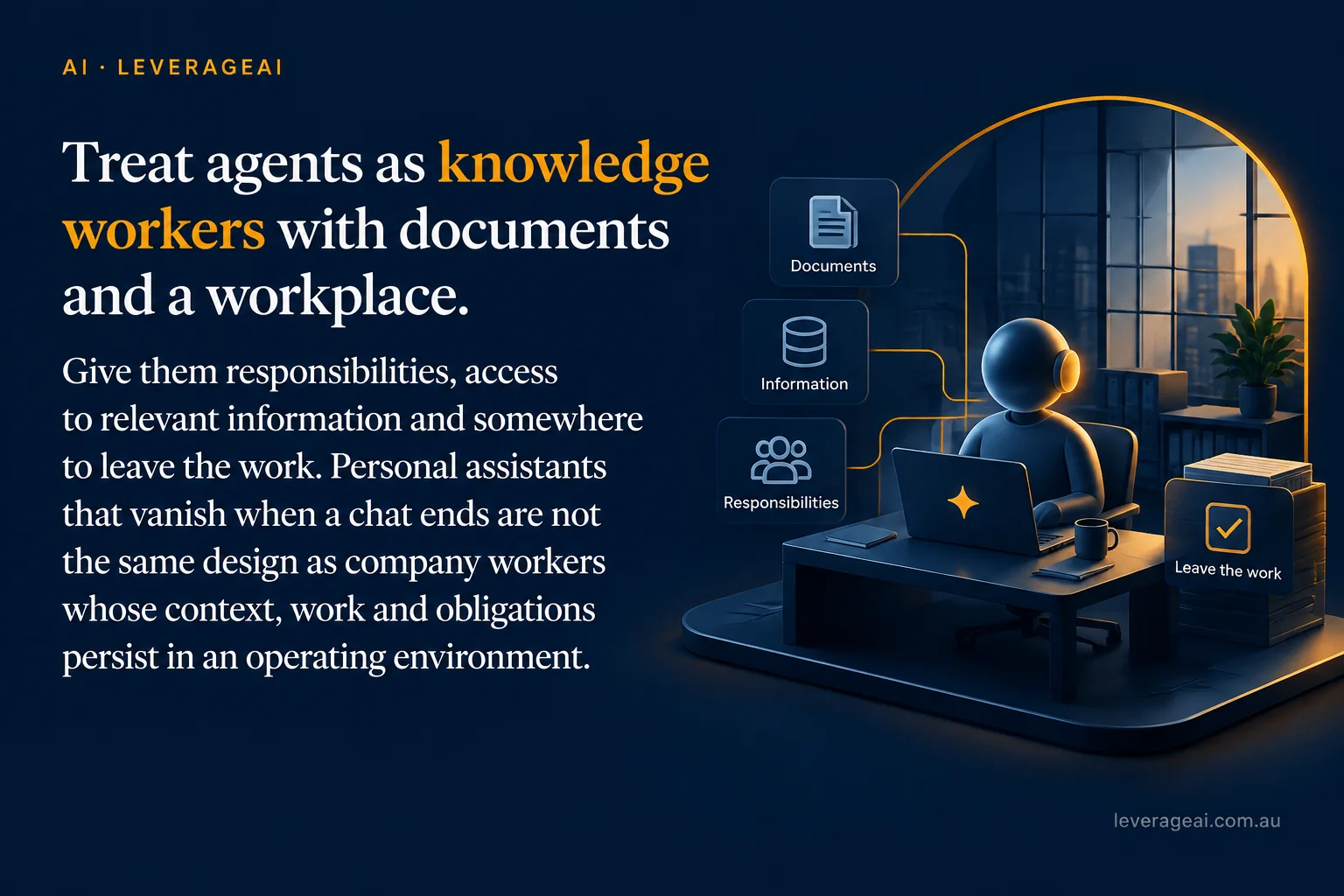
You gave your AI agent a job. Then you gave it nowhere to work.
Most companies now hand agents ongoing responsibilities: chasing renewals, managing supplier exceptions, preparing the monthly board pack. Work that continues for weeks.
Then they run it inside a chat window built for one-off questions.
That's the contradiction. A personal assistant answering a question can vanish when the conversation ends. A company worker can't. The work continues, so the context has to continue too.
Think about how a good firm hands a file to a new person. You don't give them a transcript of every conversation the last person had. You give them the folder: the evidence so far, the current read on the situation, what's been promised, what's still owed, and a desk to keep working from.
That's the test for any agent doing real company work. When the next session or the next worker picks it up, can they tell what is known, what has been done and what remains owed, straight from the company's records?
If the answer lives only in a chat history, you haven't built a worker. You've built a very articulate amnesiac and asked it to carry your obligations.
A saved transcript isn't an account of unfinished work. Neither is a memory feature. Continuity is an architecture decision, and it belongs to the company, not the model.
This isn't nostalgia for paper files. Money, commitments and permissions still need proper systems with real rigour. And calling agents knowledge workers is a design analogy, not a claim they get unlimited access or answer for themselves.
The point is narrower and harder: stop optimising the individual conversation. Give the continuing work a home.
Where does the unfinished work of your agents actually live right now?
Discover more from Leverage AI for your business
Subscribe to get the latest posts sent to your email.