Most organisations think their problem is memory. It isn't. It's continuity.
Memory is "what did we say last month." Continuity is "what are we still bound to, who owns that, and what happens if it changes." Those are different questions, and only one of them can be answered by a wiki, a fleet-wide notes file, or an AI that summarises everything it can reach.
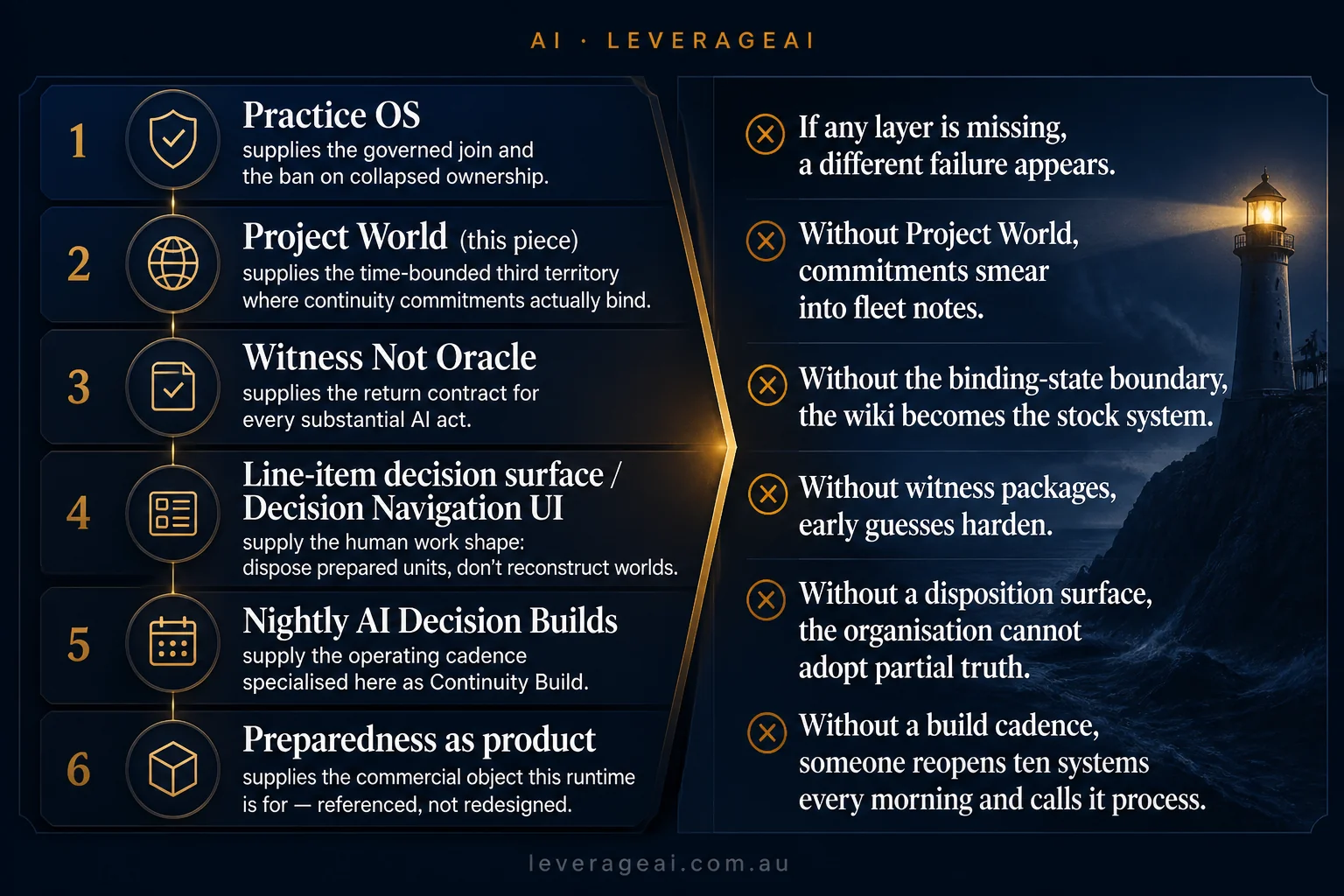
The failure is subtle because it looks like helpfulness. You ask a model to carry the project, and it obligingly reconstructs the whole world every morning — pulling from the CRM, the ticket queue, the thread, the doc — and hands you a confident synthesis. It feels like progress. What has actually happened is that four separate kinds of ownership have been collapsed into one voice. Source systems own binding state. The project owns its live commitments, and only for as long as it exists. AI acts owe you evidence, not verdicts. Humans keep the right to dispose.
Flatten those and every layer quietly starts lying. Commitments smear into general notes. The wiki starts being treated as the system of record it was never designed to be. Early guesses harden into facts because nothing returned the working that produced them. And the organisation loses the ability to hold partial truth — you either accept the whole synthesis or you go rebuild it yourself.
Which is why so many "productivity problems" are nothing of the sort. When capable people reopen ten systems every morning and call it process, they're not slow. They're compensating for the absence of a governed place where the project's live commitments can actually live, bounded in time, distinct from both the source systems underneath and the summary layer above.
The useful shift is smaller than most AI strategy: stop asking the machine to pronounce on the world. Ask it to prepare bounded units a human can accept, reject, defer, or investigate. Disposition is fast. Reconstruction is not. Most teams have automated the second and wonder why nobody's decisions got quicker.
Take out any one of these layers and you don't get a slightly worse system. You get a specific, predictable failure — and usually one that gets blamed on the people operating inside it.
Discover more from Leverage AI for your business
Subscribe to get the latest posts sent to your email.