
The most dangerous AI decisions in service businesses often happen before anyone speaks to the customer.
A ticket is classified.
A part is ordered.
A quote is generated.
A claim is reserved.
A document request is sent.
On the dashboard, all of that looks like back-office workflow. Batch processing. Operational plumbing. A nice safe place to put AI.
But that is the misclassification.
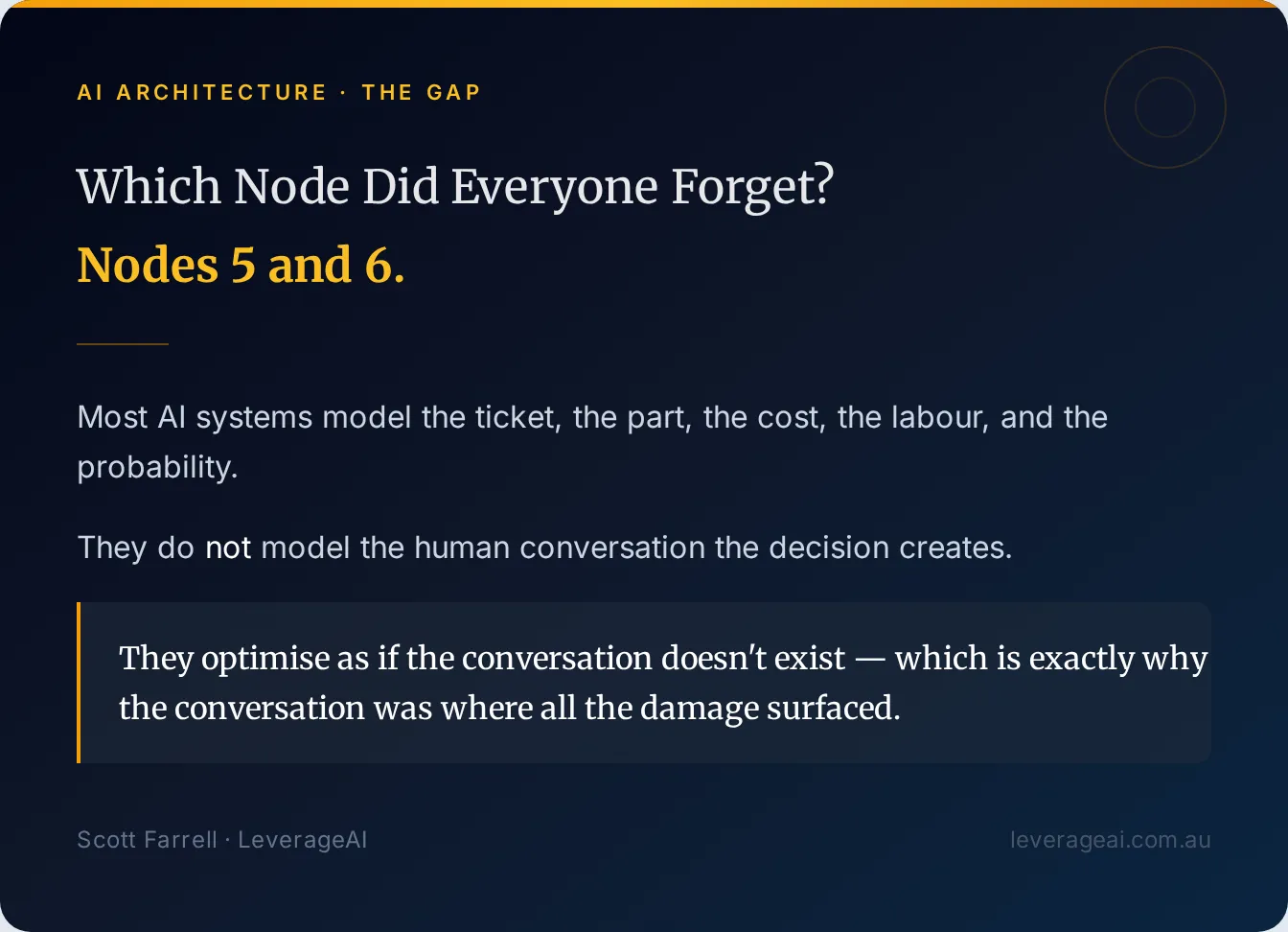
Many of these systems are customer-facing in arrears. They do not talk to the customer directly, but they create the conversation a human will later be forced to have.
That is where AI governance usually goes missing.
Most systems model the operational objects beautifully: the ticket, the part, the cost, the probability, the stock position, the labour slot, the SLA.
They do not model the moment at the counter when a service advisor has to explain why the company ordered something that sounds unrelated to the problem the customer reported.
They do not model the claims handler trying to defend an opaque document request.
They do not model the relationship manager staring at a pre-approval decision neither they nor the applicant can interpret.
So the AI optimises the workflow and spends the trust.
This is why “human in the loop” is such a weak phrase. It tells you a human is exposed to the decision. It does not tell you whether the human is competent for that loop, has the evidence to defend it, or has the authority to change it.
A frontline employee with no receipts is not oversight.
They are the shock absorber.
The governance move is not to write “consider customer experience” into the prompt and hope the model behaves. That is not a control. That is a wish.
The better architecture makes the customer conversation a governed checkpoint.
Can the human explain this without faking expertise?
If the recommendation is non-obvious, is there a customer-facing note?
If the cheap option fails, does it create a second visit, a complaint, a breach of expectation, or a loss of confidence?
If the system chooses a more expensive path, can finance later see why the cheaper alternatives were rejected?
Those questions belong in the decision architecture, not in the apology script.
This is the difference between AI that accelerates a process and AI that is fit to operate inside a service relationship.
The uncomfortable part for executives is that the “efficient” system may be locally correct and globally stupid.
It may reduce handling time and increase rework.
It may cut inventory cost and increase return visits.
It may improve triage accuracy and make staff less able to defend the company’s decisions.
It may save $200 in operational slack and burn $2,000 of trust.
The missing variable is rarely intelligence. Frontier models are already strong enough to generate plausible recommendations.
The missing variable is governance that understands the business is not just moving objects through a process. It is maintaining a shared reality with customers, staff, regulators and the board.
Here is what happened.
Here is why we think that.
Here is what we considered and rejected.
Here is what happens if we are wrong.
That is what a good human service interaction has always done.
AI should make that stronger, not make it disappear.
So before putting AI into intake, triage, quoting, claims, onboarding or service operations, I would ask one question first:
What future conversation does this decision create, and have we governed that conversation as carefully as we governed the transaction?
Discover more from Leverage AI for your business
Subscribe to get the latest posts sent to your email.