
The hard part of autonomous operations isn’t whether an agent can solve the incident.
It’s whether the organisation can state, in advance, how much judgement it is willing to delegate.
Most can’t.
Their controls understand identities, roles and data access. They rarely distinguish between a reversible recovery action and a decision that changes the system itself.
That leaves two operating models: grant broad access and hope, or keep a human in every loop and erase the economics of overnight autonomy.
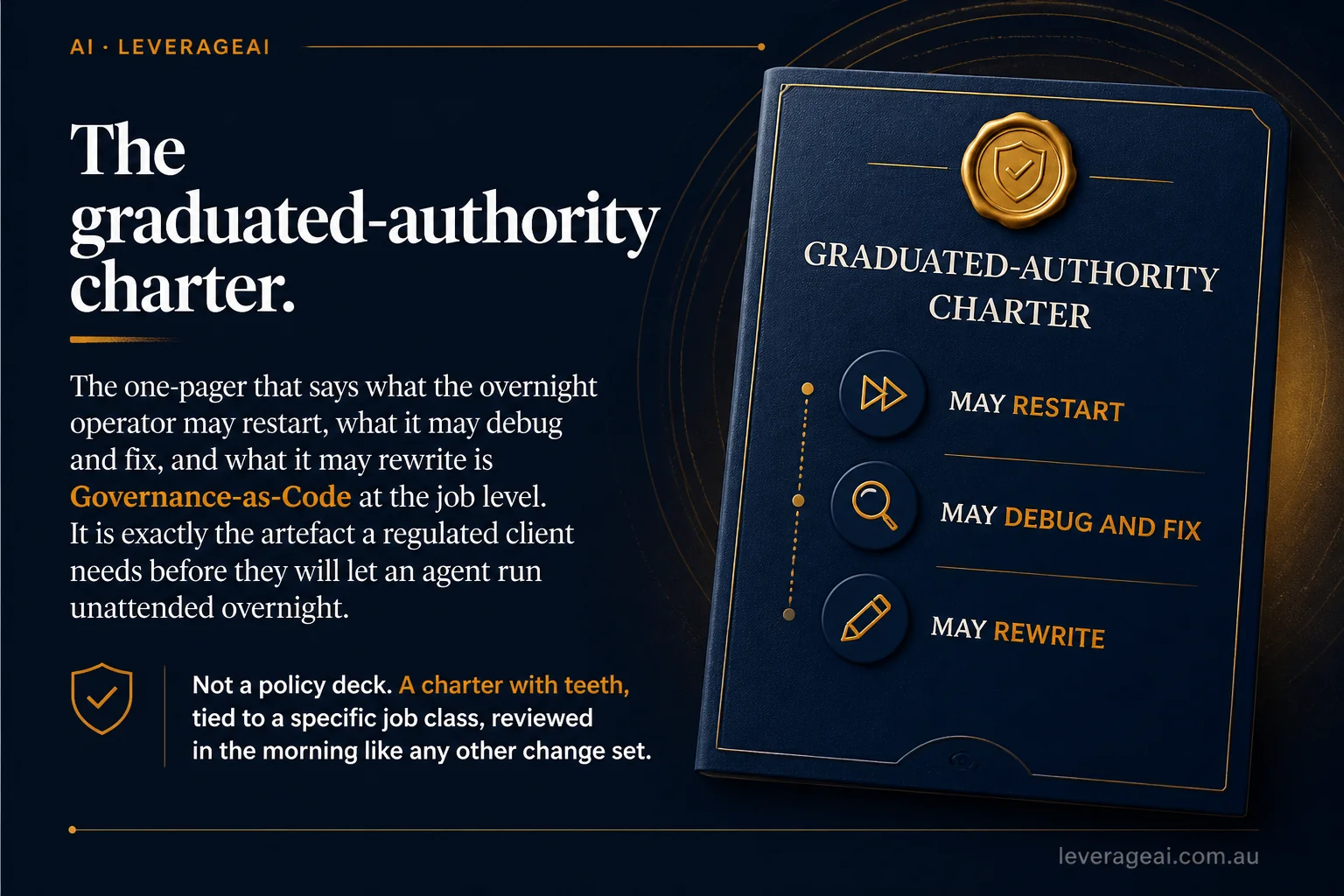
The deeper value of this charter is that it forces risk appetite out of the policy deck and into an explicit operating boundary. Accountability is established before the job starts, not reconstructed after something goes wrong.
This is what most agent roadmaps miss: capability does not create autonomy. Clearly bounded authority does.
If your team cannot write this one-pager for a specific job, it is not ready to let an agent perform that job unattended.
Discover more from Leverage AI for your business
Subscribe to get the latest posts sent to your email.