Most AI disappointment starts with a category error.
People treat AI like a very clever employee who should “just know what I mean.”
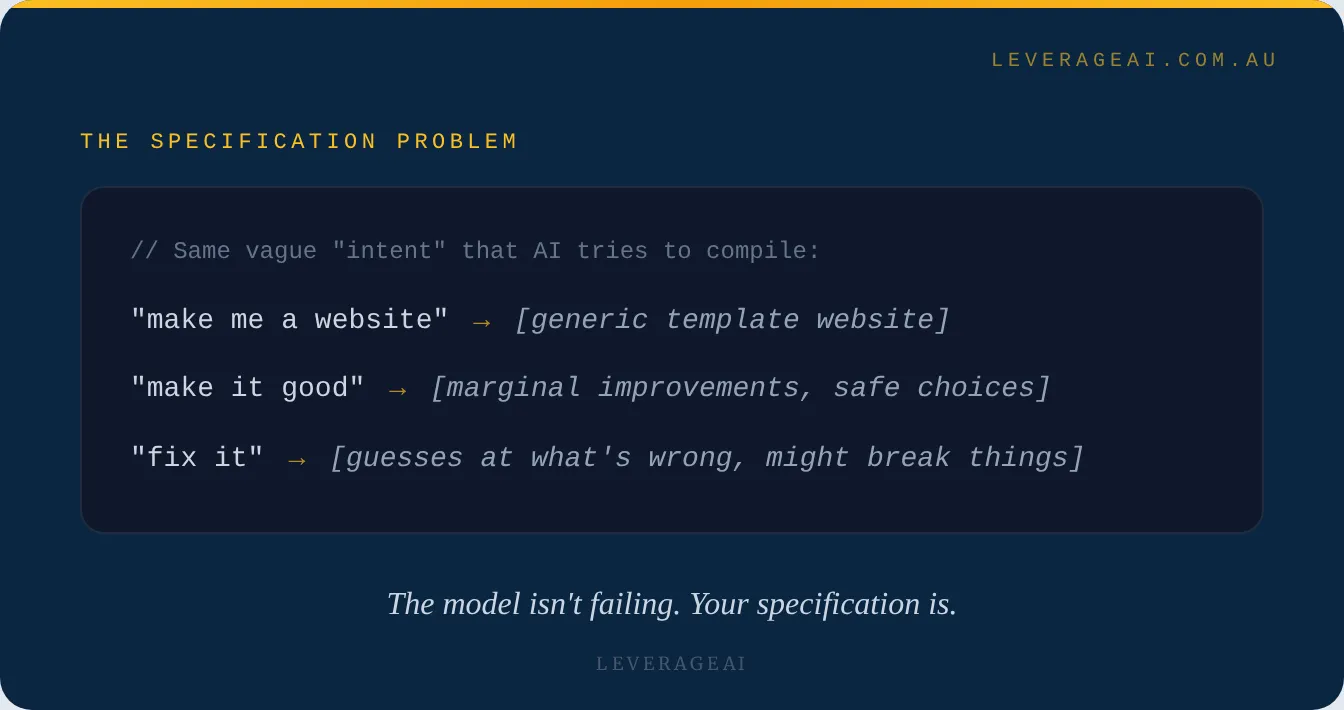
But AI is closer to a compiler.
Not a traditional compiler that turns code into machine instructions, but an intention compiler: it turns your stated intent into an artefact.
That distinction matters because compilers do not rescue unclear source code.
They execute what you gave them.
The strange thing about AI is that it does not usually fail loudly. It does not throw a clean syntax error and say, “Your business objective is ambiguous.”
It gives you something fluent, plausible and safe.
Which is worse.
Because now the failure looks like competence.
A generic strategy deck.
A bland customer email.
A chatbot that demos well and collapses in the edge cases.
A workflow automation that saves minutes in one team while creating risk, rework or resentment somewhere else.
This is why so many AI experiments feel promising in week one and disappointing by month three.
The model was never the whole system.
The real system includes:
• the quality of the problem definition
• the specificity of the constraints
• the clarity of the success criteria
• the governance around exceptions
• the judgement used to evaluate outputs
• the willingness to kill, fix or double down based on evidence
That is the uncomfortable part.
AI does not remove the need for thinking.
It punishes vague thinking faster.
In the old world, fuzzy intent could hide inside meetings, emails, handoffs and “we’ll figure it out later.” Humans absorbed ambiguity through context, politics, memory and tacit judgement.
With AI, that ambiguity gets externalised.
If leadership has not decided what “good” means, the system will optimise for something anyway.
Usually something average.
If the business has not defined acceptable risk, the system will make assumptions.
If the process is broken, AI will often accelerate the brokenness.
This is the part vendors tend to underplay: the productivity gain is not automatic. It is conditional on specification quality.
The effort moves.
Less typing.
More deciding.
Less execution.
More architecture.
Less “can we generate this?”
More “what exactly are we trying to make true, and how will we know if it worked?”
For boards and leadership teams, this changes the AI conversation.
The question is not, “Which AI tool should we buy?”
The better question is, “Where are we clear enough to let AI amplify us — and where would amplification simply scale our confusion?”
That is a very different standard.
It means the organisations that win with AI will not necessarily be the ones with the most tools, the biggest vendor contracts or the loudest internal experimentation culture.
They will be the ones with the best specification discipline.
The ones that can define the work.
Name the constraints.
Set the thresholds.
Measure the baseline.
Observe the exceptions.
And make decisions when the first visible error appears.
Because “make it good” is not a strategy.
It is an abdication dressed up as a prompt.
The useful question for leaders is simple:
Where in your organisation are people blaming AI for producing vague outputs, when the real issue is that no one has done the hard work of making the intent explicit?
Discover more from Leverage AI for your business
Subscribe to get the latest posts sent to your email.