
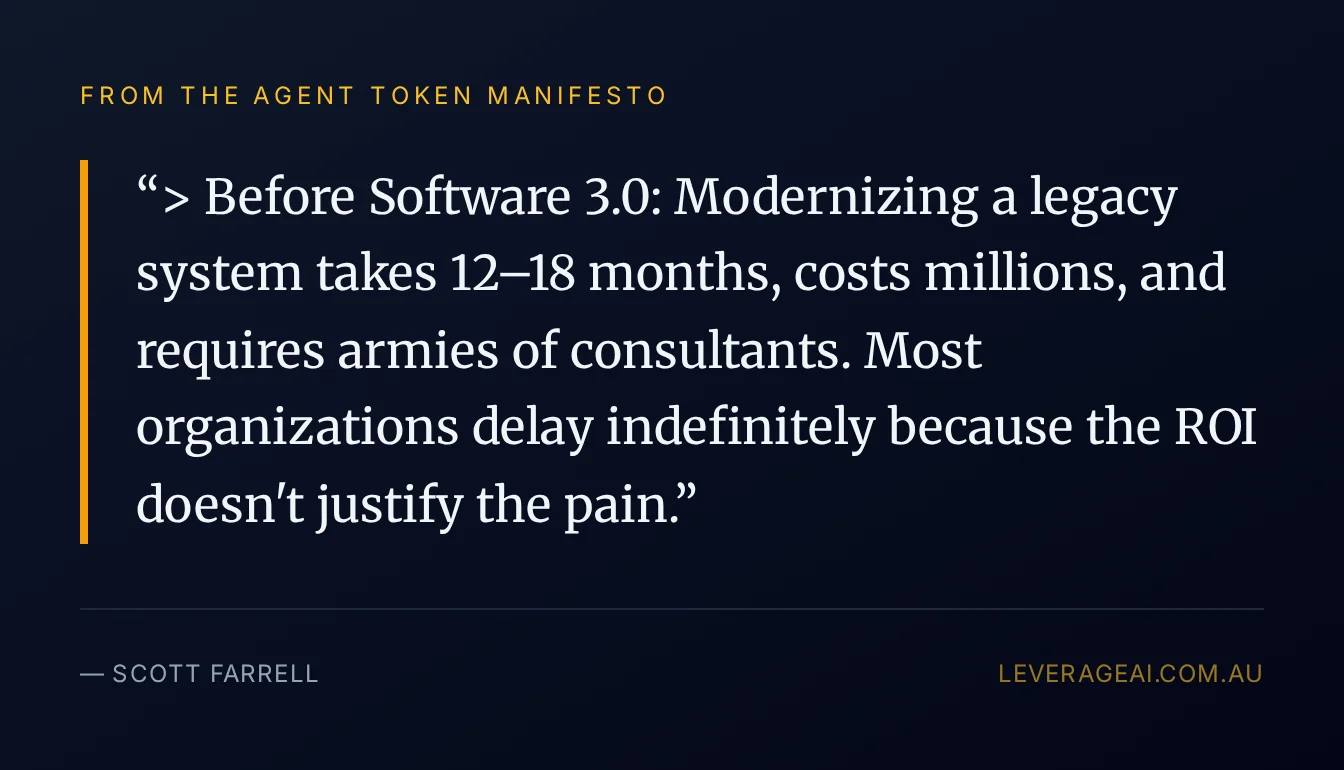
For years, legacy systems survived because the economics protected them.
Not because they were good.
Not because they were strategically sound.
Not because the business loved them.
They survived because replacing them was too expensive, too slow, too politically risky, and too dependent on scarce human coordination.
So organisations learned to live around the system.
They hired people to reconcile exports.
They built spreadsheets to compensate for missing workflows.
They paid for middleware to connect things that should never have been separated.
They accepted manual exceptions as “business process.”
They let vendor roadmaps quietly become operating strategy.
This is the part of Software 3.0 that I think many executives are underestimating.
The real change is not that AI helps developers write code faster.
That is the least interesting version of the story.
The deeper change is that autonomous agents alter the economics of system replacement itself.
When agents can inspect codebases, infer intent, generate tests, propose architectures, write migration paths, compare alternatives, and iterate through hundreds of implementation attempts without waiting for the next sprint planning meeting, the bottleneck moves.
It moves away from:
“Can we afford to modernise this?”
And toward:
“Do we know what should replace it?”
“Do we understand the risk boundaries?”
“Can we validate the output?”
“Who is accountable for the new operating model?”
“What do we do when change becomes cheap enough to be constant?”
That last question matters.
Most organisations are built around the assumption that software change is slow.
Governance committees meet monthly.
Budgets are approved annually.
Architecture boards review major decisions after weeks of preparation.
Business cases are written as if the implementation path is scarce, fixed, and expensive.
But agentic software changes that premise.
If the cost of exploring options collapses, then the scarce resource is no longer code production.
It is judgement.
The company that wins is not the one that lets agents rewrite everything.
That is chaos wearing a futuristic hat.
The company that wins is the one that can direct autonomous capability toward the right constraints: commercial value, risk appetite, customer impact, data governance, security boundaries, operational resilience, and long-term ownership.
Software 3.0 does not remove the need for architecture.
It makes architecture more important.
Because when systems can evolve faster than the organisation can reason, the danger is not underbuilding.
The danger is compounding the wrong design at machine speed.
This is why I keep coming back to the same point: AI is not a feature-buying exercise. It is a capital allocation and operating model question.
Tokens are becoming a form of computational labour.
Agents are becoming a new execution layer.
Tool access is becoming the difference between a clever assistant and an autonomous production system.
Put those together and the old software economics start to break.
The uncomfortable implication is that a lot of “too hard” systems are about to become technically possible to replace.
Which means the real excuses will be exposed.
Not enough clarity.
Not enough governance.
Not enough ownership.
Not enough executive alignment.
Not enough willingness to kill the workflows that grew around broken systems.
Legacy modernisation used to fail because the mountain was too expensive to climb.
Soon it will fail because leadership teams cannot agree which mountain matters.
So the useful question is not “How do we use AI to speed up our developers?”
It is:
If modernisation became dramatically cheaper, which system would you replace first — and what would still stop you?
Discover more from Leverage AI for your business
Subscribe to get the latest posts sent to your email.