
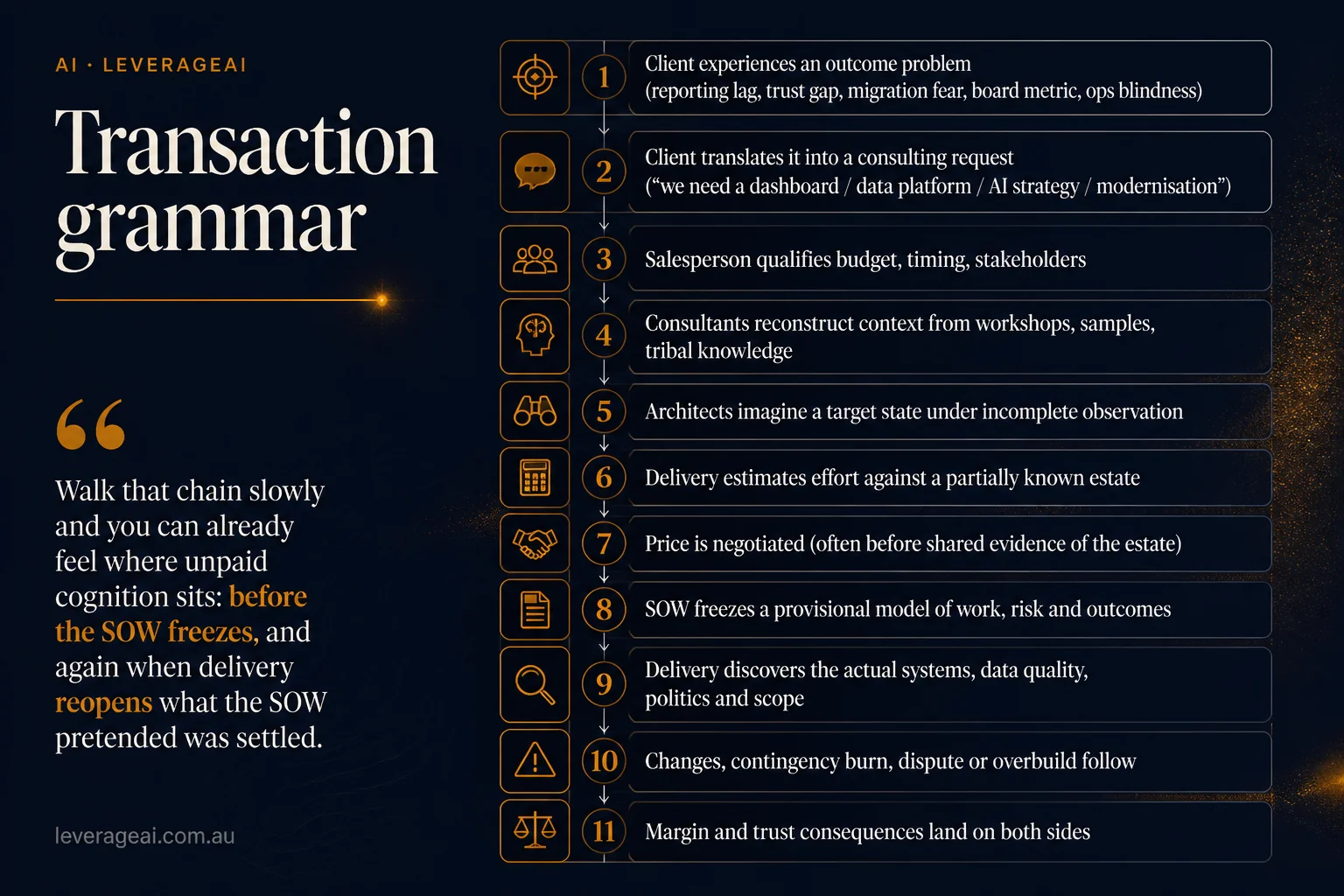
Look at where the price lands in that chain. It's set before anyone has seen the actual systems, the real data quality, or the politics that will decide how long the work takes.
Then delivery opens the estate and discovers what was always there. The same thinking gets done twice: once as a guess to win the work, once as a rediscovery that has to be absorbed by someone. Change requests, contingency burn, a tense conversation about scope. Both sides feel wronged, and both are behaving rationally inside a transaction that was designed this way.
Which is why "let's use AI to produce proposals faster" is such a seductive wrong answer. It optimises the symptom — senior people burning unpaid hours drafting scopes — while making the underlying error cheaper to repeat. You end up freezing weak assumptions with more polish and greater speed.
The harder question is why a major delivery commitment is the first thing being sold at all, at the exact moment both parties know least.
I'd hold this as a nomination, not a verdict. It's testable: proposal effort per pursuit, estimate-to-actual variance, change-request volume, and how much work already enters through something bounded and evidence-first. If those numbers come back clean, the diagnosis dies and that's a good outcome.
But if they don't, no amount of faster drafting will fix it.
Discover more from Leverage AI for your business
Subscribe to get the latest posts sent to your email.