
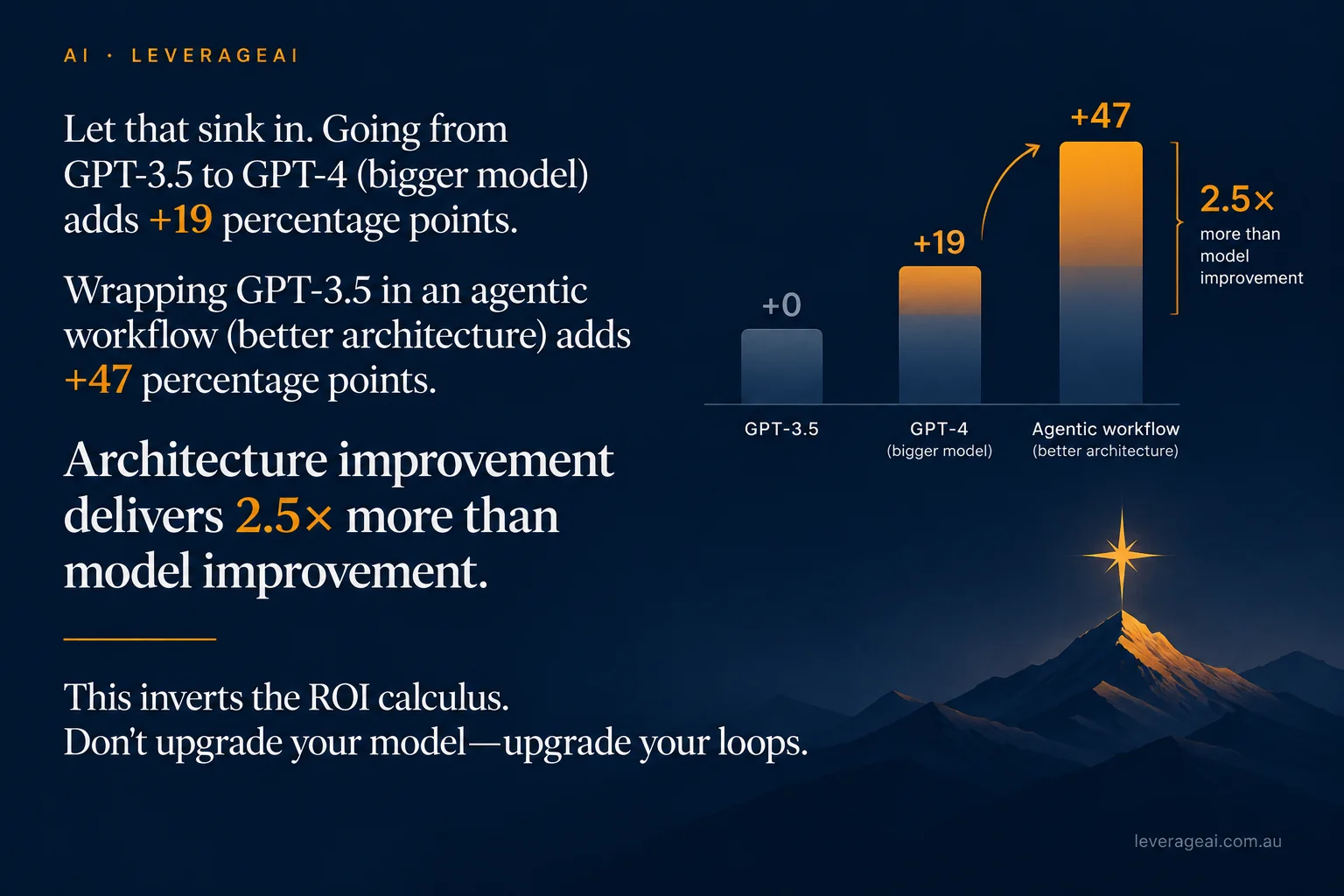
Your AI isn't disappointing you. Your setup is, and you're about to pay to fix the wrong thing.
Here's the pattern I keep seeing in mid-market teams. The output comes back mediocre. Someone concludes the model isn't smart enough. The budget conversation turns into an upgrade conversation.
But look at what most of these workflows actually do. Ask once. Take the first answer. Ship it or bin it. The model never finds out whether it was right.
Now compare that to a system that produces an answer, tests it against something real — a database, a document, code that either runs or doesn't — and revises based on what came back. On coding benchmarks, that difference has been worth more than moving to a more capable model. Architecture beat horsepower.
Two honest caveats. Benchmark percentage points are not ROI: loops cost tokens, latency and engineering time, and nobody publishes that column. And feedback only helps when it reveals something. Asking a model to grade its own homework five more times is repetition, not architecture.
The cheap move before the expensive one: run your actual task both ways. One pass, versus one pass plus a grounded check and a revision.
If the gap closes, you never had a model problem.
Discover more from Leverage AI for your business
Subscribe to get the latest posts sent to your email.