
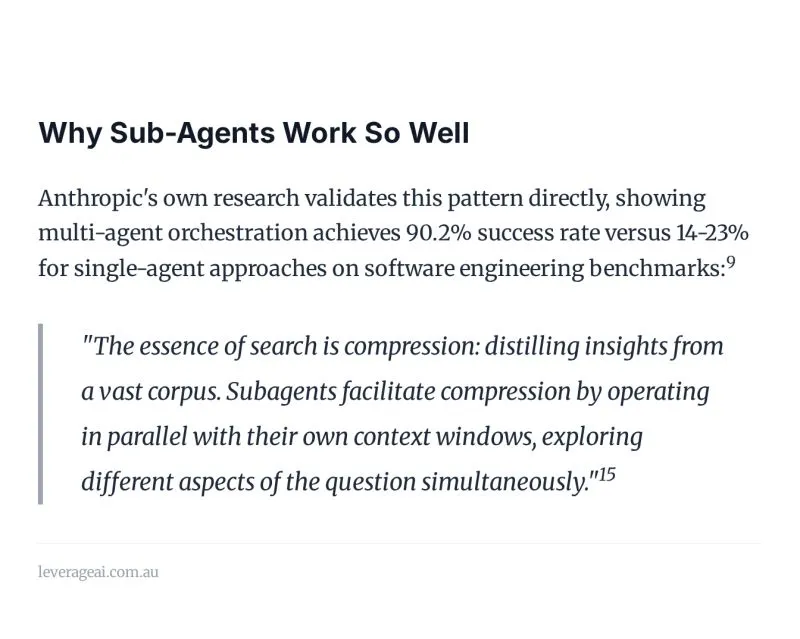
There's a number buried in Anthropic's research that should change how you think about AI deployment: 90.2% vs 14-23%.
That's the gap between multi-agent orchestration and single-agent approaches on the same engineering benchmark. Same models. Same problems. Wildly different outcomes.
Most people read that and reach for the obvious conclusion: more agents = better results. That's not the lesson. The lesson is about compression.
When you give one agent a hard problem, it has to hold everything at once — the question, the corpus, the constraints, the half-formed hypotheses, the dead ends. Its attention budget gets spent on bookkeeping, not thinking. Context windows aren't free RAM; they degrade as they fill. Doubling the input quadruples the compute, and the signal-to-noise ratio collapses.
Sub-agents work because they let you spend cheap tokens to produce expensive ones. A sub-agent can burn 200,000 tokens reading, contradicting itself, chasing the wrong lead, backtracking — and the orchestrator never sees any of it. What comes back is a 20,000-token memo. Pure signal. The mess stays in a sandbox that gets destroyed when the work is done.
This is the part executives miss when they evaluate AI: the headline capability isn't the model, it's the architecture around the model that decides what the model gets to think with. A frontier model handed a swamp of context will produce fluent mediocrity. A mid-tier model handed a tight briefing packet and a clean question will produce something defensible.
The second-order implication is uncomfortable for anyone betting their AI strategy on the next model release. If the gap between 14% and 90% comes from how you structure the work — routing, exploration, judgment, compression — then the upgrade path that matters isn't the one your vendor controls. It's the one you build.
Which raises the real question: when your AI pilot underperformed last quarter, was the model actually the problem? Or did you hand a single agent a job that needed a supply chain?
Discover more from Leverage AI for your business
Subscribe to get the latest posts sent to your email.