Most note-consolidation systems are built on a hidden assumption: that your sources broadly agree, and the job is just to squeeze the redundancy out.
A research corpus breaks that assumption on day one. Forty papers say almost the same thing — but not quite. Two contradict each other. A 2026 result quietly overturns a 2023 one that everyone still cites.
If your maintenance loop is just a compactor, it will paper over exactly the disagreements that matter most. Smooth prose, lost signal.
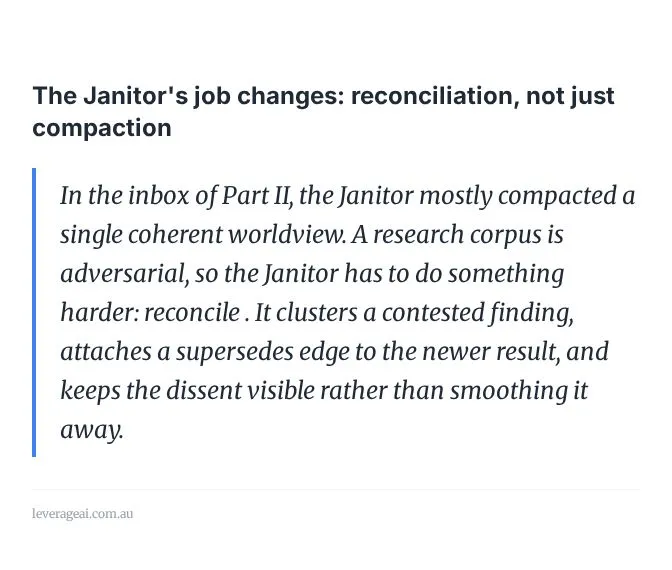
The move is to treat contradiction as a first-class object. When the janitor sees a contested finding, it doesn't pick a winner and delete the loser. It builds a "contested" cluster, attaches a supersedes edge to the newer result, and leaves the dissent navigable.
The second-order effect is the interesting one: the shape of the disagreement becomes part of what you know. A chunk store buries that under cosine similarity. A graph lets you walk straight to it.
Which is the deeper point. The reason a self-maintaining knowledge system out-thinks retrieval isn't that it remembers more. It's that it can hold a structured argument with itself over time — and let you read the minutes.
What does your current setup do when two trusted sources disagree? Pick one? Average them? Or surface the fight?
Discover more from Leverage AI for your business
Subscribe to get the latest posts sent to your email.