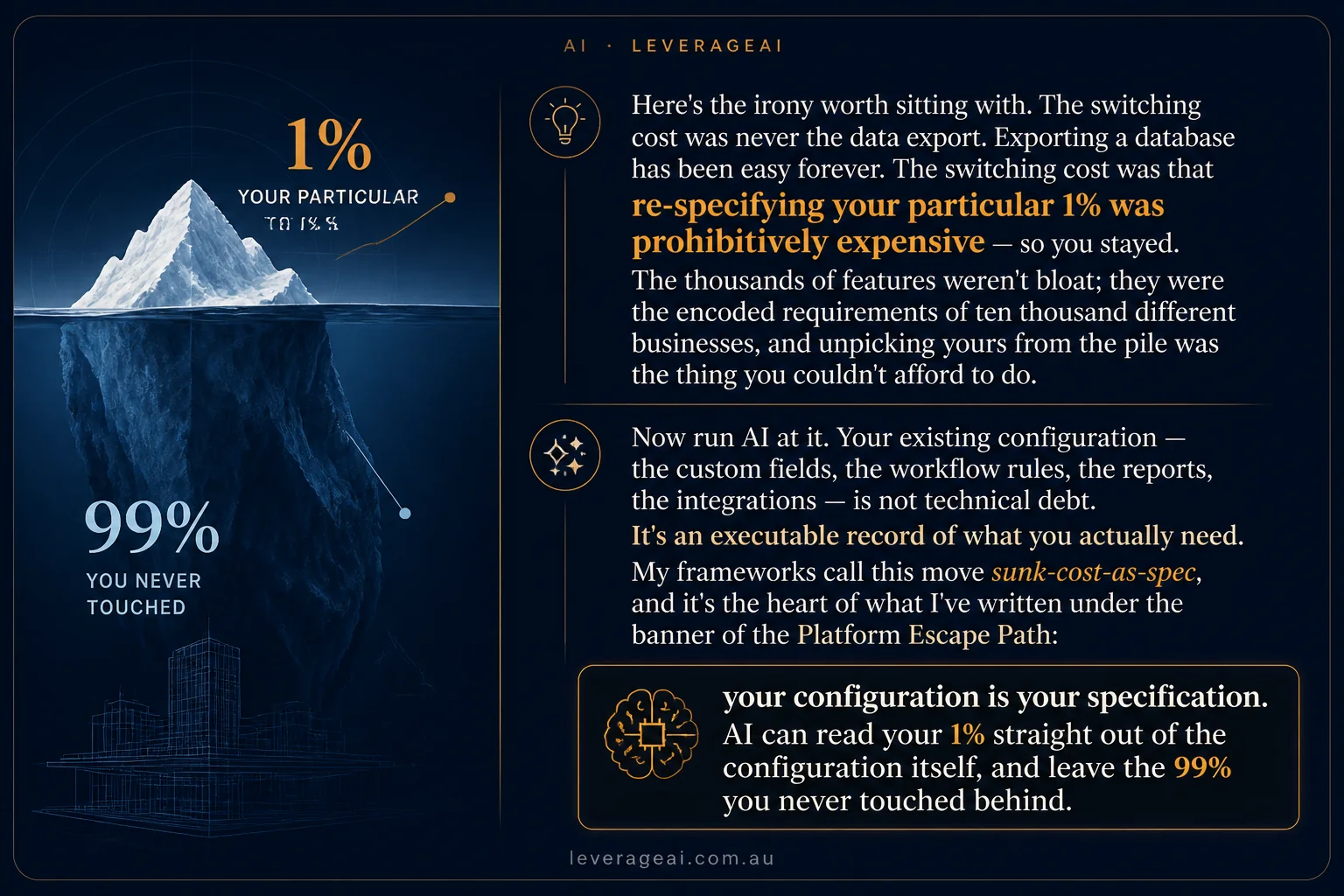
This line cuts deeper than “AI makes software cheaper.”
It says a large part of the SaaS moat was never product superiority. It was the cost of reconstructing your own intent.
That intent is already sitting inside the system—in decisions accumulated over years. Until now, it was legible to users but prohibitively expensive to turn back into software.
Once AI can recover it, feature breadth stops being the same kind of lock-in.
But the escape path has a toll: verification.
Generating the replacement is becoming cheap. Proving that it preserves every edge case, control, permission, integration and exception is now the real work.
So the strategic consequence is not that every company should rebuild its stack.
It is that the build-versus-buy calculation has changed—and many renewal decisions are still being made with the old maths.
The vendors most exposed are not those with weak features. They are those whose strongest moat is the customer’s belief that leaving would require rediscovering the business from scratch.
It may not anymore.
Discover more from Leverage AI for your business
Subscribe to get the latest posts sent to your email.