
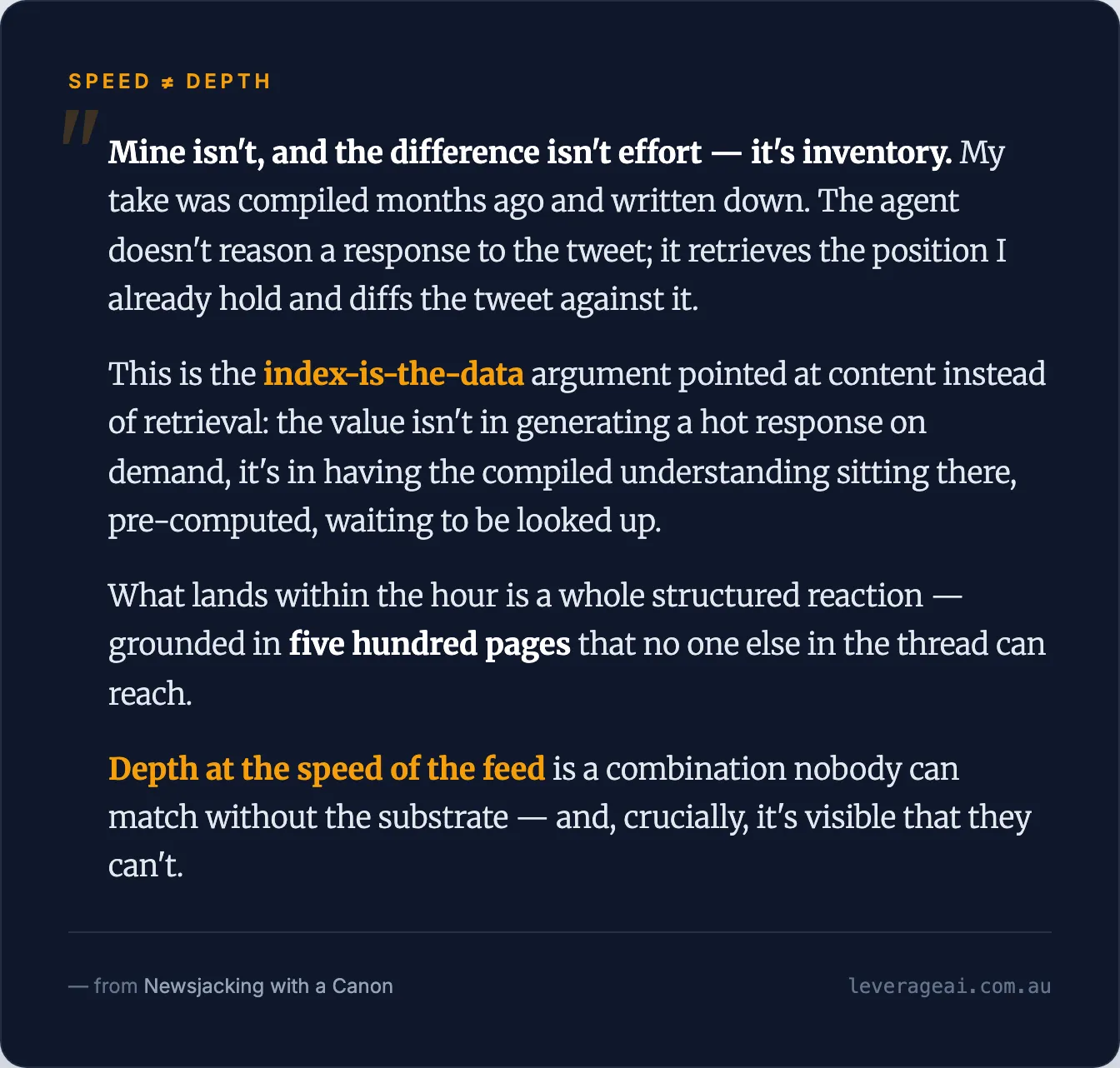
The important word here is inventory.
AI has made reaction cheap. It has not made judgement cheap.
That distinction is going to split organisations faster than most leaders realise.
If your position only exists as scattered instinct — in the founder’s head, in old slide decks, in half-remembered client work, in Slack threads nobody can find — then every response has to be improvised from scratch.
The machine can help you sound fluent, but it cannot retrieve a point of view you never bothered to compile.
That is why so much AI-generated commentary feels strangely identical. Everyone is asking powerful systems to react to the same stimulus, at the same moment, with no private substrate underneath.
The advantage is not “posting faster.”
The advantage is having already done the thinking.
A written canon changes the economics. It lets you meet a live market moment with dated receipts, sharper disagreement, and the confidence that comes from knowing what you believe before the room starts moving.
The uncomfortable consequence: organisations without a compiled body of thinking will look slower, thinner, and more derivative every year — even if they adopt the same tools.
Because the tools are becoming common.
The substrate is not.
What would your organisation be able to say within an hour if its best thinking were already indexed?
Discover more from Leverage AI for your business
Subscribe to get the latest posts sent to your email.