
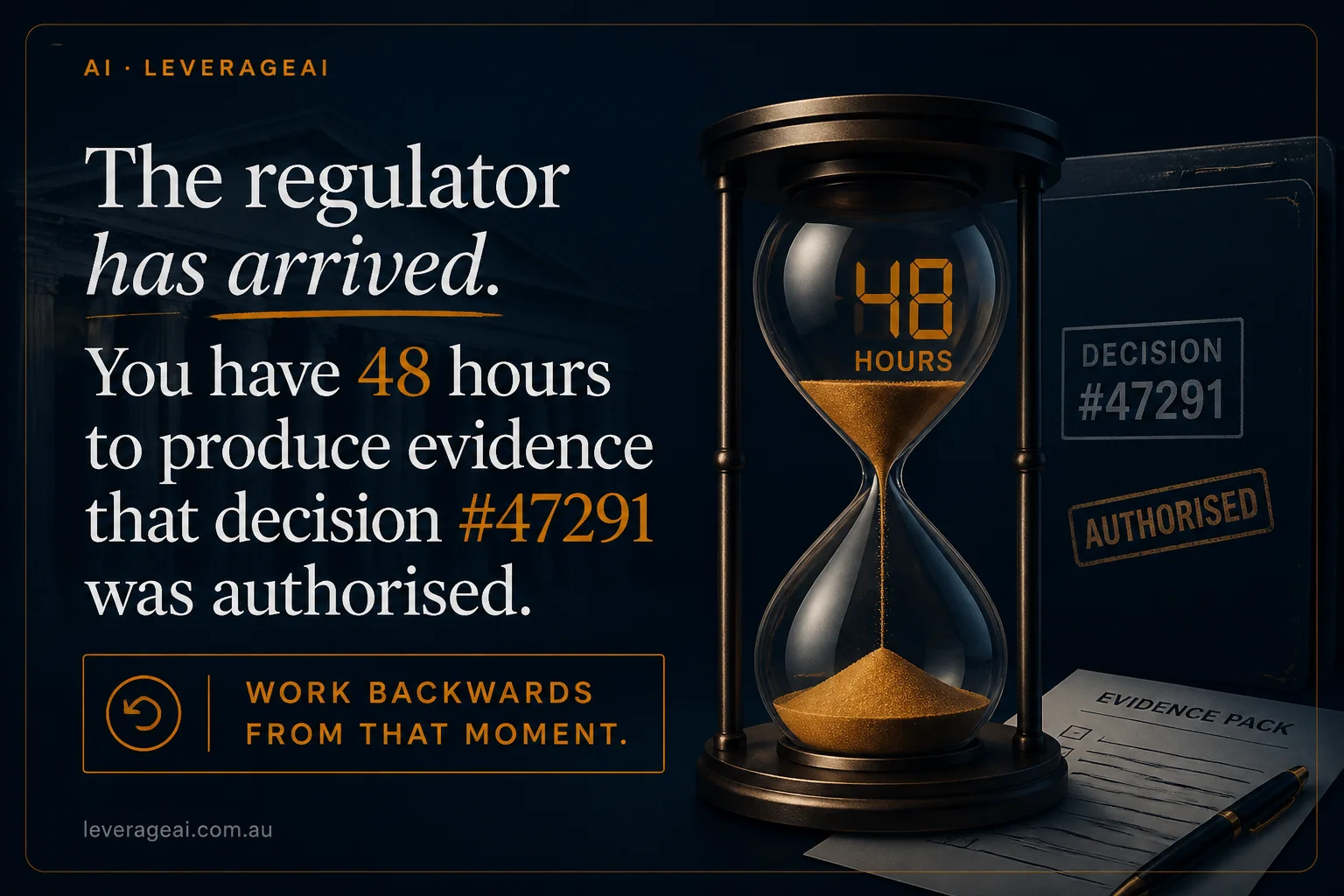
The audit moment is the only honest design brief for AI governance.
Most programs are designed forwards:
policy → training → dashboard → logs → quarterly committee.
Auditors work backwards:
outcome → authority → evidence → policy-in-force → accountable human.
That reversal exposes the weakness in most AI governance.
A log can tell a story.
A committee can show intent.
A dashboard can show trend.
None of those prove that this decision, at this time, on this data, under this delegation, was permitted to become a business outcome.
That is the line AI leaders need to draw now.
The risk is not simply that a frontier model makes a mistake. Humans make mistakes too.
The bigger risk is that the organisation cannot show where judgement ended and authorised action began.
Because when evidence has to be assembled after the fact, governance has already failed. You are no longer operating a controlled system. You are performing archaeology under pressure.
The question for boards is not “do we have an AI policy?”
It is: if one consequential AI decision is challenged, does that decision carry its own proof?
Discover more from Leverage AI for your business
Subscribe to get the latest posts sent to your email.