
There's a moment most people miss in this, and it's not the part where the machine dug up decades-old facts.
It's the timing.
We've been trained to grade AI on one axis: is the answer right? So we obsess over accuracy, hallucination rates, benchmark scores. All real. All measurable. And all of it quietly assumes the answer arrives to a mind that has finished thinking.
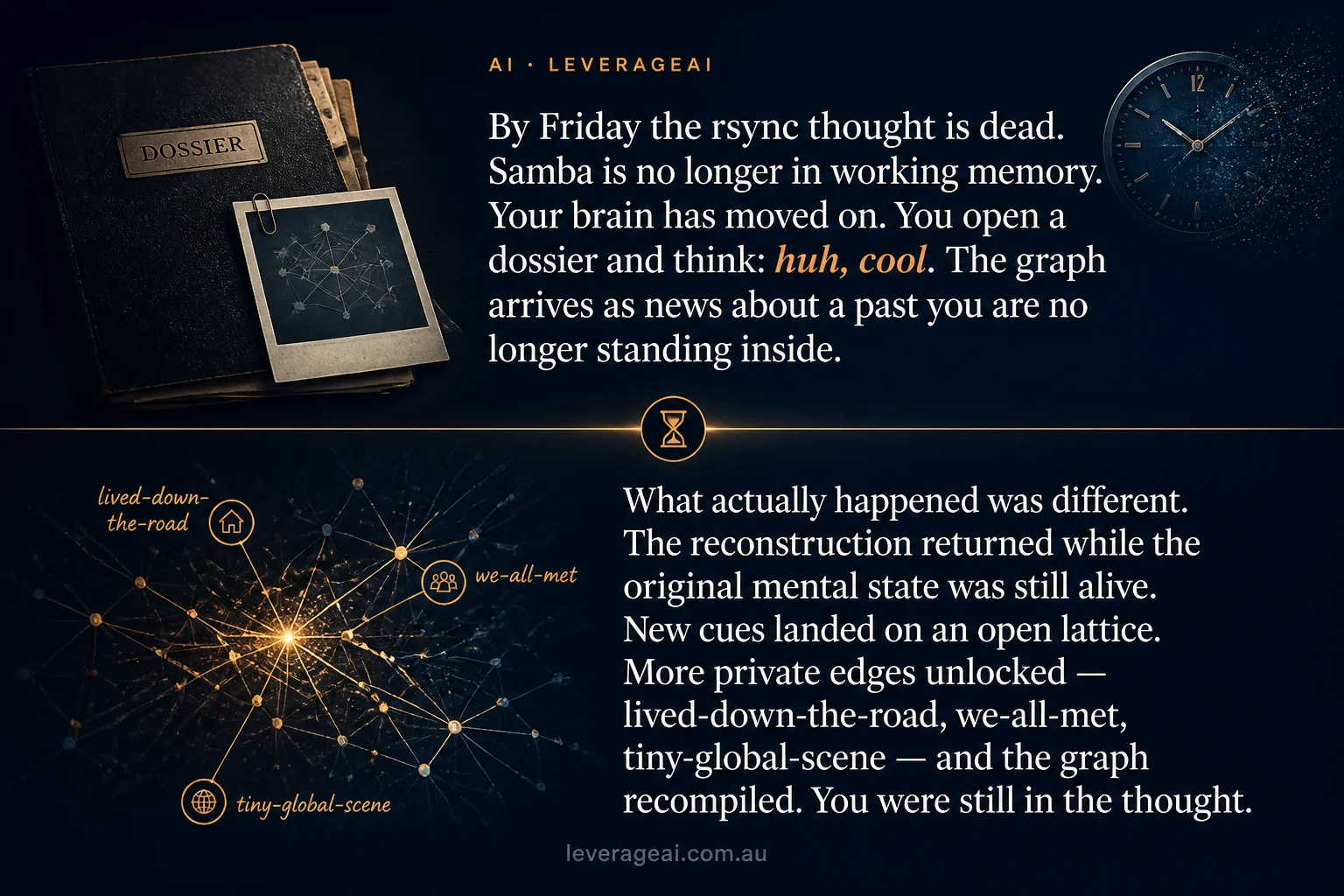
But a thought has a half-life. While it's still alive, you're holding context, intuition, half-formed connections that never make it onto a page. Feed something into that live state and it does work — it triggers the next private memory, which changes the question, which changes the answer. Let the same thought die first and you get a briefing. Accurate. Inert. You nod and move on.
Same facts. Same model. Completely different value. The only variable that moved was whether the reply beat the decay.
That's the uncomfortable part for anyone evaluating these tools. If you measure only the quality of the final answer, you're measuring the system's ability to write good reports. You're blind to its ability to re-enter your reasoning while your reasoning is still open — which is where the compounding actually happens, because the machine's breadth and your tacit knowledge keep unlocking each other. Neither side held the finished shape alone.
None of this makes the reconstruction ground truth. It's an inference product; it can join the wrong people confidently, so the edges have to stay inspectable. Speed doesn't buy you correctness.
What it buys you is presence inside the thought. And presence, not just precision, is the thing your current scorecard probably can't see.
Discover more from Leverage AI for your business
Subscribe to get the latest posts sent to your email.