
Your founder succession project will lose. It's in the wrong budget.
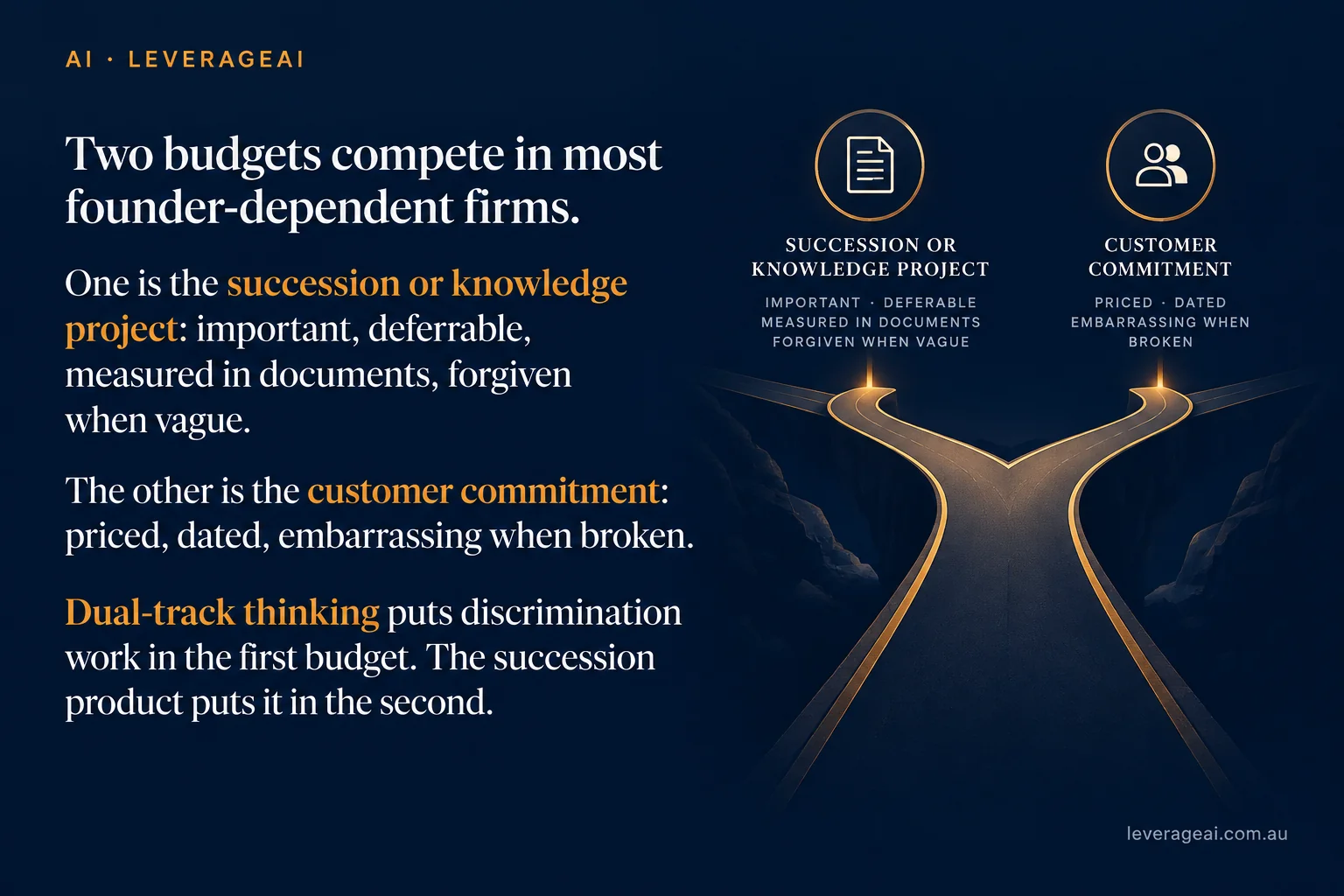
Most founder-dependent firms run two budgets, and they don't compete fairly.
One is the knowledge or succession project. Everyone agrees it matters. It's measured in documents. When it slips a quarter, nobody gets a phone call. When it's vague, it's forgiven.
The other is customer commitments. Priced. Dated. Embarrassing when broken.
Guess which one wins every prioritisation meeting.
The usual advice is dual-track: keep serving customers, and separately work on capturing what the founder knows. It sounds prudent. In practice it parks the hardest work in the budget designed to be deferred.
And the hardest work isn't writing down facts. Manuals, catalogues and specs already exist. The scarce material is discrimination: which part is actually compatible with this serial, which failure looks like something else, which substitution was tried and rejected, when a case has to go up the chain. That judgment usually lives in one head, and the firm rents it from a person every time a hard call comes in.
Now move that same work into the second budget. Sell customers a continuity or preparedness service: you already know their machines, you can name what their next project depends on, you have a path ready when something breaks.
Suddenly the vague becomes specific. A promise to a paying customer asks harsh questions an archive project never does. Did we know this machine? Could an ordinary staff member act on it, or did someone quietly ring the founder? Did the fix get written back so the next person doesn't start from scratch?
That's the real test of succession. Not whether a topic is "covered". Whether the company can keep a promise without secretly re-importing the founder.
None of this guarantees revenue or finishes succession on its own. But it gives the work an owner, a deadline and a reason to survive the next quarterly reshuffle.
If succession really matters, why is it funded like something that doesn't?
Discover more from Leverage AI for your business
Subscribe to get the latest posts sent to your email.