
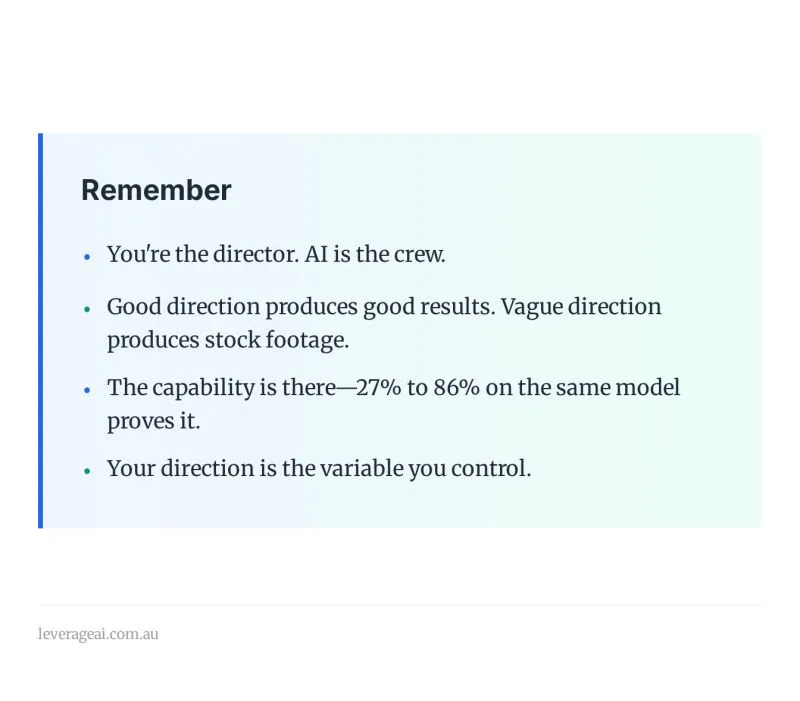
There's a study I keep coming back to. Researchers gave a model a set of hard puzzles and it scored 27%. Then they changed nothing about the model — same weights, same task — and changed only how they directed it. The score jumped to 86%.
Sit with that for a second. The capability was there the whole time. It was sitting at 86% on the first attempt too. The 59-point gap wasn't intelligence. It was direction.
This is the part most people miss when they conclude "AI is overhyped." They ran a vague prompt, got a generic answer, and filed AI under disappointing. What actually happened is more uncomfortable: the model handed back a faithful reflection of how loosely the request was framed. Ask "what's the best option?" and the honest answer is another question — best for whom, by what measure, in what context? Skip those, and the model picks something safe and bland to cover all of them. It didn't fail. It compiled exactly what you specified, which was almost nothing.
I think of a film director who tells the crew "just make it look good." No one's being lazy. They simply have no vision to execute, so they default to stock footage. The same line from a director who knows the shot — the push-in, the light from the window, the moment her expression changes — unlocks something the crew always had in them.
Here's the second-order effect that matters for anyone leading a team or a budget: this scales. When one person's vague prompt produces mush, you get a bad afternoon. When an entire organisation treats AI as a magic button — point it at a problem, expect an outcome — you get pilots that demo beautifully and quietly die before production. The "AI doesn't work for us" conclusion almost never means the model couldn't. It usually means nobody upstream did the thinking the model needed to compile.
Which flips the whole thing on its head. The variable you actually control isn't the model — those keep getting better whether you do anything or not. The variable is the clarity you bring to it. AI doesn't remove the hard thinking. It moves it earlier, makes it explicit, and then amplifies whatever you brought. Bring fuzz, it amplifies fuzz. Bring a clear specification, it scales it further than you could by hand.
So the real question isn't "is this model good enough yet?"
It's "is my direction good enough to find out?"
Discover more from Leverage AI for your business
Subscribe to get the latest posts sent to your email.