
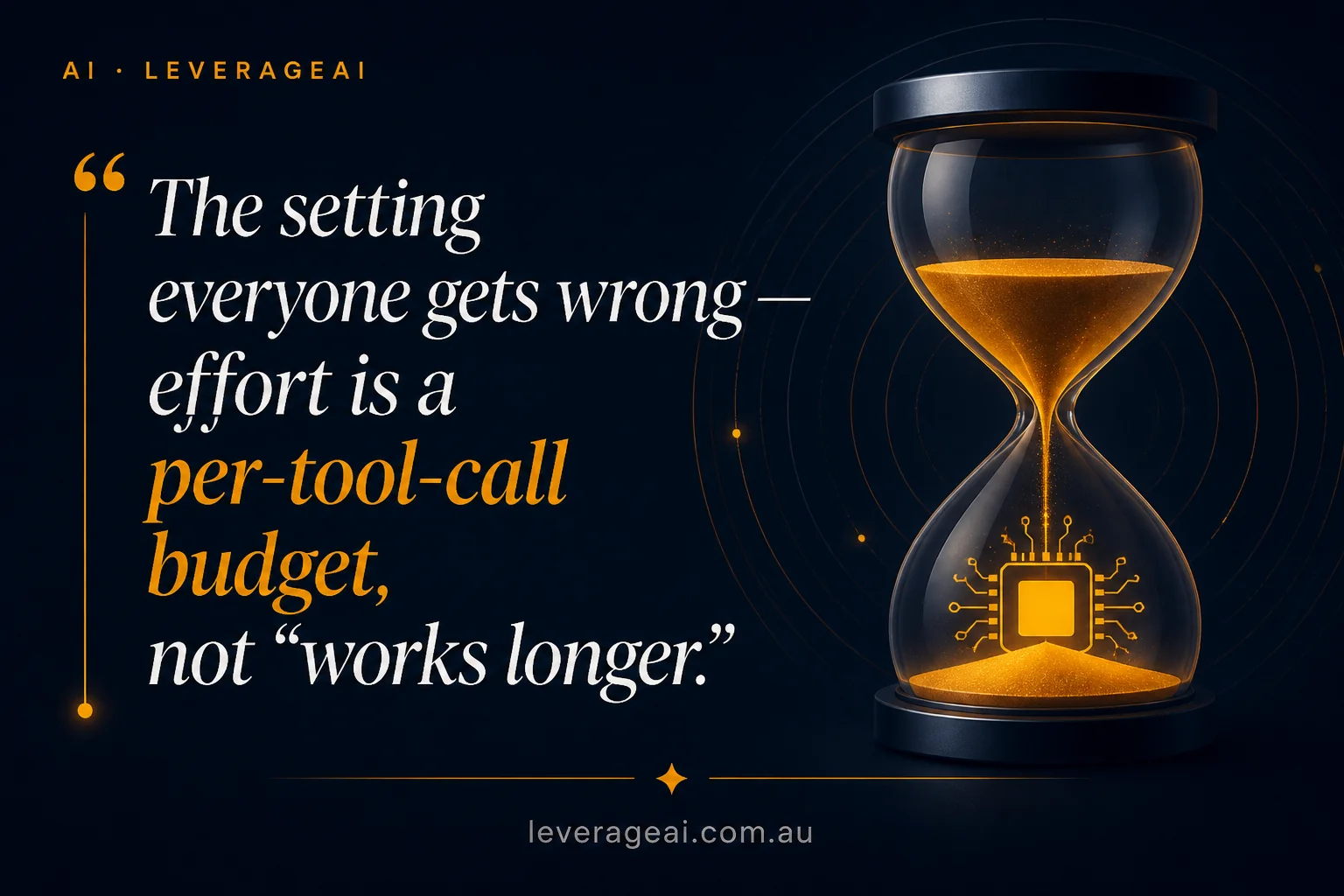
There's a dial in every agent harness that quietly decides your bill, and almost everyone reads it wrong.
The assumption is intuitive: important work deserves maximum effort. Long-running work especially. You're about to hand a model six hours of autonomy, so you turn the dial up, the way you'd give a hard job to your best person and tell them to take their time.
That's not what you bought.
The dial doesn't govern how far the agent goes. It governs how hard it thinks on every single step along the way. A task that takes 500 tool calls doesn't get more steps at max — it gets a premium charged on all 500. Including the file reads. Including the trivial edits. Including the checks that were never in doubt.
So the real question isn't "how much effort does this task deserve?" It's "which decisions in this task deserve expensive reasoning?" And in most agent loops, the honest answer is: a small handful. The rest is mechanical.
The cost is the obvious part. The subtler damage is what over-reasoning does to output. Research on test-time scaling keeps finding the same non-monotonic curve — accuracy rises, then falls, as thinking extends. Practitioners describe it plainly: the top tiers second-guess themselves, sprawl a simple change across files you didn't ask them to touch, and hand back something you now have to review harder. You paid more to create more work.
And persistence — the thing you were actually reaching for — never lived in that dial at all. It comes from a clear goal, written state, checkpoints, and standing permission to keep going. Structural, not purchased.
Which is the pattern worth taking beyond this one setting. When something in an AI stack feels underpowered, the instinct is to buy a bigger number. Usually the fix is architectural, and the bigger number is just a tax you've agreed to pay on every routine step, forever.
Check what your agents are running at. Then ask what you thought that setting was buying you.
Discover more from Leverage AI for your business
Subscribe to get the latest posts sent to your email.