
Your AI evaluator is blind to half the things you care about. It won't tell you.
When teams use AI to judge AI-generated work—videos, voiceovers, copy—they obsess over consistency, bias, and independence. But there's a more basic failure that sits upstream of all that: the judge might not be able to perceive the dimension it's scoring at all.
A model fed a transcript can't hear voice quality. A model watching a video can miss timing errors. And the scores it produces will look confident and repeatable, so you think the evaluation is working. In reality, you're optimizing for a signal that's deaf to the quality you actually care about.
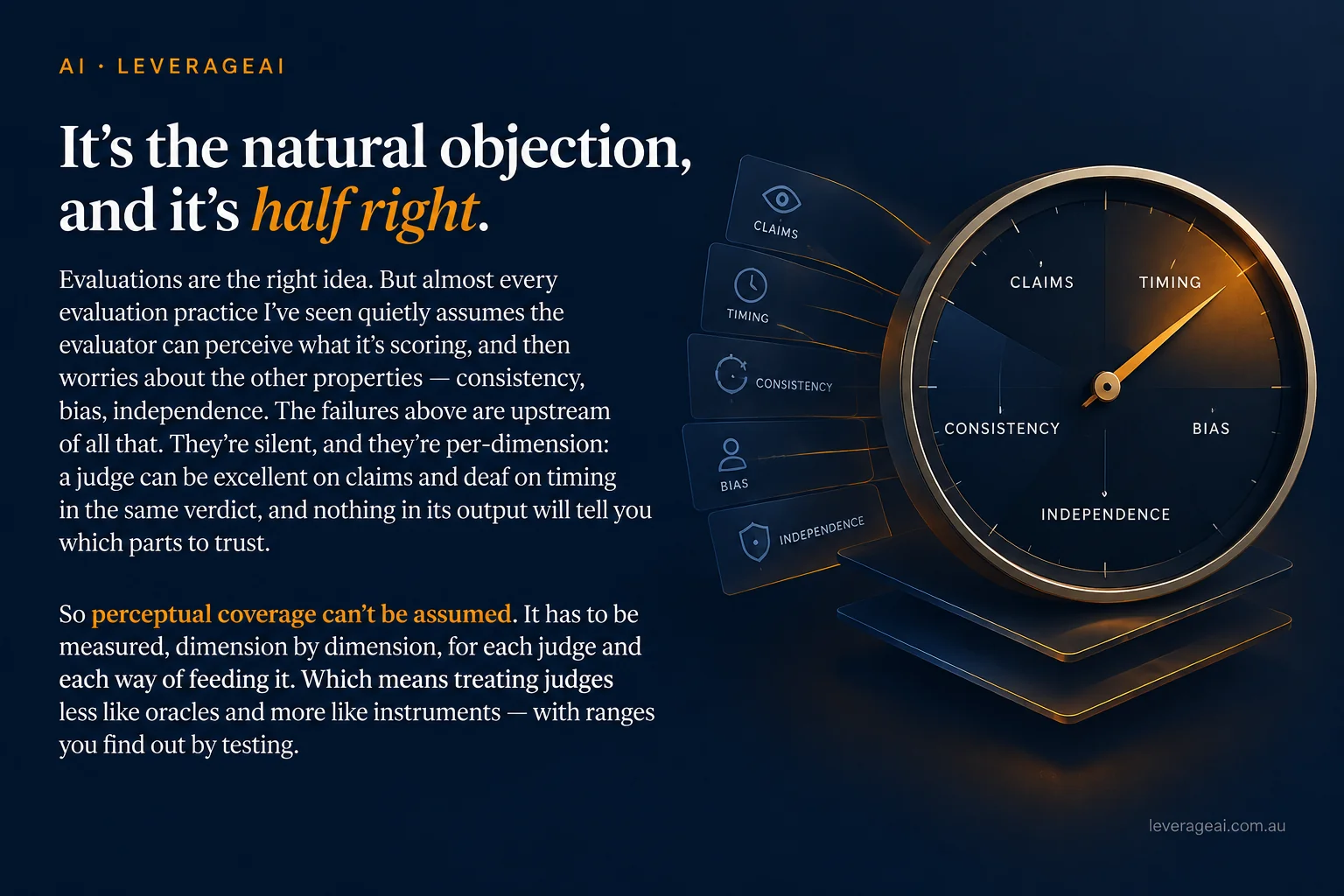
The fix isn't more judges or stronger models. It's treating each model × input package as an instrument with a tested range—not an oracle. You calibrate it dimension by dimension, using controlled pairs that hold everything constant except the one property you're testing. If the judge can't tell the difference between a voice that lands and one that grates, you know that dimension is outside its range. No amount of averaging or prompt engineering will fix that.
Perceptual coverage can't be assumed. It has to be measured. Until you do, your evaluation scores are just noise wearing a confident face.
Discover more from Leverage AI for your business
Subscribe to get the latest posts sent to your email.