
The dangerous AI readiness question is not “do we have APIs?”
It is “which part of readiness do we actually own?”
That distinction sounds bureaucratic until you watch an AI programme stall.
The application team says the system is ready because it exposes data.
The architecture team says the pilot is promising but there is no safe runtime pattern.
Risk says there is a policy, but no way to enforce authority at the moment an AI system acts.
Audit asks for evidence, and everyone points to logs that need forensic reconstruction.
Individually, everyone is doing something sensible.
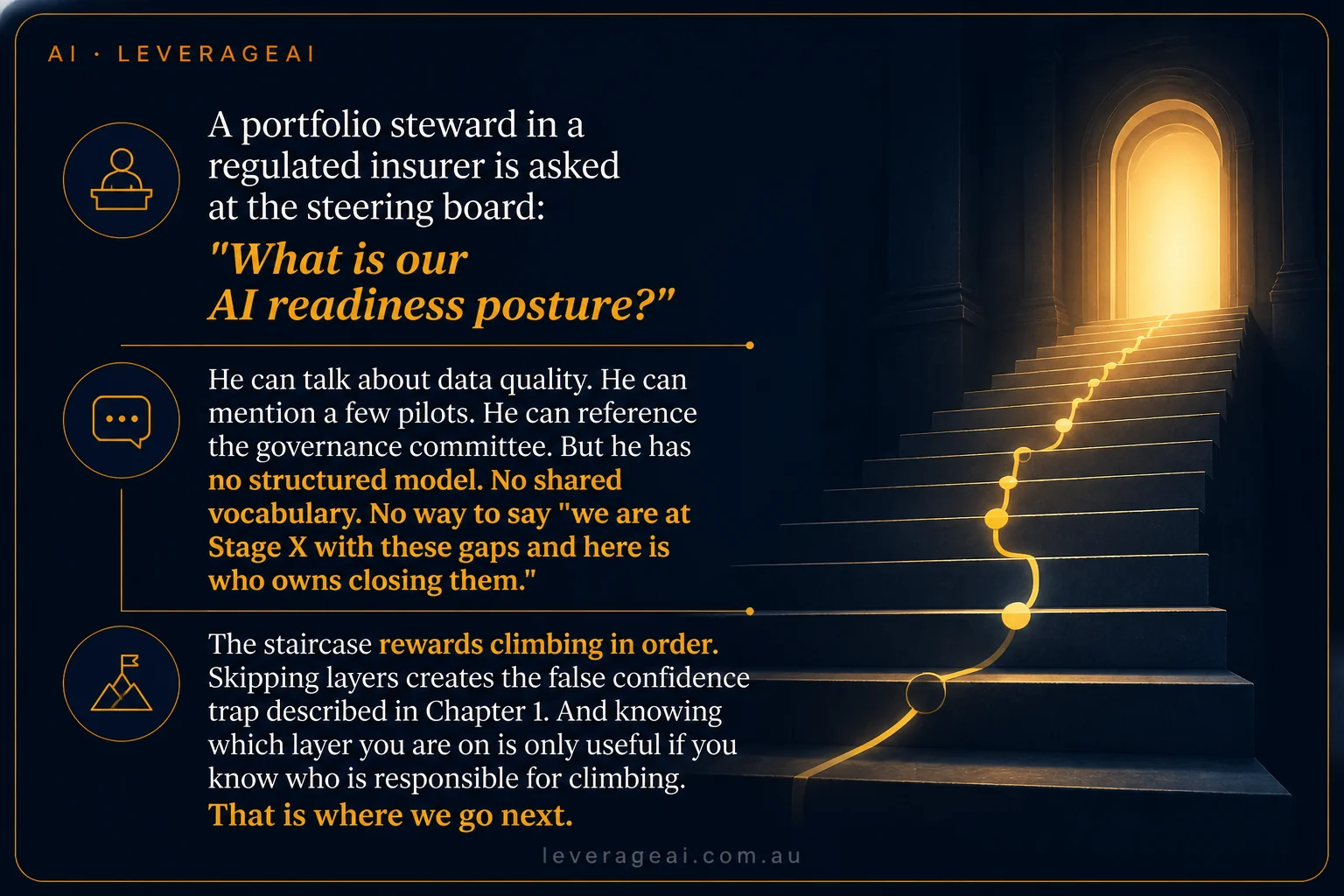
Collectively, nobody can answer the board’s simplest question:
Are we actually ready?
This is where a lot of enterprise AI governance goes wrong. Organisations collapse four different problems into one vague bucket called “AI readiness.”
But they are not the same problem.
Application fitness is about whether the estate can be read, acted on, wrapped and governed by AI at all.
Runtime safety is about whether untrusted agents can be isolated, permissioned, mediated and observed.
Decision-time authority is about whether consequential actions are technically impossible without valid authority.
Proof-carrying receipts are about whether the organisation can produce a portable evidence chain showing what was authorised, what data was used, and what machinery produced the outcome.
Those layers build on each other.
You cannot produce proof if authority was never enforced.
You cannot enforce authority if there is no runtime control plane.
You cannot safely run agents if the applications underneath are opaque GUI fossils with business logic trapped behind screens.
And you cannot fix any of this if every layer is assigned to the same generic committee.
“Everyone owns AI readiness” usually means nobody owns the specific machinery that matters.
The portfolio steward should own application AI-fitness and investment gating.
Enterprise architecture and security should own runtime containment patterns.
Governance, risk and the CISO should own authority models and policy enforcement.
Audit and governance should define the evidence standard.
Delivery teams should consume the doctrine, not invent their own governance snowflake every time a pilot starts.
That ownership split matters because AI failure is rarely a pure technology failure.
Most pilots do not die because the model cannot perform the task in a sandbox.
They die because the organisation cannot safely move from demonstration to operation.
No authority model.
No blast-radius control.
No decision-time evidence.
No shared vocabulary for which layer is missing.
So the pilot becomes another artefact in the graveyard: technically interesting, operationally unusable.
The uncomfortable implication is that many organisations who believe they are “cautious” about AI are not actually prepared.
They are simply slow.
Caution without architecture is not governance. It is delay with better manners.
Preparedness looks different.
It says: we may not deploy aggressive AI workflows tomorrow, but we know which applications can support them, which cannot, what runtime controls would be required, who owns authority, and what evidence a regulator or board would expect.
That is not evangelism.
That is stewardship.
Being ready for AI does not mean rushing into AI.
It means refusing to let tomorrow’s strategic options be determined by yesterday’s application estate, today’s committee structure, or a pilot team’s improvised controls.
The real maturity question for leadership teams is not “how many AI use cases do we have?”
It is:
If a board member asked tomorrow where our AI readiness breaks, could we answer in layers, owners and next actions — or would we give them a tour of disconnected activity?
Discover more from Leverage AI for your business
Subscribe to get the latest posts sent to your email.