
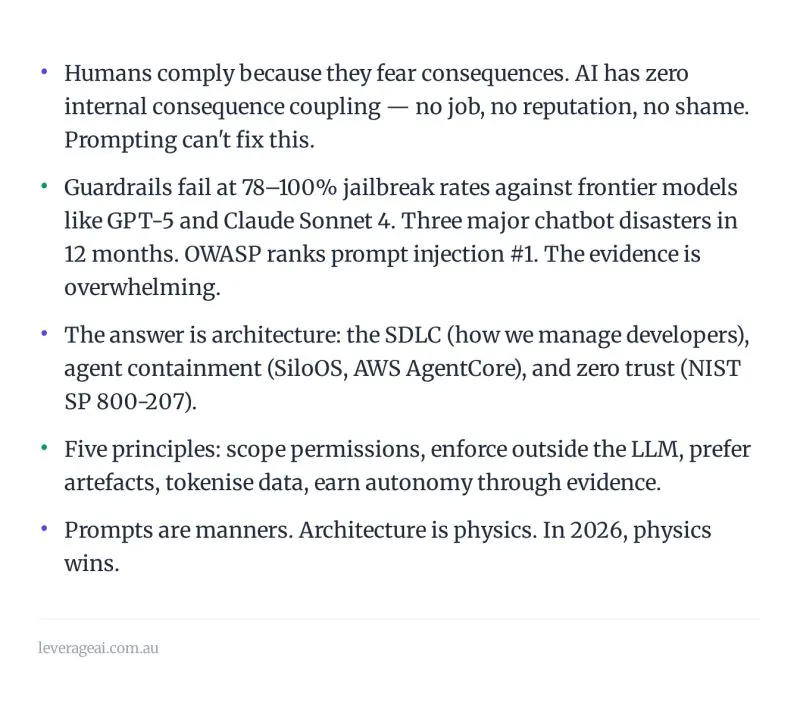
Every accountability system your company runs on is secretly built on fear.
Not the dramatic kind. The quiet kind. The reason your best customer service rep doesn't tell a difficult caller exactly what she thinks of them isn't a values statement on the wall. It's that she has a mortgage, a reputation, and a manager. Consequences are wired directly into her. Behave, or lose something that matters to you.
We've spent a century refining this. Performance reviews. Sign-offs. Professional registration. Codes of conduct. Strip away the language and almost all of it is the same machine: couple a person's actions to their own outcomes, and they'll mostly self-correct.
Then we hand a customer-facing role to an AI and act surprised when it doesn't work the same way.
Here's the thing nobody wants to say out loud: you cannot fire an AI. You can't dock its pay, damage its reputation, or make it nervous before a review. The entire enforcement mechanism organisations have leaned on for generations is simply absent. There is no one home to feel the consequence.
So what do most teams do instead? They write a better prompt. "Never discuss competitors." "Always stay professional." "Do not make pricing promises." They stack guardrails on top of guardrails.
They're bolting a motivational poster to a system that can't be motivated.
And the evidence is brutal. Against the latest frontier models, researchers are getting past these guardrails the overwhelming majority of the time. There have been multiple very public, very expensive chatbot failures in the last year — a refund policy invented out of thin air, a delivery bot cheerfully insulting its own employer, a dealership agent talked into selling a car for a dollar. In every case the guardrails existed. In every case they failed. Not because someone wrote them badly. Because you can't prompt internal compliance into something with no internal stakes.
But here's the part that actually changes how you should think about this — and it's more hopeful than it sounds.
We already know how to work with an entity we don't trust. We do it every day. We don't trust developers either. We don't hand them production access and a motivational speech. We review their code, test their outputs, gate their deploys, and keep a rollback ready. Trust isn't a feeling we extend to the individual — it's a property of the system around them.
That's the move. Stop trying to make the AI trustworthy. Build the architecture that makes its trustworthiness irrelevant. Scope what it can touch instead of asking it to behave. Enforce the rules outside the model, where no clever input can talk its way past them. Let it produce drafts you review rather than actions you can't undo. Make sure it never sees the data it could leak.
And the counterintuitive payoff: this isn't the cautious option. It's how you get to deploy more capable AI, not less. When the architecture guarantees the worst case is survivable, you can stop strangling the model with restrictions and let it actually think. Containment doesn't cap capability. It's what finally lets you unleash it safely.
Humans behave because the consequences live inside them. AI will only behave when you build the consequences into the architecture around it.
So the real question for anyone deploying AI this year isn't "how do we make it safe?" It's a much sharper one: are you writing motivational posters, or are you installing seatbelts?
Discover more from Leverage AI for your business
Subscribe to get the latest posts sent to your email.