A Newsfeed That Hunts Its Own Blind Spots: The Wiki-Grounded Curator
“Interesting” isn’t a property of a tweet — it’s the gap between the tweet and what you already know.
Progressive Resolution built the write side. Invert it for reading, and one property does all the work: resolution correlates inversely with staleness risk — so the layers cheap enough to cache are exactly the layers that never rot.
The 60-year-old pattern that makes AI work survive an agent that dies every hour — and why “it fits the context window better” is only a quarter of the story.
Every vendor’s AI can see only the vendor-shaped fragment of your world — and four structural locks mean it always will.
Your failing, expensive agent is usually a missing capital asset — not a missing capability. Compile the context once, and a cheap model behaves as if it knows your world. That is a price spread you can capture on purpose.
Frontier-quality agent decisions don’t come from a bigger model. They come from where you put the model swap — and from refusing to summarise the one thing your judgement actually needs.
Tight intent, loose method — why over-prompting a smart model is a denial-of-service attack on its intelligence, and why a north star still isn’t “no rules.”
RAG isn’t failing you. It was engineered for the one-shot chatbot turn. Your agents have a different job — they must traverse, write, hold state, and compound — and on every one of those axes a wiki-graph is native and RAG is…
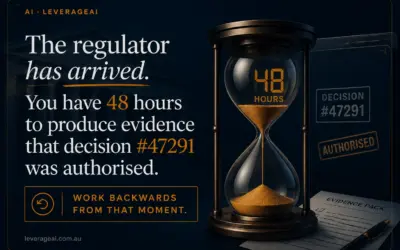
The governance question for agentic AI is not “can it explain itself?” It is “can we replay what it knew?” — and only an inspectable, version-controlled wiki-graph can answer it.
How a Tesla service interaction exposes their poor AI governance — and the architecture that fixes it