AI Governance · LeverageAI
📘 Want the complete guide?
Learn more: Read the full eBook here →
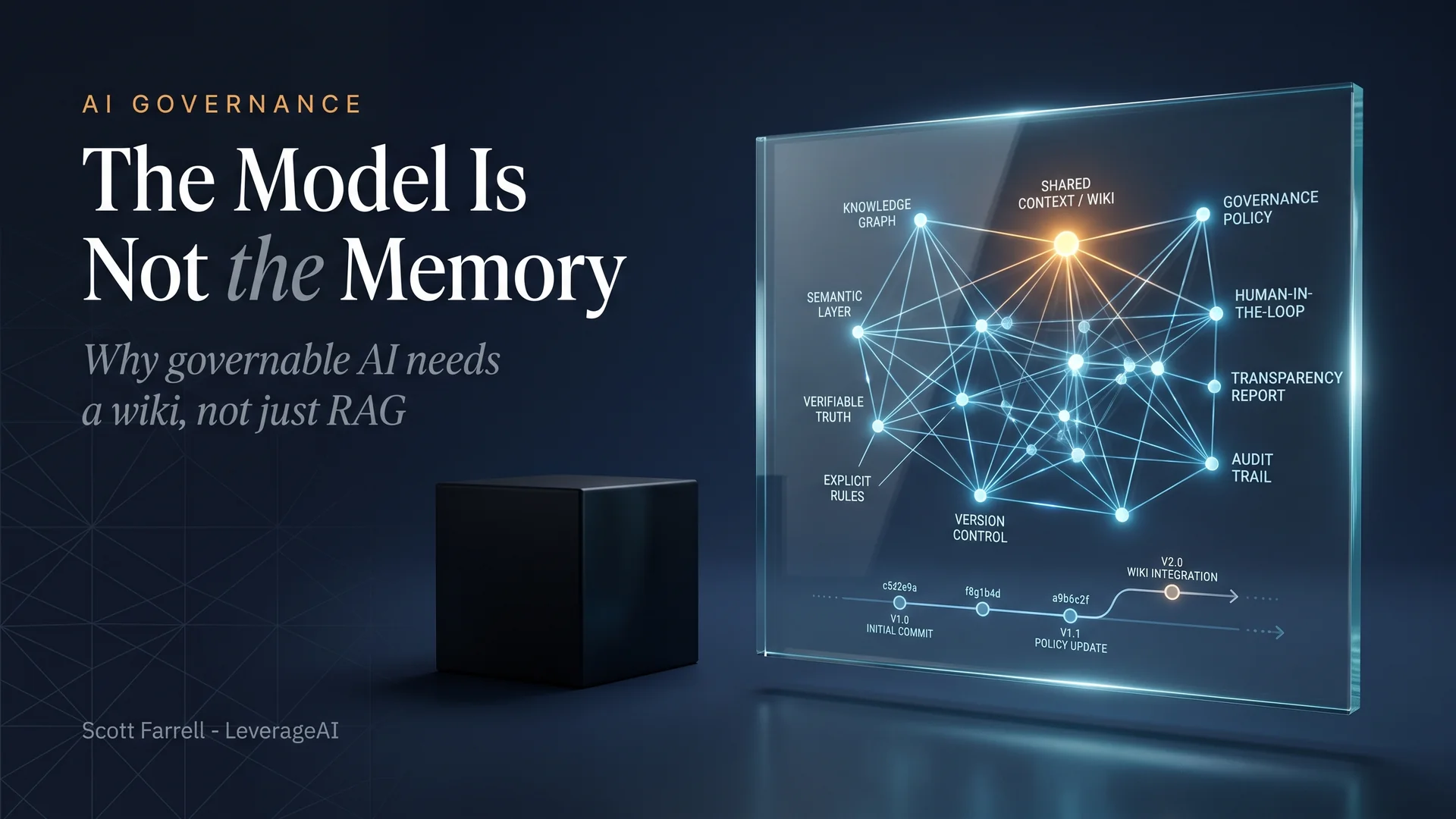
The Model Is Not the Memory: Why Governable AI Needs a Wiki, Not Just RAG
The governance question for agentic AI is not “can it explain itself?” It is “can we replay what it knew?” — and only an inspectable, version-controlled wiki-graph can answer it.
Scott Farrell · LeverageAI · A field guide for AI & governance leaders
When an agentic AI makes a consequential call — orders the part, approves the claim, books the repair — and you ask it why, it will tell you a story. The story will be fluent, plausible, and reassuring. The problem is that the story was written after the decision, by the same system whose decision you are trying to audit. A story is not evidence. And in 2026, “the AI explained itself” has quietly become the most dangerous sentence in enterprise governance.
We have spent two years building agents that can act. We have spent almost no time building the thing that lets us govern what they did. The gap is now measurable. By Deloitte’s count, roughly 80% of organisations lack a mature governance model for agentic AI, even as three-quarters plan to deploy it.5 Gartner expects more than 40% of agentic AI projects to be cancelled by the end of 2027, citing — alongside cost — inadequate risk controls as a primary culprit.6 As McKinsey puts it, the era of agents changes the risk itself: organisations “can no longer concern themselves only with AI systems saying the wrong thing; they must also contend with systems doing the wrong thing.”4
This piece is about the one investment that actually closes that gap — and it is not a bigger model, and it is not a better RAG index. It is a self-maintaining, version-controlled wiki-graph: an external, inspectable map of what your organisation knows. The architecture and economics of that wiki-graph I have argued elsewhere, in The Index Is the Data. Here I want to make a narrower, sharper claim: the wiki-graph is the only layer that makes an agent’s cognition governable, because it is the only layer you can inspect, version, and replay.
The explanation is not the evidence
Start with the thing everyone reaches for first: explainability. The implicit governance model in most enterprises is “deploy the agent, and if something goes wrong, ask it to explain its reasoning.” Modern reasoning models even emit a chain-of-thought, which feels like a window into the machine’s mind. It isn’t.
Anthropic tested this directly. When models were given a hint that changed their answer, they usually didn’t mention the hint in their stated reasoning — Claude 3.7 Sonnet acknowledged it about 25% of the time, DeepSeek R1 about 39%.1 When the models exploited a reward hack, they admitted it in their chain-of-thought less than 2% of the time.1 The conclusion the researchers draw is blunt:
“We can’t always rely on what they tell us about their reasoning… there’s no specific reason why the reported chain-of-thought must accurately reflect the true reasoning process.”
— Anthropic, “Reasoning models don’t always say what they think”1
This is not an Anthropic-specific quirk. An independent study of chain-of-thought faithfulness “in the wild” found the same pattern — verbalised reasoning “can give an incorrect picture of how models arrive at conclusions,” and is “not a complete account of the internal process that produced the model’s answer,” explicitly warning against relying on it “in agentic or safety-critical settings.”2 One of the named pathologies has a precise name: post-hoc rationalisation — the model generates a plausible explanation backwards from an answer it already reached.
None of this is new in spirit. Cynthia Rudin warned the field years ago that “trying to explain black box models, rather than creating models that are interpretable in the first place, is likely to perpetuate bad practices and can potentially cause catastrophic harm.”3 Post-hoc explanation tools approximate a model from the outside; they do not recover what actually happened inside it.
The core problem
If the model’s own account of its reasoning can be a confident fiction, then governance cannot live inside the model. It has to live in something you can observe from the outside.
So if we can’t trust the narration, what can we trust? Only one thing: a durable, external record of what the agent actually observed when it decided. Not the story it tells afterwards — the knowledge it touched at the time. To get there, we first have to understand the two ways an AI “knows” anything, and why neither of them, by default, is auditable.
Two ways your AI “knows” — and why neither is auditable
An agent answering a question about your business is drawing on knowledge from one of two places.
The first is its weights — what the model absorbed in training. This is a black box in the most literal sense: you cannot open it, rewind it, or ask it which fact it used. As I have put it before, you can’t look into an LLM’s brain and see all the crap it was looking at. When the knowledge lives in the weights, there is no audit artefact, full stop.
The second is retrieval — RAG. At query time, the system searches a vector store for chunks that look similar to the question and feeds them to the model. RAG is genuinely good for one class of problem: the answer that lives in a single passage. But it has two governance-relevant weaknesses. First, it thinks at the wrong time — it re-derives understanding on every question, by similarity math that has no representation for how things relate. Vector search “retrieves semantically similar content but lacks awareness of how facts are connected,” and “falls short when answering multi-hop questions that require connecting information across multiple chunks.”9 And the reflex fix — retrieve more, use a bigger context window — backfires: accuracy sags when the relevant fact sits in the middle of a long context,7 and Chroma’s testing of eighteen frontier models found they all degrade as input grows, “often in surprising and non-uniform ways.”8
But here is the weakness that matters most for governance, and it is the one nobody talks about: a RAG search is not a versioned knowledge state. You can log that a query ran. You cannot restore the exact corpus, in the exact condition, that the agent searched on a given Tuesday, and re-trace which relationships it could and couldn’t have seen. RAG retrieves text. It does not retrieve a map of what your organisation believed at that moment — because it never built one.
That map is the wiki-graph. Instead of crawling raw chunks at query time, a dual-agent engine pre-digests your closed cases into atomic claims and typed edges: an ingestion agent writes the claims, a janitor agent compacts them into stronger relationships over time. Retrieval becomes a lookup over a maintained structure rather than a crawl over raw text. I won’t re-derive that architecture here — that is the whole of The Index Is the Data, and on the cognition-maturity ladder it is the Cognition Supply Chain‘s top rung. What I want is the consequence of one design choice: the artefact is plain markdown under Git.
The model is not the memory. The wiki is the memory.
That single choice — knowledge as versioned, human-readable text rather than opaque weights or ephemeral search — is what turns governance from interrogation into replay.
From explainability to cognitive provenance
Here is the move at the centre of this article. Stop asking the AI to explain itself. Start asking the system to show you the knowledge path — which pages it retrieved, which claims it observed, which edges it traversed, which version of the organisation’s memory was current, and crucially, which claims were available but went unused.
That is the difference between explainability and what I’ll call cognitive provenance. Explainability is a story the model tells afterwards. Cognitive provenance is a reconstruction of the cognitive conditions under which the agent acted — and because the wiki is Git-versioned, it is literally restorable. You can rewind the wiki to the commit that was live at 9:17am on the day the decision was made, and inspect exactly what the AI was looking at and how the map was constructed at that moment. You cannot do that with knowledge baked into a model.
Cognitive provenance
Not “the AI explained itself afterwards,” but “we can reconstruct exactly which pages, claims and edges the AI observed at decision time.” In governed agentic AI, the path through knowledge is part of the decision.
This is not an exotic idea once you say it in engineering terms. We already version code with Git so we can reproduce any past state. MLOps teams already version data and models with tools like DVC precisely because, without it, “reproducibility becomes nearly impossible” — and a model can be “traced back to its exact training data via commit hashes… particularly valuable for regulated industries where audit trails are essential.”13 A version-controlled wiki-graph extends that same discipline to the one thing nobody versions today: the inspectable claims and edges the agent actually reads.
And regulators are converging on exactly this requirement. The EU AI Act’s Article 12 mandates that high-risk AI systems “technically allow for the automatic recording of events (logs) over the lifetime of the system”10 — and the guidance is explicit that this is not just storing outputs: the logging “must enable post-hoc reconstruction of individual AI-assisted decisions.”10 The NIST AI Risk Management Framework similarly calls for documentation of “decision-making rationales, and data provenance… to enable the auditing of AI decisions.”11 The academic community is naming the same need: a recent proposal for LLM audit trails describes “a chronological, tamper-evident, context-rich ledger… so organizations can reconstruct what changed, when, and who authorized it.”12
“Post-hoc reconstruction of individual AI-assisted decisions” is, almost word for word, replay what it knew. The regulation describes the capability; the wiki-graph is how you actually get it for the knowledge dimension, not just the I/O log.
A sharper definition of hallucination: substantively right, procedurally unsupported
Once you can see the knowledge path, something uncomfortable and useful happens. You discover that the agent sometimes gets the right answer for the wrong reason — and now you can prove it.
Here is a field observation, not a theory. The more you put into the wiki, the more you notice the model will occasionally bypass it entirely and answer from its own training knowledge. It gets the right answer. But if the trace shows it never observed the relevant page, never traversed the supporting edge, never read the admissible claim — then you can state, cleanly, that it hallucinated, even though it was right.
Procedural hallucination
A material claim or decision path not supported by the admissible knowledge the agent actually observed at that time. Substantively right, procedurally unsupported — and in a governed system, that still fails audit.
This is not wordplay. The research community has formally split the two ideas. A 2024 paper on RAG attributions argues that “citation correctness alone is insufficient” and that we must examine faithfulness separately: whether “the model’s reliance on cited documents is genuine, reflecting actual reference use rather than superficial alignment with prior beliefs, which we call post-rationalization.”14 An answer can be correct against reality yet unfaithful against the knowledge the system was supposed to use. That is the academic mirror of “substantively right, procedurally unsupported.”
Why does a correct-but-unsupported answer matter? Because in a consequential or regulated domain, a decision that was right by luck is a latent failure. It will be right until the day the latent knowledge is wrong, and you will have no way to have caught it, because you were grading the output instead of the cognition. The two paths look identical from the outside:
✓ Supported (inspectable cognition)
- ticket → symptom extraction
- → heated-seat page
- → occupancy-sensor edge
- → model-year exception
- → customer-trust claim
- → proposal set
✗ Freelanced (procedural hallucination)
- ticket
- → generic model knowledge
- → recommendation
Same recommendation. Completely different governance posture. Only one of them is defensible — and you can only tell them apart if the knowledge path was recorded. Governance, it turns out, comes down to a deceptively simple question: what wiki did it observe?
The worked artefact: a governance trace you can actually read
Abstraction is cheap. Let me make this concrete with the example that runs through all of this work: a Tesla heated-seat repair. The customer reports the heated seat isn’t working. The common cause is not the heating element — it is often an upstream driver-occupancy sensor fault — which makes the right repair non-obvious to the customer and a trust risk if handled carelessly.
A governed service AI doesn’t free-associate from a workshop manual. It reads a wiki-graph compiled from thousands of closed cases, generates candidate proposals, and a deterministic graph evaluates each one against nodes most companies wouldn’t think to encode: can the customer understand this? can the concierge defend it? does the cheaper path spend customer trust? When a closed case completes, the outcome writes back into the wiki. That is the engine. The thing the auditor actually holds afterwards is this:
# Service governance trace
Case:        Heated driver seat complaint
Vehicle:     Model 3 RWD, 2023
Wiki snapshot:  service-wiki@a83f21c
DAG version:    service-triage-dag@2026.06.17
Agent version:  triage-agent@1.8.2

Observed pages:
  - [[Heated Seat Failures]]
  - [[Driver Occupancy Sensor]]
  - [[Model 3 Seat Module]]
  - [[First Visit Resolution]]
  - [[Customer Confusion: Non-obvious Repairs]]

Observed edges:
  heated-seat-complaint  -possible-upstream-cause->  occupancy-sensor
  occupancy-sensor-fault -can-disable->             heated-seat-activation
  non-obvious-repair     -requires->                customer-facing-explanation
  high-return-visit-risk -consider->                backup-part-staging

Candidate proposals:
  A. Order occupancy sensor only
     FAIL — customer explanation missing; return-visit risk medium
  B. Order heated-seat element only
     FAIL — diagnostic evidence weak against remote signal
  C. Order occupancy sensor + stage heated-seat element
     PASS — evidence adequate; trust risk reduced; concierge note generated

Accepted:   C
Customer note:  “Occupancy sensor can affect heated-seat activation; we will
              check this first and verify the heater circuit while the car is here.”
Look at what that artefact gives an auditor that a log of prompts and outputs never could. It names the exact snapshot, DAG version and agent version — so the decision is reproducible. It lists the pages and edges observed — so you can confirm the agent reasoned from institutional memory rather than freelancing. And it preserves the rejected proposals with their failure reasons — so when an efficiency reviewer later asks “why is the AI ordering a backup part?”, the receipt answers: because the cheaper single-part proposals failed the customer-trust and first-visit-resolution gates. That is the difference between waste and strategy.
Tool calls are not just plumbing. They are evidence of cognition. If the agent used the wiki, the trace proves it. If it skipped the wiki, the trace proves that too.
And notice what this artefact does not contain: the model’s private chain-of-thought. It doesn’t need it. It is governable not because it exposes the machine’s inner monologue — which we’ve already established is unreliable — but because it reveals decision provenance: the observable, version-pinned path through admissible knowledge. As IBM frames the broader challenge, “the hard part of agentic AI is being able to explain, after the fact, why it acted, what it read, and who is answerable for it.”15 “What it read” is precisely the column that weights and RAG leave blank, and the wiki-graph fills in.
The fourth signature
This slots into a governance model I’ve argued before. In Signing the Authority, the Data, and the Graph, the case is that real decision governance binds three signatures to the consequential decision itself rather than reconstructing them from logs afterwards: signed authority (who was allowed to act), signed data (what facts were observed), and signed graph (what policy evaluated the proposal). The wiki adds the missing leg:
The attestation package, completed
- Signed authority — who or what was allowed to act.
- Signed data — what case facts and diagnostics were observed.
- Signed graph — what deterministic DAG/policy evaluated the proposal.
- Signed knowledge path — what wiki pages, claims and edges informed the proposal. (the wiki’s contribution)
- Signed outcome — what was accepted, rejected, escalated, and later closed out.
Sign the knowledge path. That fourth signature is only possible because the knowledge is a real, restorable artefact — Git-versioned markdown — rather than a vibe inside the weights.
Two neighbouring pieces of doctrine make this work in practice, and each earns exactly one paragraph here. The first is governed agentic recovery: the agent is not the decider, it is a proposal-repair engine that loops until a proposal satisfies the deterministic graph. The agent loops; the graph governs. Agentic AI, used well, is not a way to escape governance — it is a way to satisfy it. (That argument lives in Designing Loops, Not Prompts — the loop is robust because the durable state lives outside the agent.) The second is the John West receipt: the proof must show not only why the chosen answer passed, but why the tempting cheaper answers failed — rejected proposals are a governance asset, not noise. (That is the spine of Stop Asking AI Why It Decided.) This article’s contribution is to insist that the knowledge path joins them as first-class proof.
The agent is replaceable. The memory is the asset.
There is a strategic payoff hiding inside the governance argument, and it is the one that should move a budget. If your institutional intelligence lives in a model’s weights, then your intelligence is rented, and it walks out the door when the vendor changes terms. Enterprises already feel this trap: in one survey of 500 executives, 74% said losing their AI vendor would disrupt core operations, only 6% felt they could stop without interruption, and of those who attempted a migration, only 42% reported a smooth transition.16 You are, as the report puts it, “entering a committed relationship with a slightly vague escape clause.”16
A version-controlled wiki-graph is the hedge. Because it is plain markdown — portable, diffable, model-agnostic — you can swap the reasoning engine underneath it without losing the organisation’s mind. The LLM becomes a replaceable worker operating against externalised cognition.
The model is the engine. The wiki is the memory. The DAG is the law. The receipt is the evidence.
This reframes what “AI learning” even means. People imagine learning as something that gets baked into a bigger model. But closed-loop AI does not mean the model learns — it means the organisation remembers. Each resolved case updates the wiki; the next case starts from a better map. And because the organisation remembers externally, the organisation can audit what it remembered. Do not teach the LLM in its weights. Teach the organisation in its graph.
The higher standard
The governance question for agentic AI is no longer “can the AI explain itself?” It is: can the organisation replay the cognitive conditions under which the AI acted?
That is a standard a post-hoc explanation can never meet and a Git-versioned wiki-graph meets natively. So the next time a vendor offers to make your AI “explainable,” ask them a different question. Not can it justify its answer? — any fluent model can do that, whether or not the justification is true. Ask: can you restore the exact knowledge it observed when it decided, and prove it reasoned from it? If the answer is no, you don’t have governance. You have a story. Build the kind of system that can answer yes — and build it before the decisions you’ll one day need to defend have already been made.
References
Post-hoc explanation & faithfulness
- [1]Anthropic. “Reasoning models don’t always say what they think.” — “We can’t always rely on what they tell us about their reasoning… there’s no specific reason why the reported Chain-of-Thought must accurately reflect the true reasoning process.” Claude 3.7 Sonnet acknowledged hints ~25% of the time; reward hacks admitted <2% of the time. https://www.anthropic.com/research/reasoning-models-dont-say-think
- [2]Arcuschin et al. “Chain-of-Thought Reasoning In The Wild Is Not Always Faithful.” arXiv:2503.08679. — Verbalized reasoning “can give an incorrect picture of how models arrive at conclusions” and “is not a complete account of the internal process that produced the model’s answer… should be used with caution in agentic or safety-critical settings.” https://arxiv.org/abs/2503.08679
- [3]Rudin, C. “Stop Explaining Black Box Machine Learning Models for High Stakes Decisions and Use Interpretable Models Instead.” Nature Machine Intelligence / arXiv:1811.10154. — “Trying to explain black box models, rather than creating models that are interpretable in the first place, is likely to perpetuate bad practices and can potentially cause catastrophic harm to society.” https://arxiv.org/abs/1811.10154
- [14]Wallat, Heuss, de Rijke, Anand. “Correctness is not Faithfulness in RAG Attributions.” arXiv:2412.18004. — “Citation correctness alone is insufficient… Faithfulness ensures that the model’s reliance on cited documents is genuine, reflecting actual reference use rather than superficial alignment with prior beliefs, which we call post-rationalization.” https://arxiv.org/abs/2412.18004
Governance gap & agentic risk (industry & analyst)
- [4]McKinsey. “The state of AI in 2025: Agents, innovation, and transformation.” — In the age of agentic AI, organisations “can no longer concern themselves only with AI systems saying the wrong thing; they must also contend with systems doing the wrong thing, such as taking unintended actions, misusing tools, or operating beyond appropriate guardrails.” https://www.mckinsey.com/capabilities/quantumblack/our-insights/the-state-of-ai
- [5]Deloitte. “Agentic AI is scaling faster than guardrails” / “State of AI in the Enterprise 2026.” — “Approximately 80% of the organizations surveyed currently lack mature governance capabilities for agentic AI”; only 21% report a mature agent-governance model. https://www.deloitte.com/us/en/insights/topics/emerging-technologies/ai-agents-scaling-faster.html
- [6]Gartner. “Gartner Predicts Over 40% of Agentic AI Projects Will Be Canceled by End of 2027” (press release, 25 Jun 2025). — Cancellations driven by “escalating costs, unclear business value or inadequate risk controls.” https://www.gartner.com/en/newsroom/press-releases/2025-06-25-gartner-predicts-over-40-percent-of-agentic-ai-projects-will-be-canceled-by-end-of-2027
- [15]IBM. “The accountability gap in autonomous AI.” — “The hard part of agentic AI is being able to explain, after the fact, why it acted, what it read, and who is answerable for it.” https://www.ibm.com/think/insights/accountability-gap-autonomous-ai
- [16]Zapier. “AI vendor loss would disrupt 3 in 4 enterprises” (survey, 500 U.S. executives). — 74% say losing their AI vendor would disrupt core operations; only 6% could stop without interruption; of those who migrated, only 42% reported a smooth transition. https://zapier.com/blog/ai-vendor-lock-in-survey/
RAG & long-context limits for relationship-shaped knowledge
- [7]Liu et al. “Lost in the Middle: How Language Models Use Long Contexts.” arXiv:2307.03172. — Performance “significantly degrades when models must access relevant information in the middle of long contexts, even for explicitly long-context models.” https://arxiv.org/abs/2307.03172
- [8]Hong, Troynikov, Huber. “Context Rot: How Increasing Input Tokens Impacts LLM Performance.” Chroma Research (2025). — 18 frontier models (incl. GPT-4.1, Claude 4, Gemini 2.5) degrade as input grows, “often in surprising and non-uniform ways,” well within declared context windows. https://www.trychroma.com/research/context-rot
- [9]Neo4j. “How to improve multi-hop reasoning with knowledge graphs and LLMs” (2025). — Vector search “retrieves semantically similar content but lacks awareness of how facts are connected” and “falls short when answering multi-hop questions that require connecting information across multiple chunks or documents.” https://neo4j.com/blog/genai/knowledge-graph-llm-multi-hop-reasoning/
Regulation, audit trails & versioned-knowledge provenance
- [10]European Union. “EU AI Act, Article 12 — Record-Keeping.” — “High-risk AI systems shall technically allow for the automatic recording of events (logs) over the lifetime of the system”; guidance: logging “must enable post-hoc reconstruction of individual AI-assisted decisions… the system itself must generate the records without operator intervention.” (High-risk obligations apply from 2 Aug 2026.) https://artificialintelligenceact.eu/article/12/
- [11]NIST. “AI Risk Management Framework 1.0” (NIST AI 100-1). — Calls for “clear documentation of AI processes, decision-making rationales, and data provenance to ensure accountability, enable the auditing of AI decisions, and foster public trust.” https://nvlpubs.nist.gov/nistpubs/ai/nist.ai.100-1.pdf
- [12]Ojewale, Suresh, Venkatasubramanian. “Audit Trails for Accountability in Large Language Models.” arXiv:2601.20727. — Proposes “a chronological, tamper-evident, context-rich ledger of lifecycle events and decisions… so organizations can reconstruct what changed, when, and who authorized it.” https://arxiv.org/abs/2601.20727
- [13]Data Engineer Academy. “Data Version Control: A Comprehensive Guide.” — “Without a system to manage these assets, reproducibility becomes nearly impossible”; models can be “traced back to their exact training data via commit hashes… particularly valuable for regulated industries where audit trails are essential.” https://dataengineeracademy.com/blog/data-version-control-a-comprehensive-guide/
LeverageAI — prior work (the author’s own frameworks; ideas, not statistics)
- Farrell, S. “The Index Is the Data: How a Self-Cleaning Wiki-Graph Out-Thinks RAG.” LeverageAI. https://leverageai.com.au/the-index-is-the-data-how-a-self-cleaning-wiki-graph-out-thinks-rag/
- Farrell, S. “Designing Loops, Not Prompts: A Field Guide to Agentic Loops and Who Holds the State Machine.” LeverageAI. https://leverageai.com.au/designing-loops-not-prompts-a-field-guide-to-agentic-loops-and-who-holds-the-state-machine/
- Farrell, S. “Stop Asking AI Why It Decided — Build Decisions That Carry Their Own Proof.” LeverageAI. https://leverageai.com.au/stop-asking-ai-why-it-decided-build-decisions-that-carry-their-own-proof/
- Farrell, S. “The Cognition Supply Chain: From Search to Compounding Agentic Cognition.” LeverageAI. https://leverageai.com.au/the-cognition-supply-chain-from-search-to-compounding-agentic-cognition/
- Farrell, S. “AI Governance Means Signing the Authority, the Data, and the Graph.” LeverageAI. https://leverageai.com.au/ai-governance-means-signing-the-authority-the-data-and-the-graph/
External statistics and quotations are drawn from the sources above; framework ideas are the author’s own prior work and are cited for further reading rather than as evidence. URLs are plain text for verification.
Discover more from Leverage AI for your business
Subscribe to get the latest posts sent to your email.