
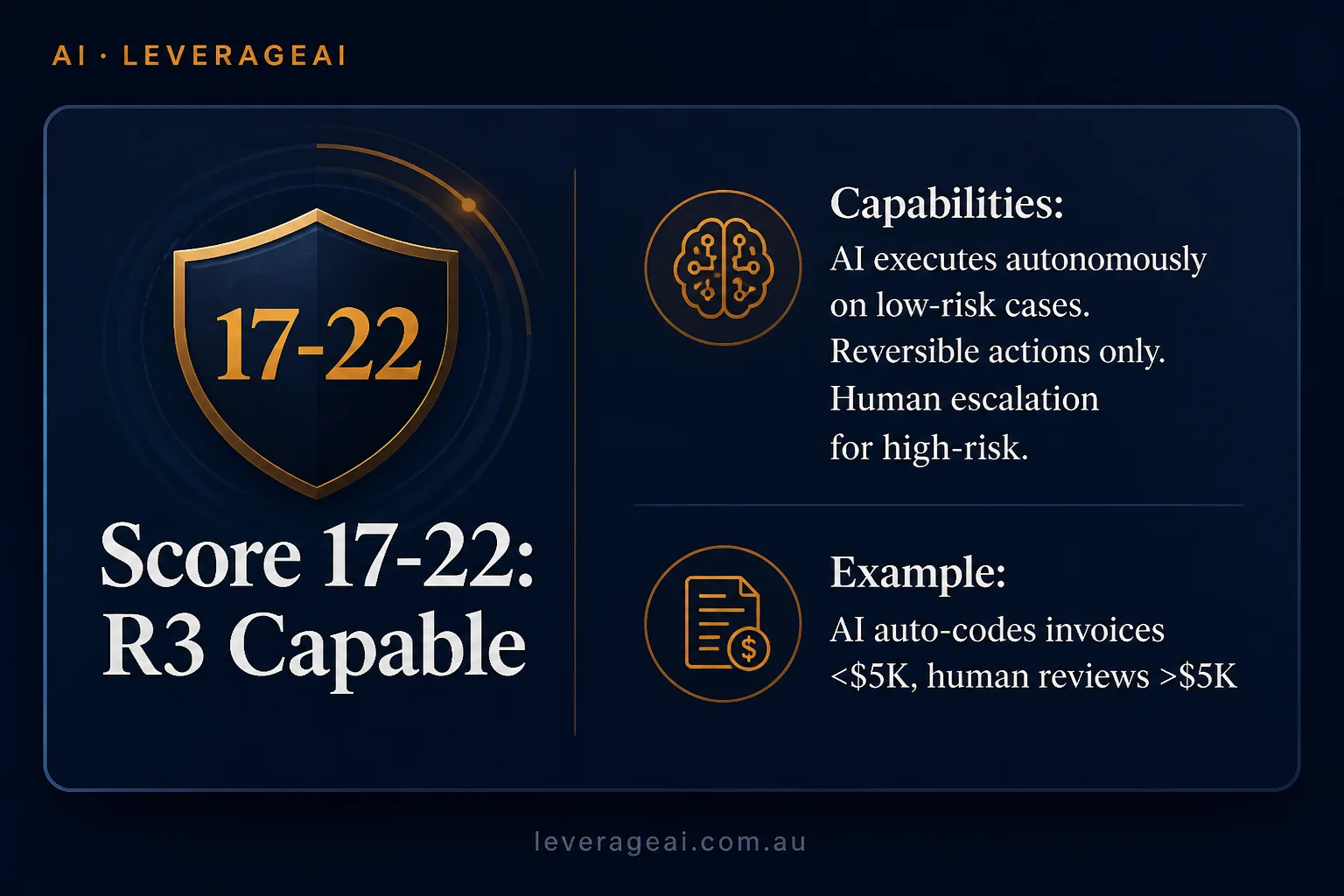
Notice what the $5,000 line actually is.
It isn't a technical limit. The system doesn't get worse at coding an invoice because the number is bigger. The threshold exists because somebody decided where a mistake stops being an annoyance and starts being a problem — and then wrote that decision into the workflow.
That's the part most leadership teams skip. They ask what the AI can do. The better question is which decisions are reversible, measurable, and cheap to be wrong about.
Autonomy isn't a capability grade. It's a consequence budget.
Which is why real autonomy looks disappointing at first. Narrow scope. Reversible actions only. A human sitting at the risk boundary. Baselines captured before anything shipped, so when the first error arrives — and it will — you're comparing it to a known human error rate instead of arguing about it in a meeting.
Every organisation I've seen kill a working system killed it in that meeting. Not because the AI was underperforming. Because nobody had agreed in advance what an acceptable error looked like, so the loudest anecdote won.
A good demo tells you the model is capable. It tells you nothing about whether you are.
So the honest test isn't whether your AI could handle the whole invoice queue. It's whether your CFO, your operations lead and your risk owner could all say the same number out loud, unprompted, and mean it.
If they can't, you don't have an autonomy problem. You have an agreement problem — and no amount of model capability will fix it.
Discover more from Leverage AI for your business
Subscribe to get the latest posts sent to your email.