
AI · Careers · A Field Note
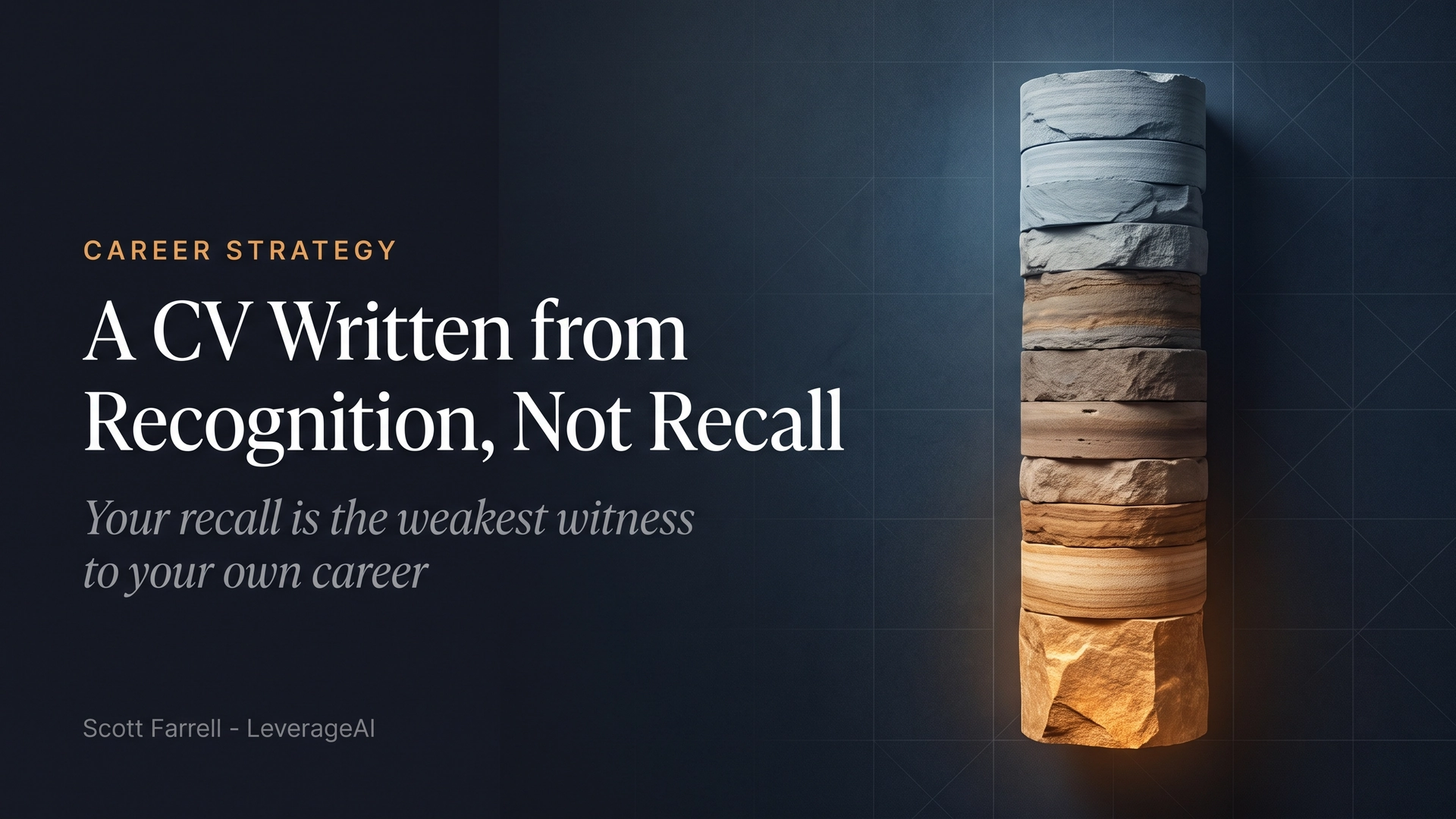
A CV Written from Recognition, Not Recall
Everyone’s CV undersells them, and not because they’re modest. Writing a résumé is autobiographical retrieval under time pressure — and you do it from recall, the weakest channel you own. Point a cheap, patient cue-engine at the exhaust of your career instead, and you don’t remember your past. You recognise it.
The argument
A CV is not a memoir you compose from memory — it’s a query you run against an indexed life. Recall is the wrong instrument: it’s the channel that fails first and hands you only the last few years and the headline roles. An indexed past — old CV versions, project files, ripgrep over a career’s exhaust — serves cues that fire recognition, and one good cue returns not a fact but a whole lattice of forgotten depth. That recovered depth does strategic work: framed right, it proves your knowledge predates the abstractions a younger cohort mistakes for the territory — which turns the gray-hair objection into the one edge a bootcamp can’t confer.
A few weeks ago I was applying for a role in voice AI. I happen to think voice AI is the boss fight — structurally hard, with latency physics and governance and the genuinely difficult cases all landing on the same project at once; I’ve written about that fork in the industry elsewhere. That’s not a reason to pass on the job. It’s a reason I’d walk in with a keen lens on what breaks first. But before any of that, I had to do the small, universal, weirdly dreadful thing: write the CV.
I was using AI to help. My IP wiki was coming together but wasn’t fully running yet, so I did the humble version — I pointed Fable at ripgrep, plain rg over my own files, and fed it older copies of my CV that had been sitting on iCloud for years. And believe it or not, AI attached to ripgrep is quietly powerful. It read the old versions, asked me for dates, tidied things up — and then it started finding things I’d forgotten I’d done. The more I looked back, the more technologies and experiences I discovered that actually supported my résumé. Things I had simply stopped listing. This piece is about why that happens to almost everyone, and what to do about it.
The bug is in the instrument, not the merit
Here is the uncomfortable claim, and it is architectural rather than a matter of effort: your CV undersells you because of how memory works, not because you’re being humble. Sitting down to write a résumé is autobiographical retrieval under time pressure. And under time pressure, from a blank page, you write from free recall — the single weakest channel your memory owns.
I’ve written before, in The Life Wiki, about the asymmetry that governs this, so I won’t re-derive the science here — the short version is that human memory degrades retrieval far faster than storage.1 Recognition holds up when free recall falters. The material is intact; it’s the pointer to it that flakes. Which is why the actor’s name you cannot summon arrives the instant you see it — and why, the moment it arrives, so does the film, the year, and the person you watched it with. One cue, and a whole lattice comes back.
Now apply that to twenty-five years of professional exhaust instead of an actor’s name. When you write a CV from memory, you are running the weakest possible query against the richest possible archive. You get the last few years, the headline titles, and whatever happens to be near the surface. The load-bearing depth — the hard-won, un-recalled specifics that would actually distinguish you — stays dark, not because it’s gone but because free recall can’t reach it. The honest CV, it turns out, is the one you can’t write from memory.
Résumé writing is autobiographical retrieval under time pressure — which is why everyone’s CV undersells them. People write from recall, and recall is the weakest channel they own.
The flood, running on a career
Here is what the cue-engine did to me, told with its trigger and its lattice, because the mechanism is the whole point.
Somewhere in the sweep, I remembered — vaguely — that I’d run Asterisk once. I couldn’t have told you the details cold; that memory was a chink, not a paragraph. But ripgrep-plus-Fable served the cue, recognition fired, and out came not one fact but the whole lattice at once. This was back in one of my early companies, twenty or thirty staff. A phone system only big companies could afford — hooked to normal phone lines and VoIP lines both, with complex routing so different calls used different lines for different reasons, and VoIP handsets on every desk when that was genuinely early. And it ran on a tiny single-core Intel Celeron in the corner, maybe two gigs of RAM, with a voice card in it. It cost me pennies.
And then the technical detail flooded back in its own right — I knew G.711 and G.729,2,3 the codec trade-off between clean bandwidth and squeezed bandwidth; I understood call routing, packetization, the buffering and jitter that real-time audio lives and dies by.4 None of that was recalled, in the effortful blank-page sense. It was recognised, off a cue, and it arrived as a connected structure rather than a list. The CV problem was never a knowledge gap. It was the retrieval-degrades-while-storage-survives asymmetry, pointed at a career instead of a crossword clue — and the fix was the same prosthetic index I build for a living, aimed at iCloud instead of a photo library.
Old CVs are a corpus nobody mines
The single best trick in the whole exercise was quieter than the flood, and I want to specify it exactly, because almost everyone owns the raw material and nobody thinks to use it: your old CV versions are a corpus.
Every revision of your CV was a snapshot of how you presented yourself at one moment in time. Version-chained, they are the supersedes-history of your professional identity — not just what you did, but the running record of how you chose to frame it. The diff between two versions is data in its own right. In my own files, the tell was this: my older CVs listed everything under my brand names, and the later ones flipped it, listing those same names as clients. That flip isn’t noise. It’s metadata about how I positioned my own entrepreneurship over time — a decision I’d made and completely forgotten making, recoverable only by reading the versions against each other.
So the method has two moves, and they cut in both directions:
Mining a career from recognition — the method
1. Treat your archive as the source of truth, not your memory. Gather the raw layer: every old CV version you can find (iCloud, Dropbox, email attachments, that folder on the old laptop), plus project files, proposals, invoices, and correspondence. This is your career’s exhaust, and it is intact even where your recall isn’t.
2. Point a cue-engine at it. AI attached to ripgrep is enough to start — you don’t need a finished index. Let it search, ask you for dates, and surface candidates. Its job is not to write your CV. Its job is to serve cues so your own recognition fires. You remain the terminal judgment on your own history; it just hands you the way back in.
3. Read the version-diffs as positioning metadata. Where did brand-names become clients? Where did a whole role quietly drop off? The supersedes-chain tells you what you added and what you pruned — both are signal.
4. Recover depth, then decide what it’s for. Recognition over-produces on purpose. The point of the flood isn’t to list everything it returns — it’s to have the whole lattice in front of you so you can choose the one or two things that do real work for this role.
That last move matters, because the goal was never a longer CV. It was a truer one — and, as it turned out, a sharper weapon.
The scar-tissue asset
Here is where the recovered depth stopped being autobiography and started being strategy. More and more, people want to hire people who can do things, not talk about them. They don’t want the consultant; they want the person at the keyboard. And then I walk in, and physically I don’t look like the twenty-two-year-old developer they’re picturing. If you’re over about forty in this industry, you know the shape of that room. The instinct is to hide the years. The instinct is wrong.
Because look at what that Asterisk history actually is in a voice-AI application. The industry’s current voice-AI cohort learned real-time audio through an abstraction — through Twilio’s API, mostly. Many of them have never held a jitter buffer, never chosen a codec under a bandwidth constraint, never learned first-hand why real-time media hates a naive virtualized environment. I ran the whole stack, bare metal, when it was hard, two decades before the abstraction existed. And then — this is the part that lands — I did the modern version too, and hit the modern version of the very same trade-off.
On some recent voice projects I worked out how to hand the media streams off provider-to-provider: Twilio wired straight to a model’s realtime socket, the audio bypassing my own server entirely. It scales beautifully. And the cost of that elegance is observability — you can’t hear the call you’re not carrying. Hand off the stream and you lose the ability to interject, monitor, or govern in real time; you only learn how the conversation went once it’s over, which causes its own problems. That is the fast-lane / slow-lane governance fork stated from scar tissue: the architecture that scales best is the one that blinds you, and knowing that fork exists — and what each branch costs — is precisely the judgment a voice-AI company cannot hire out of the bootcamp cohort.
You’re not the older candidate who also codes. You’re the candidate whose knowledge predates the abstractions the twenty-two-year-olds mistake for the territory.
That single sentence is worth more in the interview than the entire rest of the CV. And it inverts the gray-hair objection on contact. ZMODEM downloads inside a live Telnet session so you didn’t have to drop the line; a certified NetWare administrator back when Novell was the network; TCP at the socket level, before frameworks wrapped it in three layers of convenience — that isn’t nostalgia on a CV. Framed as nostalgia, it makes you look old. Framed correctly, it’s evidence that your knowledge goes all the way down — which is exactly the property that survives every abstraction-layer churn the industry throws at it. The people who mistake the current abstraction for the territory are the ones who get stranded when it moves. You’re not the older candidate who also codes. You’re the one whose depth predates the thing the room thinks is bedrock.
This is not a small edge to leave un-recalled on an old file, and the market data says the moment favours it. Stanford’s Digital Economy Lab found that since the spread of generative AI, early-career workers aged 22–25 in the most AI-exposed occupations have seen a 16 percent relative decline in employment, while more experienced workers in the same occupations have remained stable or grown.5 The tier that learned the trade through the current abstraction is the tier the next abstraction displaces; the depth underneath is what holds. Meanwhile Visier’s analysis of hundreds of thousands of employment records finds experience is more valued in tech than outside it — older tech workers are increasingly rated top performers as they age — and yet tech still hires proportionally fewer of them.6 And the objection starts absurdly early: UK survey data puts the onset of perceived age discrimination in tech at 29, twelve years before the all-industry average.7 Older engineers performing better and being hired less is exactly the paradox the scar-tissue sentence is built to break. The market undervalues your depth by default; it can’t dismiss what you put in front of it in the right frame — and you can only put it in front of them if you’ve recovered it first.
How it reads in a cover letter
Concretely, here is roughly the paragraph the exercise produced — the depth doing its job, in the register of an actual application:
“I should be upfront that I don’t come to voice AI through the usual door. I built real-time telephony on bare metal in the early 2000s — Asterisk on a single-core box, G.711 and G.729, my own call routing, packetization and jitter handling — and I’ve since built the modern version, handing media streams provider-to-provider between a carrier and a realtime model. That second build taught me the trade-off your team will eventually meet: hand the stream off and you gain scale but lose the ability to hear, interject, and govern the live call. I’d rather bring that judgment in early than discover it in production. I don’t just know the frameworks; I know what they’re abstracting, because I was there before they existed.”
No amount of trying-harder-to-remember produces that paragraph, because free recall can’t reach it under the pressure of a blank page. Only the cue-engine over the archive does.
Keep the bronze — the archive you almost deleted
One coda, because it’s the discipline that makes all of this possible. Doing the CV sweep reminded me of a Lotus Notes mailbox I kept for years — twenty years of professional correspondence back to the mid-1990s — and, I’m fairly sure, deleted recently because it felt like dead weight. It wasn’t dead because the data was gone. It was dead because the container was: Java clients, an old machine, full-text search that only helps if you already know what you’re looking for. That’s recall wearing a search box — the wrong instrument again.
Under the old economics, an unreadable archive was junk. Under the new economics, it’s feedstock: a model can research a dead format and write the driver on demand, and cheap comprehension turns the whole pile into cues. Which resets the calculus on every old drive and dead-format mailbox you own. As I’ve argued in Keep the Bronze — storage is cheap, comprehension is now cheap, so deletion is the only irreversible operation in the whole stack. Keep the bronze. All of it. Even if you don’t think you want the information, once it’s indexed it’s useful — and the map can always be built later, but only over territory that still exists.
So write your next CV as a query, not a memoir. Point the cue-engine at everything you’ve actually done — not at the anxious, time-pressured sliver of it you happen to be able to summon at a blank page. Your recall is the weakest witness you have to your own career. You have a better one. It’s just waiting for the cue.
References
- [1]Farrell, Scott / LeverageAI. “The Life Wiki: A Prosthetic Index for a Healthy Aging Brain.” — “Aging degrades retrieval far more than storage. Recognition survives when recall fails. The memories aren’t gone — the pointers are flaking.” leverageai.com.au/the-life-wiki-a-prosthetic-index-for-a-healthy-aging-brain/
- [2]International Telecommunication Union. “ITU-T Recommendation G.711: Pulse code modulation (PCM) of voice frequencies.” The foundational 64 kbit/s PCM voice codec. itu.int/rec/T-REC-G.711
- [3]International Telecommunication Union. “ITU-T Recommendation G.729: Coding of speech at 8 kbit/s using conjugate-structure algebraic-code-excited linear prediction (CS-ACELP).” The low-bandwidth VoIP speech codec. itu.int/rec/T-REC-G.729
- [4]Schulzrinne, H., Casner, S., Frederick, R., Jacobson, V. “RFC 3550: RTP: A Transport Protocol for Real-Time Applications” (IETF, STD 64). — “to reconstruct the timing produced by the source, so that in this example, chunks of audio are contiguously played out the speaker every 20 ms.” datatracker.ietf.org/doc/html/rfc3550
- [5]Brynjolfsson, E., Chandar, B., Chen, R. / Stanford Digital Economy Lab. “Canaries in the Coal Mine? Six Facts about the Recent Employment Effects of Artificial Intelligence” (November 2025). — “since the widespread adoption of generative AI, early-career workers (ages 22-25) in the most AI-exposed occupations have experienced a 16 percent relative decline in employment even after controlling for firm-level shocks. In contrast, employment for workers in less exposed fields and more experienced workers in the same occupations has remained stable or continued to grow.” digitaleconomy.stanford.edu/publication/canaries-in-the-coal-mine-six-facts-about-the-recent-employment-effects-of-artificial-intelligence/
- [6]Visier. “Four Common Tech Ageism Myths Debunked With Data.” — “experience and maturity are more valued in tech than in non-tech industries. We call this the ‘Tech Sage Age.’ … older workers in tech are increasingly rated as Top Performers as they age compared to Non-Tech workers … there is systemic ageism in tech hiring practices: Tech hires a higher proportion of younger workers and a smaller proportion of older workers than non-tech.” visier.com/blog/four-common-tech-ageism-myths-debunked
- [7]CWJobs survey (n≈2,250), as reported by diginomica. “The tech industry has an ageism problem.” — “the report found that employees begin experiencing old-age discrimination at the ripe old age of just 29. This is 12 years earlier than the average across all industries, which starts at age 41.” diginomica.com/tech-industry-has-ageism-problem-heres-why-matters-us-all
Discover more from Leverage AI for your business
Subscribe to get the latest posts sent to your email.