
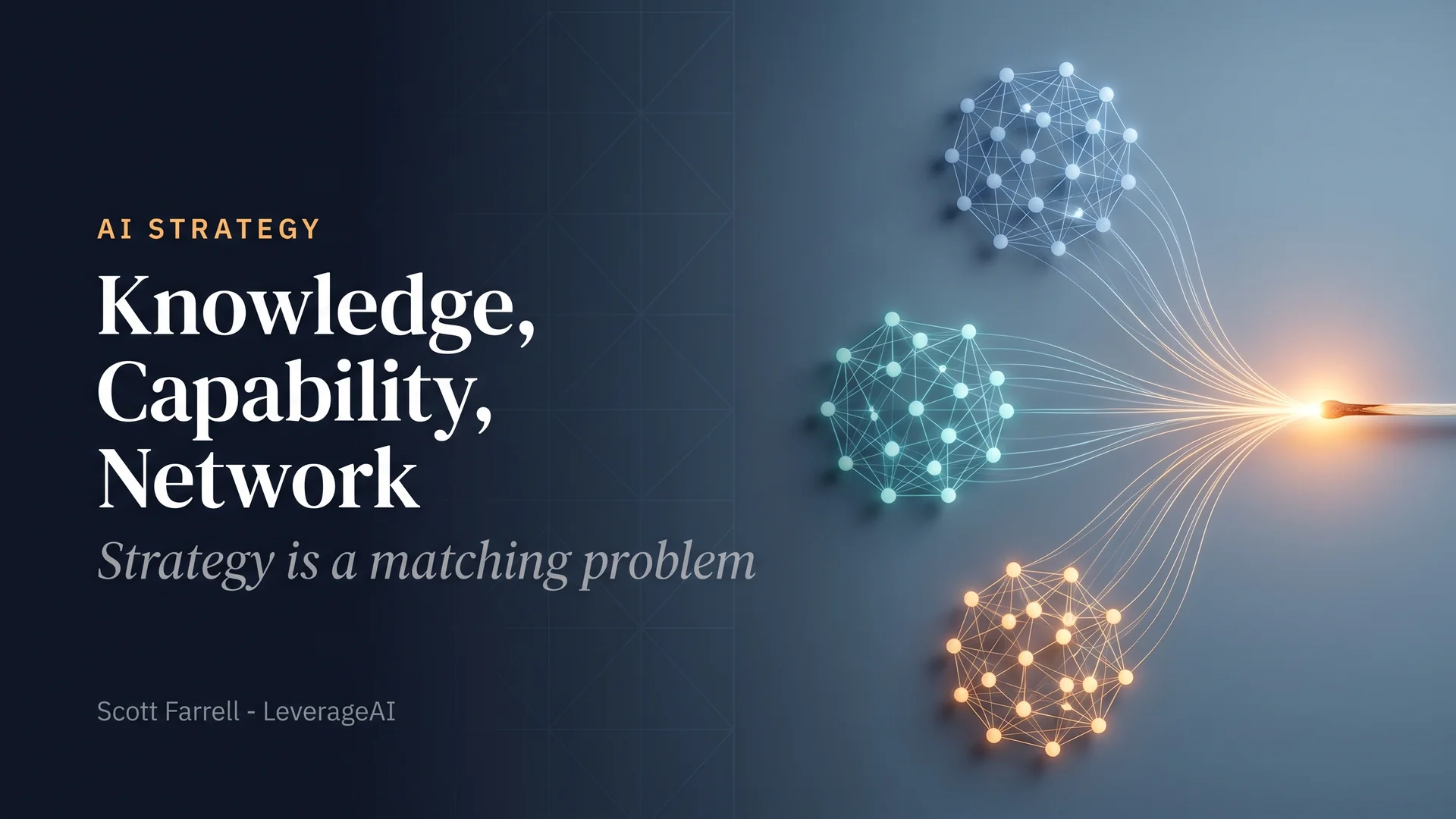
AI Strategy
Knowledge, Capability, Network
Strategy is a matching problem — and until now, your side of the match was never machine-readable.
Scott Farrell · LeverageAI · Australian AI strategy & systems
📚 Read the full field guide
The full field guide — the three-corpus substrate, goal compilation and the North Star, the canon as lens, and the TRIZ case library that makes every run compound. The Strategy Engine →
Here is an experiment worth doing with the most capable AI model you can get your hands on — the long-horizon kind that plans across stages, delegates to sub-agents, and works for hours or days without you.7 Ask it: “How do I make money selling agents?”
Then do the one thing that feels wrong: tell it not to answer. Not yet.
Because whatever it says next will be worthless — not because the model is weak, but because you’ve asked it the wrong kind of question. You’ve asked the best strategist that has ever existed to strategise about a person it knows nothing about. It will give you a competent, plausible, strategy-shaped answer. And it will be the same answer it gives everyone else.
The naked model gives you the distribution’s answer
A model with no access to you can only answer “how do I make money selling agents?” for a generic person. It reaches into the vast distribution of business advice it was trained on and returns the average of it: pick a niche, build a portfolio, post on LinkedIn, productise your service. None of it is wrong. All of it is the mean.
The uncomfortable truth underneath is simple, and it doesn’t get less true as the models get smarter: even the smartest model that ever existed can’t reason from information it doesn’t have. Capability upgrades how well it reasons. It does nothing about what’s in the room. And the thing that was never in the room is you — what you actually believe, what you’ve actually built, and who would actually take your call.
Everyone else asking the same model the same question gets the distribution’s answer. You’d get yours.
This is the ceiling of an idea we’ve written about before — Context Arbitrage, the widening value gap between a frontier model and a compiled context to point it at. At the low end, context arbitrage saves you money on routine agent work. At the high end — strategy — it’s the difference between generic advice and a plan that could only have been written for you.
Strategy is a matching problem
Strip business development back to its mechanism and it stops looking like creativity and starts looking like matching: fitting what you have against what the world currently wants. This isn’t a metaphor. It’s the oldest serious idea in strategy — the resource-based view of the firm, which says durable advantage comes from looking inward at your own resources and capabilities, not just outward at competitors.1,2 Firms differ because their resource mixes differ; the work of strategy is exploiting the mix you actually have.
Here’s the part that has quietly changed. For the entire history of that idea, one half of the match — what you have — lived in your head, your old drives, your inbox, and a folder of half-finished projects. It was never machine-readable. So the matching had to be done by a human, slowly, from memory, which is the weakest instrument any of us owns.
The core
Compile what you have into something an AI can walk, and the goal question changes category. It stops being generation — inventing plausible strategy — and becomes search over your actual option space.
Search over what, exactly? Over the real plays available to you: which theses you hold that the market currently wants, which proofs you already possess that de-risk each play, and which relationships shorten which paths. That’s not a better prompt. It’s a different problem — a solvable one.
The three corpora: the complete input set
Every competent business-development advisor works from exactly three files. No advisor in history has ever had all three compiled, current, and walkable at once. You now can.
Knowledge
What you believe
Your IP — the theses, frameworks, and named doctrine you’ve built up. The lens you see problems through, and the reason your read of a market differs from the consensus.
Capability
What you can prove
Your project history and CV — implementations with dates and receipts. Not what you say you can do; what you’ve shipped. Buyers hire the person at the keyboard, not the person with the deck.
Network
Who you know
Years of email — relationships, warm paths, dormant threads, who owes you a coffee. The corpus everyone assumes is irrelevant, and the one that most often decides the deal.
Knowledge, capability, network. Point a patient, long-horizon model at all three and the earlier question finally has somewhere to land. “How do I make money selling agents?” resolves into concrete matches: this thesis you hold is one the market is paying for right now; this thing you shipped in 2024 de-risks it in a first meeting; this person two threads deep in your inbox runs exactly the kind of business that would buy it.
Take one worked play. Suppose the match is “governed AI for a mid-market insurer.” The knowledge corpus supplies the angle — your view that AI failure is an architecture-and-readiness problem, not a model problem. The capability corpus supplies the proof — the disintermediation architecture you actually delivered in insurance, with a date on it. The network corpus supplies the path — the former colleague now sitting two rungs from that insurer’s executive team. Miss any one corpus and the play collapses: a thesis with no proof is talk, a proof with no path is a cold email, a path with no thesis is a coffee that goes nowhere.
The corpus you’re under-rating is the network
If you’re the technical kind of operator, you rate your knowledge highly, your capability accurately, and your network barely at all. That’s the expensive mistake. Opportunities are capability × relationship — a product, not a sum — and a mediocre idea with a warm path beats a brilliant idea cold.
The numbers on this are not subtle. Warm introductions convert to a first conversation roughly 10–20× more often than cold outreach.3 Referrals are the single highest-converting channel of any, landing around 11–26% where cold sources sit near 0.2–2%.4 Referred deals close at 50–70% against 20–30% for cold ones.5 And when buyers decide who to trust, they lean hardest on people and vendors they already know — Forrester found 82% trust colleagues and 79% trust incumbent vendors.6 A warm intro transfers credibility before the first meeting; the person making it has already done the trust work for you.
The dev wiki knows what you can build. The Gmail wiki knows who’d take the call.— The sleeper input in any goal-oriented run
This is why the “maybe-irrelevant” email corpus is so often the commercially decisive one. Your knowledge tells the model what’s true; your network tells it what’s reachable. Strategy that ignores reachability is just a wish list.
Why not just let the AI decide?
Because strategy hallucination is expensive, and because the market’s own data says the AI isn’t the edge. Teams that adopt AI proposal tooling win no more often on average than teams that don’t — one 2026 analysis found essentially zero correlation between AI adoption and win rate.10 What moves the number is the substrate and the discipline around it: heavily-templated proposals win 15–25% of the time; fully customised ones win 50–65%.9 The tool writes faster. The match wins.
So the machine’s job is not to decide. It’s to propose with receipts. Every play it surfaces should arrive as an evidence package: the belief it rests on, the proof it can wave, and the relationship it would travel through — each with its receipt. A goal-run that can’t cite its way through isn’t strategy; it’s enthusiasm. And the terminal judgment stays exactly where it always sat.
The division of labour
The machine proposes with receipts. You dispose. Your decision authority is the one component in this whole system that was never for rent.
The economics only work because a long-horizon model can afford to do this properly. It holds the goal, dispatches cheap sub-agents to explore each corpus, judges what comes back, and returns proposals — the multi-agent orchestrator-worker pattern that already outperforms single-agent approaches on hard research tasks.8 Frontier agents now sustain coherent work for hours, with the horizon roughly doubling every six months.7 The patient director and the walkable substrate arrived at the same time. That’s why this is a now-problem, not a someday one.
The historian hands its files to the strategist
There’s a quiet symmetry worth naming. Everything in those three corpora is backward-reaching — a record of what you’ve believed, built, and done. The instinct is to treat an archive as memory: something you consult about the past. Point it at a goal and the archive turns around. The historian hands its files to the strategist; institutional memory becomes prospective.
And notice the recursion, because it’s the first exhibit of the whole argument. The question was “how do I make money selling agents?” — and the thing answering it is an agent, running on a compiled worldview, matching your assets against the market. Whatever plays it surfaces, the demonstration was already running. The proof of the idea is the machine producing the answer.
What to actually do
You don’t need three tidy wikis to start. You already own the raw material — years of writing, a drive full of projects, an inbox you can’t search. What changed is that making it walkable is now cheap. Three moves:
- Compile knowledge first. Turn your accumulated thinking into a queryable form — not a pile of documents, but claims and connections a model can navigate. This is the lens everything else gets matched through.
- Make capability provable. Index your project history and CV so “what have I actually shipped in X?” returns receipts with dates — the proofs that de-risk a play in a first meeting.
- Don’t skip the network. The email corpus feels like noise and is usually the decider. Compile it, and ask the goal question against all three at once.
Then ask your big question — and this time, let it answer. Not because the model got smarter, but because for the first time your side of the match is in the room. The distribution’s answer is available to everyone. Yours is available only to you.
References
- [1]Barney, J. B. “Firm Resources and Sustained Competitive Advantage.” Journal of Management 17 (1991), 99–120. — Advantage comes from looking internally at a firm’s own resources rather than only at competitors. en.wikipedia.org/wiki/Resource-based_view
- [2]Wernerfelt, B. “A Resource-Based View of the Firm.” Strategic Management Journal 5(2) (1984), 171–180. — Firms are bundles of resources; heterogeneous resource mixes are the source of differing strategies. en.wikipedia.org/wiki/Resource-based_view
- [3]Gasimo. “Warm Intro vs Cold Outreach: What the Data Actually Says.” — “Warm introductions convert to a first conversation roughly 10–20× more often than cold outreach.” gasimo.org/warm-intro-vs-cold-outreach-what-the-data-actually-says
- [4]Landbase / Marketo. “35 B2B Sales Statistics 2026.” — Referral leads are the highest-converting channel (~11–26%) versus 0.2–2% for cold sources. landbase.com/blog/b2b-sales-statistics
- [5]Launch Leads. “Warm Intros & Referrals for B2B Sales 2026.” — “Referred Lead Close Rate … 50–70% (vs. 20–30% for cold leads).” launchleads.com/lead-generation-strategies/warm-intros-referrals
- [6]SalesHive, citing Forrester B2B trust research. — “82% of buyers trust coworkers and management as information sources, and 79% trust vendors they already work with.” saleshive.com/blog/b2b-trends-client-relationships-trust-building
- [7]METR. “Task-Completion Time Horizons of Frontier AI Models” (2026); Prosus, “State of AI Agents 2026.” — Frontier agents sustain autonomous work for ~5 hours, with a task-length doubling time of roughly 196 days. metr.org/time-horizons
- [8]Anthropic. “How we built our multi-agent research system.” — An orchestrator-worker architecture where a lead agent coordinates and delegates to parallel sub-agents; +90.2% over single-agent on internal evaluations. anthropic.com/engineering/multi-agent-research-system
- [9]Cobl.ai. “Sales Proposal Statistics: What Actually Closes Deals.” — “Heavily-templated proposals have win rates ranging from 15% to 25% while fully-customized proposals reach win rates up to 65%.” cobl.ai/blog/sales-proposal-statistics-what-actually-closes-deals
- [10]AutoRFP.ai. “RFP Statistics 2026.” — “65% of top-performing teams use AI proposal technology, but AI alone shows no independent correlation with wins … Spearman correlation between AI adoption and win rate = 0.00 (p = 0.98).” autorfp.ai/blog/rfp-statistics
Frameworks referenced (Context Arbitrage; Proposal Compiler / Marketplace of One; The Scout and the Senior; The Wiki Is the Kernel) are the author’s own work, published at leverageai.com.au. Statistics are drawn from independent external sources only. Production observations are described as observations, not benchmarked results.
Discover more from Leverage AI for your business
Subscribe to get the latest posts sent to your email.