AI & Cognition · Augmentation
The Model Release That Upgraded My Brain
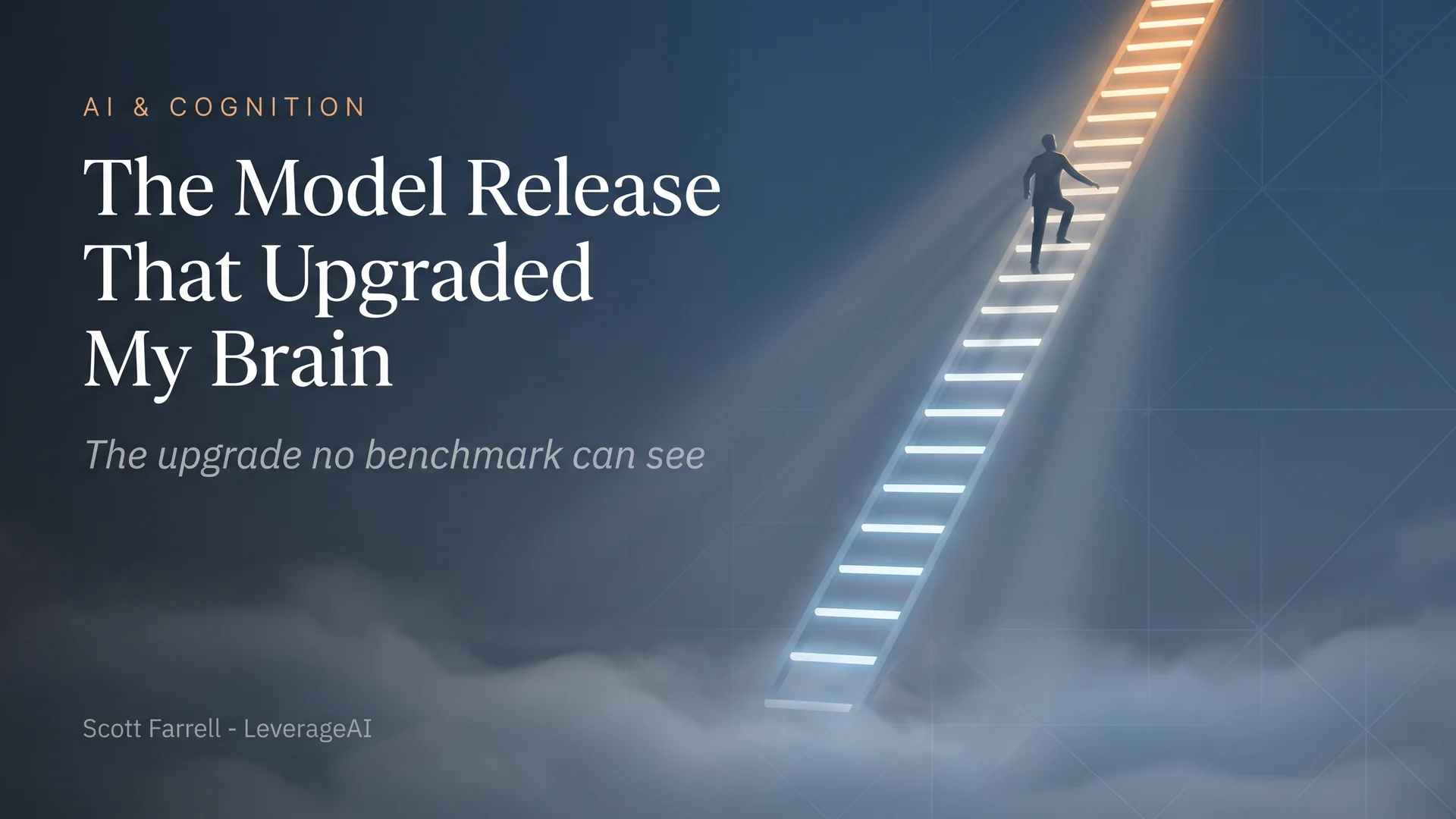
A frontier release upgrades three things at once, and everyone measures only two: the software and the artifacts. The third upgrade lands in the user — through the friction of output too dense to skim. Same model, opposite gradients: delegate your thinking and you atrophy; spar with something above your weight and you strengthen.
📚 Read the full field guide
The full field guide: the read-back training loop, the Matthew effect of augmented cognition, and the interface answer — provide the ladder, never lower the ceiling. The Upgraded User →
The argument
A new model got harder for me to read. Its recommendations made me stop and think; its vocabulary sent me off to verify terms; I caught myself saying “just explain number one to me.” The instinct is to file that as a UX regression. It’s the opposite. Effortful comprehension is where learning lives — and a more-capable partner at your exact frontier was, until now, the scarcest resource on earth. The frontier just made it subscribable. Whether that upgrade strengthens you or hollows you out isn’t a property of the model. It’s your posture.
The new model made my own outputs harder to read, and it took me a few days to understand that this was the best thing it had done to me. I’d ask it to review something and come back with three recommendations, and I’d look at the first one and think: what is it even saying? Not because it was badly written. Because it was dense — a complicated point compressed into a short run of words — and I had to stop and spin my own cogs harder to unpack it. Sometimes I just typed back, explain number one to me. I don’t get it. I have never had to do that before, in any model, in two years of using them to write and to code.
Here’s the claim I want to defend, because it sounds like hype and isn’t: you’d assume a frontier release upgrades the software, and maybe the writing. I think it directly upgraded my brain. You wouldn’t expect that to be possible — that a model someone ships can measurably change the person using it. It is possible, there’s a name for the mechanism, and it comes with a warning label most people are reading upside down.
Three upgrades, and the two everyone measures
A frontier release upgrades three things at once. The first is the software — the model itself, which is what the benchmarks measure, and 2025–2026 has been a run of them clearing bars that stood for years.11 The second is the artifacts — the code it writes, the prose it drafts, the outputs you keep. Everyone measures those two, obsessively, because they’re visible and they sit still long enough to score.
The third upgrade is the user. For anyone standing in the right posture, a denser model raises the level they operate at — through the same three properties that make it harder to skim: density that demands re-reading, vocabulary that demands verification, and recommendations that demand genuine thought to even parse. And that third upgrade is invisible to every benchmark on earth, for a simple reason: it doesn’t happen in the machine. It happens outside it, days later, in a person. There is no eval for “the reader is now smarter than they were on Tuesday.”
Which is why the tell for the third upgrade is friction, and why almost everyone misreads it. Two years of models writing below my level trained me to skim — and the skim never taught me anything. A model that finally writes at or above my level breaks the skim reflex and forces the re-read. It feels like the product got worse. It’s the product finally getting good enough to teach.
The friction is the feature
Learning science has a name for effort that feels like an obstacle and is actually the mechanism: desirable difficulty. Robert and Elizabeth Bjork spent decades showing that comprehension which costs effort encodes far more durably than comprehension that comes easy. Their own framing is that good learning means “making things hard on yourself, but in a good way.”1 The label is deliberate: they’re desirable because they enhance long-term retention and transfer; they’re difficulties because, as Bjork puts it, they “slow down the rate your own performance is improving.”2
That last point is the one that dissolves my confusion about the model. Bjork and Soderstrom draw the distinction that anchors the whole field: performance and learning are not the same thing. Performance is what you can do during instruction; learning is the durable change that persists and transfers — and “the problem is that performance is visible and learning is not.”3 A model that writes below you optimises your performance in the moment: everything reads smoothly, nothing snags, you feel fast. It teaches you nothing, precisely because nothing was hard. A model that writes just above you tanks your in-the-moment fluency — you re-read, you look things up, you feel slow — and that discomfort is the learning happening where you can’t see it.
The reason this works is even older. Vygotsky called the sweet spot the zone of proximal development: the gap between what you can do alone and what you can do “under adult guidance or in collaboration with more capable peers.”4 You grow when you work just past your unaided ceiling, in the company of something more capable than you. His sharper line: “the only ‘good learning’ is that which is in advance of development.”5
Now hold those two ideas next to what actually shipped. For your entire life, the supply of “a more capable partner, on demand, in your own domain, at your exact frontier” was the scarcest resource on the planet. A great mentor, a formidable colleague — a few hours a month, if you were lucky and well-connected. What a frontier release does is make that resource subscribable, with its difficulty setting ratcheting up every time the model does. “What the hell is it even saying — explain number one to me” is not a UX failure. It is the exact texture of studying under someone better than you. The re-read is where the growth is.
The model raised its level, and I’m reporting muscle soreness. That’s not a side effect. For the right posture, that’s the product.
Vocabulary is compression, and it raises your ceiling
The least mystical part of this — and maybe the deepest — is the vocabulary. Every term the model has made me chase down this week, I’ve watched myself re-deploy correctly within hours. That’s not confusion resolving; that’s acquisition. And each acquired term is a compression handle: a word that packages a whole structure so you can manipulate it as a single unit.
Cognitive science has measured this since the 1950s. George Miller found that working memory is limited not in raw information but in chunks — and a chunk is “the largest meaningful unit in the presented material that the person recognizes.”6 Chase and Simon then showed the difference between a novice and an expert is largely that the expert holds bigger chunks: a chess master glances at a board and stores whole configurations where a beginner sees individual pieces.7 A named concept is a bigger chunk. Once “zone of proximal development” is one handle in your head, it costs one slot instead of a paragraph — so a denser lexicon literally raises the effective capacity of your own working memory. The partner introduces the handle, you verify it externally, and a structure that used to cost you a paragraph now costs a token. That is the machinery of getting smarter, running in plain sight, one verified word at a time.
This is worth being precise about, because it’s easy to overclaim. I’m not invoking the discredited strong form of linguistic determinism — language doesn’t imprison thought. The defensible, measured claim is the chunking one: naming a structure makes it a manipulable object, and people reason faster over objects they have names for. Everything I’m describing here I’m reporting as a first-person observation, not a lab result. No study has measured a specific model making a specific person smarter. What the science establishes is the mechanism — desirable difficulty, the ZPD, chunking — and the mechanism is exactly the one the friction is delivering.
Same model, opposite gradients
Now the warning label, because the dominant story about AI and your brain runs the other way — and it isn’t wrong, it’s half the picture. The standing fear is that AI flattens its users: cognitive offloading, the calculator effect, everyone’s thinking regressing to the model’s mean. That fear has real evidence. Sparrow, Liu and Wegner named the Google effect back in 2011: when we expect future access to information, “we have lower rates of recall of the information itself and enhanced recall instead for where to access it.”8 The internet became a form of external memory, and we offloaded onto it.
The AI-specific version has arrived, and it’s pointed. A 2025 study in Societies found that cognitive offloading “significantly mediates the relationship between AI usage and critical thinking,” with one participant putting the fear in plain words: “The more I use AI, the less I feel the need to problem-solve on my own. It’s like I’m losing my ability to think critically.”9 A larger study from Microsoft Research and Carnegie Mellon, presented at CHI 2025, found the crucial fork: “higher confidence in GenAI is associated with less critical thinking, while higher self-confidence is associated with more critical thinking.”10
Read that fork carefully, because it is the whole game. The atrophy is real — but it’s a posture, not a property of the technology. Delegate your thinking and you atrophy; spar with something above your weight and you strengthen. Same model, opposite gradients. The difference is entirely whether the human stays in the loop as a reader who has to keep up, or exits as a consumer who need not. The person who says “just write the email” and ships it unread gets the atrophy. The person who reads the dense answer, re-reads it, chases the term, and comes back sharper gets the upgrade. The tool is identical. The gradient is opposite.
Key Insight
The anti-atrophy property is the human gate. A model can’t decide whether it strengthens you or carries you — that’s set by whether you stay in the loop as someone who has to comprehend the output. Which means the single most consequential lever on what AI does to your mind isn’t the model. It’s your posture toward it.
Consumer posture → atrophy
“Write this email for me.” Ship it unread. Ask for the answer, take the answer, move on. Confidence in the tool rises; the effort of thinking falls.
The friction gets designed away — “dumb it down” — and with it the difficulty that was doing the teaching. You keep the artifact and lose the adaptation. Over enough reps, the muscle you stopped using is the one you’ll need when the stakes are real.10
Sparring posture → strengthen
Read the dense answer. Re-read the part that snagged. Chase the unfamiliar term and verify it outside the chat. Ask “explain number one” — then redeploy the term yourself by Wednesday.
You can’t run the work — judge the output, steer the next turn — without actually comprehending it. The architecture that keeps you in the loop is the architecture that keeps you learning. The soreness is the signal that it worked.
Not an exoskeleton — a training partner
I’ve written before about the cognitive exoskeleton — the idea that AI saturates the pre-work and side-work around a high-stakes human moment, so you arrive fully loaded rather than overwhelmed. The metaphor was deliberate: an exoskeleton amplifies the wearer; it does not replace them. I need to sharpen it, because on its own it undersells what just happened. An exoskeleton carries the load for you; your muscles idle inside it. Take it off and you’re exactly as strong as before — not one rep stronger. If augmentation were only an exoskeleton, the atrophy crowd would be simply right.
What a denser model adds on top is closer to training with a stronger partner: resistance calibrated just past your current strength, and the adaptation happening in you. You don’t just leave the session having lifted more this once. You leave it slightly stronger for every session after — including the ones without the partner. That’s the difference between a machine that carries you and a machine that trains you, and it maps precisely onto the ZPD: growth happens because the resistance sat just past your unaided ceiling.
This also amends an argument I made earlier, in a piece called The Boring Release. There I argued that the release worth waiting for was never the frontier launch at all — it was the quiet collapse in the price of comprehension, a dividend that lands bottom-first on the reading, ingestion and artifact layers, while “a frontier improvement only sharpens the single terminal pass.” I stand by the economics. But that framing measured the software and the artifacts and stopped there. It missed a third upgrade it structurally couldn’t price — the one that happens outside the machine, days later, in the user. The frontier release didn’t just sharpen the terminal pass. It sharpened the person holding it.
The upgrade lands on the read-back
One honest boundary, and a pointer to where this goes next. The third upgrade doesn’t fully land in the conversation — the conversation is where the insight is born, fast and fragile. It consolidates later, when you read the elaborated version back: the model takes the compressed idea, stretches it into arguments and examples and reasons-why, and hands it back to you days later, and you think “wow, that really was a good idea.” That read-back is the human half of the loop — the encoding and the spaced repetition that turn a fast insight into something you own. It’s a mechanism worth its own treatment, and it has one in the ebook this article opens.
But the fork stays the point. A frontier release is not just a better tool; for the right posture it’s a standing invitation to work just past your own edge, delivered as friction and priced into your monthly bill. Most people will file the friction as a defect and ask for it to be smoothed away. Don’t. The density that makes you re-read, the vocabulary that makes you verify, the recommendation that makes you stop and think — that’s not the model being difficult. That’s the model, for once, being a good enough teacher to be worth the effort. The soreness is the product. Keep the read.
References
- [1]Elizabeth L. Bjork & Robert A. Bjork. “Making Things Hard on Yourself, But in a Good Way: Creating Desirable Difficulties to Enhance Learning” (2011); and “Introducing Desirable Difficulties Into Practice and Instruction.” — “making things hard on yourself, but in a good way.” unh.edu/teaching-learning-resource-hub — itow-introducing-desirable-difficulties-into-practice-and-instruction-bjork-and-bjork.pdf
- [2]Robert Bjork. “Desirable Difficulties: Slowing Down Learning” (video, verbatim transcript). — desirable difficulties “enhance long-term retention and transfer,” and “slow down the rate your own performance is improving as a student.” youtube.com/watch?v=gtmMMR7SJKw
- [3]Robert Bjork & Nicholas Soderstrom (2015), as summarised in “Robert Bjork: A Teacher’s Guide to Desirable Difficulties.” — “performance and learning are not the same thing … performance is visible and learning is not.” structural-learning.com/post/robert-bjork-teachers-guide-desirable
- [4]Lev Vygotsky. Mind in Society (1978). — the zone of proximal development: “the distance between the actual development level as determined by independent problem solving and the level of potential development as determined through problem solving under adult guidance or in collaboration with more capable peers.” files.eric.ed.gov/fulltext/EJ1081990.pdf
- [5]Lev Vygotsky. Mind in Society (excerpts). — “The only ‘good learning’ is that which is in advance of development.” academicliteracy.files.wordpress.com/2018/06/exerpts-from-vygotskys-mind-and-society.pdf
- [6]George A. Miller. “The Magical Number Seven, Plus or Minus Two.” Psychological Review, 63(2), 81–97 (1956). — memory span is limited in chunks, not bits; a chunk is “the largest meaningful unit in the presented material that the person recognizes.” en.wikipedia.org/wiki/The_Magical_Number_Seven,_Plus_or_Minus_Two
- [7]William G. Chase & Herbert A. Simon. “Perception in Chess.” Cognitive Psychology (1973). — experts recall bigger and more chunks than novices, having stored a large number of patterns in long-term memory. cognitivearchaeologyblog.wordpress.com — 1996-gobet.pdf (Gobet & Simon, on Chase & Simon 1973)
- [8]Betsy Sparrow, Jenny Liu & Daniel M. Wegner. “Google Effects on Memory: Cognitive Consequences of Having Information at Our Fingertips.” Science, 333(6043), 776–778 (2011). — when people expect future access to information, “they have lower rates of recall of the information itself and enhanced recall instead for where to access it.” pubmed.ncbi.nlm.nih.gov/21764755
- [9]Michael Gerlich. “AI Tools in Society: Impacts on Cognitive Offloading and the Future of Critical Thinking.” Societies, 15(1), 6 (2025). — cognitive offloading “significantly mediates the relationship between AI usage and critical thinking”; participant (p.20): “The more I use AI, the less I feel the need to problem-solve on my own. It’s like I’m losing my ability to think critically.” mdpi.com/2075-4698/15/1/6
- [10]Hao-Ping (Hank) Lee, Advait Sarkar, Lev Tankelevitch, et al. “The Impact of Generative AI on Critical Thinking.” Proceedings of CHI 2025 (Microsoft Research + Carnegie Mellon). — “higher confidence in GenAI is associated with less critical thinking, while higher self-confidence is associated with more critical thinking.” microsoft.com/en-us/research/publication/the-impact-of-generative-ai-on-critical-thinking
- [11]Stanford Institute for Human-Centered AI, 2026 AI Index; IEEE Spectrum, “12 Graphs That Explain the State of AI in 2026.” — frontier models in 2025–2026 meeting or exceeding human baselines on several hard reasoning and mathematics benchmarks (general-phenomenon context; no claim attached to any specific release). hai.stanford.edu/ai-index · spectrum.ieee.org/state-of-ai-index-2026
- [12]LeverageAI (Scott Farrell). The author’s prior frameworks named and sharpened here: the Cognitive Exoskeleton (“an exoskeleton amplifies the wearer; it does not replace them”) — leverageai.com.au/maximising-ai-cognition-and-ai-value-creation ; and The Boring Release Is the Revolution (the comprehension-price collapse; “a frontier improvement only sharpens the single terminal pass”) — leverageai.com.au/context-arbitrage-turn-intelligence-from-opex-into-capex . This piece adds the third upgrade neither framing measured: the one that lands in the user.
Discover more from Leverage AI for your business
Subscribe to get the latest posts sent to your email.