
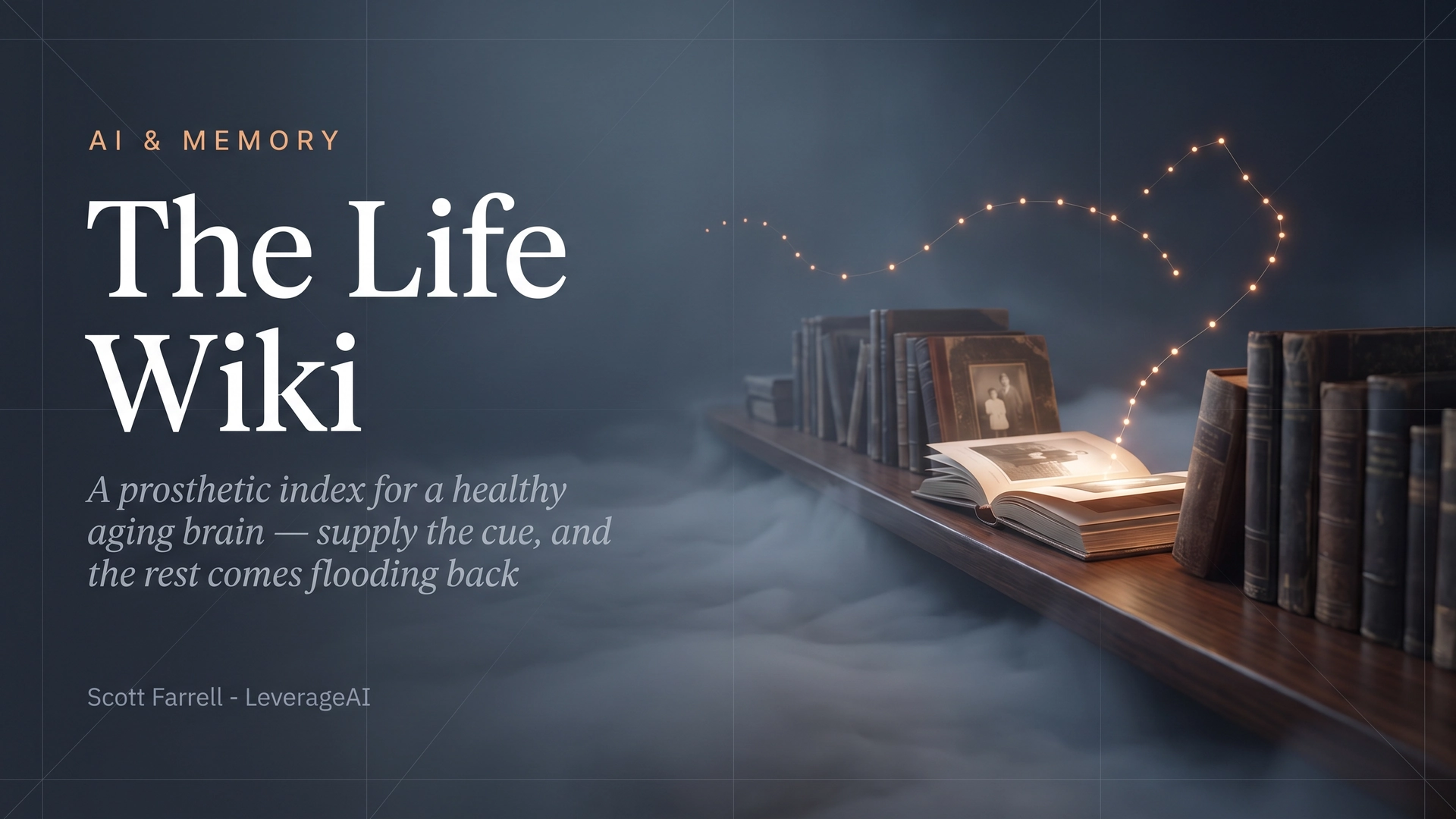
AI · Memory · A Field Note
The Life Wiki: A Prosthetic Index for a Healthy Aging Brain
You reach for an actor’s name and it’s gone. You look it up, and before you’ve finished reading, whole floods of things come back. The memory was never lost — the pointer flaked. Which changes what a memory aid should be: not a machine that remembers for you, but an index that hands you the cue.
The argument
Healthy cognitive aging degrades retrieval far more than storage. Recognition holds up when free recall falters, and one good cue restores not a fact but a lattice — proof the memories are intact and the pointers are flaking. So the prosthetic that matters is an external index over intact-but-unreachable raw sources: it compiles backward over the exhaust of a life (email, documents, photos — which arrive with natural keys already attached), and it surfaces cues, never conclusions. Your own recognition does the remembering. Navigator, not oracle — applied to selfhood.
I’m a fifty-five-year-old bloke, and I’ve already noticed some cognitive slips. Can’t think of a word. Can’t think of an actor’s name. And what I’ve found is that you can Google it, or ask an AI — and then you go oh yeah, yeah, and whole floods of things come back. There’s just this little chink that’s obviously missing now. But when you put the chink back, it reconnects, and you can continue. Experience and wisdom don’t seem to drift. The bigger lessons stay learned. It’s the details that sometimes sit just out of reach.
I want to take that small, familiar, slightly frightening experience seriously — because if you look at what it actually implies, it tells you the entire design of the memory aid worth building. And it turns out I built the first sketch of it years ago, for my mother, before I had the vocabulary to know what it was.
The chink and the flood
Start with what the science of healthy cognitive aging actually says — and let me be careful here, because this is a lane with a hard boundary. Nothing that follows is about dementia, and none of it makes a clinical claim about you or me. It’s about the ordinary, near-universal texture of a brain getting older.
The pattern researchers keep finding is an asymmetry. Meta-analyses of memory and aging converge on the conclusion that there is “a consistent age-related decrement in recall that is disproportionately greater than the age-related decrement in recognition”1 — the decline you feel when you reach for a name is much steeper than the decline in knowing the name when you see it.2 The classic explanation, from Fergus Craik’s work, is environmental support: recognition hands you the item back, so the retrieval work is done for you, while free recall “must be self-initiated by the subject” — and self-initiated retrieval is precisely what gets expensive with age. Age differences shrink, reliably, as the environment supplies more of the retrieval work: free recall shows the biggest gap, cued recall a smaller one, recognition the smallest.3
Two honest cautions before I lean on that. Recognition is relatively preserved, not untouched — careful meta-analytic work shows recognition declines with age too; the asymmetry is real but it is a matter of degree.4 And “chink-then-flood” is my phrase, not the literature’s. But the mechanism underneath it is textbook. The tip-of-the-tongue state — the maddening certainty that you know the word you cannot produce — has been studied specifically in older adults, and the finding is exactly what the flood suggests: it is “not a problem of storage” but of weakened links, because the cues were effective in restoring the missing word.5 The knowledge is there. The access path is what flakes. Meanwhile the deep stuff — vocabulary, judgment, accumulated domain knowledge, what psychologists call crystallized ability — doesn’t just survive aging; on population averages it keeps rising into the seventh decade.6
Aging degrades retrieval far more than storage. Recognition survives when recall fails. The memories aren’t gone — the pointers are flaking.
That’s the reassurance hiding inside the small daily blanks. When one Google search brings back not just the actor’s name but the film, the year, the person you watched it with — that flood is evidence. Evidence that the storage is intact, the lattice is intact, and the only thing that failed was a pointer. You didn’t lose the memory. You lost the way in.
Supply the cue — the design consequence
Cognitive psychology has known for fifty years what makes a way in. Tulving and Thomson’s encoding specificity principle says that a retrieval cue works to the extent that it matches what was stored with the original experience7 — the song from the party retrieves the party. Cued recall beats free recall; the right fragment of context reopens a memory that direct effort couldn’t reach. The whole apparatus of remembering, in other words, is cue-driven — and the part of the system that ages worst is the part that generates cues internally.
Follow that to its conclusion and you get a design, and the design is not the one the market keeps building. If storage survives and self-initiated retrieval is what degrades, then the memory aid that matters is not a machine that remembers for you and recites the answer. It is an external index over intact-but-unreachable raw sources — something that does the one thing your brain is losing (finding the pointer) and then hands control straight back to the thing your brain is keeping (recognition). Supply the cue. Let the person’s own recognition machinery do the remembering.
I’ve spent the last couple of years, in my professional life, becoming a specialist in exactly this shape of system: compiled wiki layers over messy corpora, indexes that hold relationships and meaning and point into raw sources rather than replacing them. I’ve written about that doctrine as navigator, not oracle — the system that guides you to the evidence rather than pronouncing a verdict — and as witness, not oracle: return the claim with its exhibit and a pointer you can open, never a bare assertion you must trust. It only recently hit me, with some force, what those doctrines are for when you point them at a person. The prosthetic I’ll want at eighty-five is the technology I’m building at fifty-five. The index is the data; the cue is the memory.
MemoryMate, re-read with today’s eyes
Years ago, when I was looking after my mum, I built a memory aid. I called it MemoryMate — or something equally unglamorous. The idea: a device on the table listens to the conversation and transcribes it in real time, tries to work out what memories are in play, and on the far side of the screen it quietly prompts. You start telling somebody about last week — oh yeah, I went to, um… what did I do last week? — and it offers, gently: you went to the zoo with your granddaughter; you saw the lions. And the crucial detail, the thing I got right without knowing why: you don’t necessarily read what it says. You glance, and — oh yeah. The zoo. And you’re off again, telling it in your own words.
Look at that design with current vocabulary and it’s a wiki system built before I had the word. Transcribe everything — that’s capture. Extract memories — that’s ingestion. Prompt gently on the other side of the screen — that’s retrieval. And its quiet load-bearing choice was that it targeted recognition, not recall. It never asked my mum to remember. It never quizzed her, never corrected her, never recited her own week back at her as a fact she had to accept. It supplied the cue and let the intact recognition machinery fire.
I now know that this is what good practice does by hand. Reminiscence work with older adults is built exactly on prompted recollection — “using prompts such as photographs, music or personal artefacts” to help people recall, organise and share their own life events — and it is associated with gains in mood, self-esteem and wellbeing, including in studies with healthy older adults.8,9 External memory aids — most commonly the humble memory book of photos with captions — are an established, formally recommended compensation practice.10 (Much of the strongest clinical-outcomes research sits in dementia care, which is not this article’s claim or lane — I cite the practice only for its design principle, which is the same one: the cue triggers the person’s own recollection; nobody recites a life at its owner.) MemoryMate was a machine for doing that by software. What it lacked, in hindsight, were two structural things — and both have just become buildable.
Upgrade one: the wiki compiles backward
MemoryMate’s obvious gap was that it hinged on recordings. It could only know what it had heard since you switched it on. The current wave of AI wearables — the pendants and clips that record everything you say and summarise your day11 — inherit exactly that limit: always-on capture is capture forward, from the day you clip the thing on. Your pre-history — the decades that are precisely what a memory aid is for — is structurally out of reach. (The category is also fragile in a way worth noticing: the best-known memory pendant was acquired in December 2025 and discontinued, its recordings’ fate tied to someone else’s servers.12 A prosthetic memory that dies with a vendor is a strange thing to trust your life to.)
But here’s the thing the pendant framing misses: the pre-history is already recorded. Decades of email. Documents. And — this was the realisation that genuinely stopped me — the photo library. Me and my daughter: every soccer game, every birthday, every Christmas. The pendant recorders can only capture forward from the day you clip them on. The wiki compiles backward: email, documents and photos are the exhaust of a life, and you already own the distillery.
Photos are the exhaust of a life — and you already own the distillery.
Backward compilation is the first structural upgrade, and it’s the one cheap AI comprehension just made real. I’ve written elsewhere about what that repricing means for archives generally — keep the raw layer; the map can always be rebuilt, but only over territory that still exists — and about how even dead-format archives are reachable now, because the adapter can be written on demand. This article isn’t about the salvage mechanics; those pieces are. The point here is narrower and more personal: the corpus a life-wiki needs is not something you have to start capturing. It is sitting on your devices, unindexed, right now.
Upgrade two: photos arrive with natural keys attached
The second upgrade is a gift I didn’t expect. Unstructured archives are usually hard because nothing in them says what belongs with what. The photo corpus is different — almost unfairly so — because it comes with natural keys attached: EXIF timestamps and GPS coordinates are written automatically into the file by the camera,13 and your phone has already done the face work — Apple’s Photos runs on-device clustering that groups “face and upper body feature vectors that correspond to the people detected in the library.”14 Time, place, person: deterministic join columns, pre-computed, free. I’ve written before about joining soft data on natural keys instead of embedding everything — provenance, not resemblance — and a photo library is that doctrine’s happiest case.
Join on those keys and the natural page type falls out immediately: the event. Christmas 2022 as a page — with claims, who was there, what happened, edges to adjacent events, pointers into the library. The L0 map of a life-wiki is a timeline. Here is roughly what one such page looks like, worked:
An event page, assembled — keys → claims → cue
Keys (deterministic, already computed): 214 photos and 11 videos where EXIF timestamp ∈ Dec 24–26 2022; GPS clusters to two locations (home; the coast house); face clusters resolve to six people — my daughter, my parents, my brother’s family.
Claims (compiled once, by a vision-language model captioning each photo into text15): “Christmas Day lunch outside on the deck”; “daughter in a green dress, opening the bike”; “backyard cricket, late afternoon”; “drive to the coast on Boxing Day.” Each claim carries edges — to the people on it, to Christmas 2021 and Christmas 2023, to the place pages — and a pointer back to the exact photos. The wiki never holds the photos, just the meaning and the way back.
Cue (what the aid actually says, years later): not a recitation — a prompt. “Christmas 2022 — the year of the bike, and backyard cricket on the deck?” And recognition does the rest: oh yeah — and then it rained, and we played inside, and… The flood. The page’s job is one good chink.
Notice what that compiled layer holds that the photo apps structurally can’t. Apple and Google Photos are genuinely good classifiers now, and getting better — but reviewers in 2025 still find the search “isn’t perfect” on even simple attribute queries,16 and users report the new natural-language search drawing blanks beyond keyword-ish lookups.17 That’s not a bug they’ll patch; it’s a category boundary. “Cake” is a classifier query. “Show me happy times with my daughter” is a relationship query — across events, people and years — and it is answerable only where relationships live. The compiled layer holds what the photo app structurally can’t: meaning.
The dignity constraint is architecture
Now the part I care about most, and the reason this design and not another. There is an obvious product to build on top of a life-index, and it is the wrong one: the oracle. “On 25 December 2022 you did the following things.” An answer machine pointed at your own past. Every capability trend pushes toward it, and it fails the only test that matters here — because the moment the aid tells you your life, you stop being the author of your history and become its audience.
The dignity constraint is not a tone-of-voice guideline. It is architecture, and it’s the same architecture the whole essay has been assembling: navigator, not oracle, applied to selfhood. The aid never tells you your life — it surfaces cues, and your own recognition does the remembering, which keeps the person the terminal judgment on their own history. Fill in the gaps; never speak over the flood. In system terms the constraint is checkable: the index stores relationships and pointers, not verdicts; it must show the exhibit (the photo, the thread) rather than assert the conclusion; and the interaction contract is offer candidate cues, then yield. MemoryMate had this property by instinct. The Life Wiki has to keep it by design, because the failure mode — a well-meaning machine gently overwriting a person’s own account of their own life — is the one this whole architecture exists to make impossible.
Fill in the gaps. Never speak over the flood.
And I can offer a live demonstration, because the conversation in which I worked all this out demonstrated it for me. Mid-riff, describing an old Docker project, I hit a blank: “we had the Cloudflare VPN thing — I forget what that’s called. So there you go. Memory gap.” The AI I was talking to didn’t lecture me about my project. It offered two candidate cues — the standard container for that job is gluetun; if it was literally Cloudflare’s, it was WARP — and my own recognition selected, and the rest of the stack came flooding back unprompted. Candidate cues offered; recognition selecting. That exchange is MemoryMate — running in production, right now, on its designer.
What the archive is for
I’m not going to say this will help me when I’m eighty-five and really struggling to put sentences together. But who knows. It might. The honest version of the claim is smaller and still worth building a system for: the same cue-then-recognition machinery that rescues an actor’s name today is the machinery a compiled index can serve for a lifetime — over a corpus that is already sitting there, already keyed, waiting to be understood once. This is the time-shifted proxy family of systems in its most personal form: the constraint was never the data, it was the accessibility. (There’s a sharply practical cousin of this argument — what recognition-over-an-indexed-past does to writing a CV — that deserves its own piece, and will get one.)
But the deepest reason to build it has nothing to do with deficits, and my daughter showed it to me. Driving home from soccer the other night, she was watching a video of herself, little, singing Let It Go at full volume. She used to be embarrassed by that video. Now she’s old enough to see the small person in it as someone else — that’s not really you anymore — and to love her. That’s what the archive is for. Not preserving the past — giving you a livable relationship to it. A life-wiki doesn’t exist so a machine can remember your life. It exists so that you can keep walking back into it — on a good cue, in your own words, for as long as the walking is yours.
So the one thing to do this week is small: go and look at your oldest corpus — the photo library, the ancient mailbox — and notice that it is intact, keyed, and unindexed. The map can be built later. It can only be built over territory that still exists.
References
- [1]Danckert, S. L. & Craik, F. I. M. “Does Aging Affect Recall More Than Recognition Memory?” Psychology and Aging (2013). — “Several analyses of the resulting data converge on the conclusion that there is a consistent age-related decrement in recall that is disproportionately greater than the age-related decrement in recognition.” www.ovid.com/00002004-201312000-00002
- [2]Rhodes, S. et al. “Age-related differences in recall and recognition: a meta-analysis.” Psychonomic Bulletin & Review (2019). — “the age difference in recall is disproportionate to that for recognition and supports theories of memory and aging which posit specific deficits in processes related to retrieval.” link.springer.com/article/10.3758/s13423-019-01649-y
- [3]Craik, F. I. M. & Jennings, J. M. “Human Memory.” In The Handbook of Aging and Cognition. — “recognition tasks should present less of a problem to the older person than recall tasks… In the case of recall, the operations must be ‘self-initiated’ by the subject”; “age differences were greater in free recall than in cued recall.” www.rotman-baycrest.on.ca/files/publicationmodule/@random45f5724eba2f8/_2HumanMemory92_51.pdf
- [4]Fraundorf, S. H. et al. “Aging and recognition memory: A meta-analysis.” Psychological Bulletin (2019). — “we establish that such deficits also exist in recognition” — recognition is relatively preserved, not untouched. pmc.ncbi.nlm.nih.gov/articles/PMC6481640
- [5]“The tip-of-the-tongue phenomenon in older adults with subjective memory complaints.” PLOS ONE (2020). — “the ToT phenomenon in older adults might be not a problem of storage, but may be due to weak links… because the cues were effective in facilitating the retrieval of target nouns.” journals.plos.org/plosone/article?id=10.1371/journal.pone.0239327
- [6]“A strong dependency between changes in fluid and crystallized abilities in human cognitive aging.” PNAS (via PMC). — “Population-average declines are observed across adulthood for fluid abilities, whereas population-average increases are observed through the seventh decade of life for crystallized abilities.” pmc.ncbi.nlm.nih.gov/articles/PMC8809681
- [7]Tulving, E. & Thomson, D. M. Encoding specificity principle (1973), as stated in JEP:HLM (1977). — “Specific encoding operations performed on what is perceived determine what is stored, and what is stored determines what retrieval cues are effective in providing access to what is stored.” www.rotman-baycrest.on.ca/files/publicationmodule/@random45f5724eba2f8/JExptlPsycholHLM77_3_701.pdf
- [8]Nature Index. “Reminiscence Therapy for Enhancing Mental Health in Older Adults.” — “encourages older adults to recall, organise and share personal life events, using prompts such as photographs, music or personal artefacts… shown to bolster mood, self-esteem and social engagement.” www.nature.com/nature-index/topics/l4/reminiscence-therapy-for-enhancing-mental-health-in-older-adults
- [9]Allen, A. P., Doyle, C. & Roche, R. A. P. “The impact of reminiscence on autobiographical memory, cognition and psychological well-being in healthy older adults.” European Journal of Psychology (2020), via MDPI Behavioral Sciences systematic review (2023). www.mdpi.com/2076-328X/13/10/830
- [10]Pearson EBP Brief (summarising Sohlberg et al., 2007). “The Utilization of Internal and External Memory Strategies in Evidence-Based Practice.” — “Memory books: most common. Studies support using external aids to compensate for memory impairments. Using external strategies = Practice Guideline.” www.pearsonassessments.com/content/dam/school/global/clinical/us/assets/ebp-briefs/EBPV14A1.pdf
- [11]Stern, J. “I Recorded Everything I Said for Three Months. AI Has Replaced My Memory.” Wall Street Journal. — “The Bee, Limitless and Plaud wearables record everything you say and use AI to provide summaries, to-do’s.” www.wsj.com/tech/personal-tech/ai-personal-assistant-wearable-tech-impressions-28156b57
- [12]Plaud.ai. “Plaud vs. Limitless: Which is the Better AI Voice Recorder?” — “Limitless was acquired by Meta in December 2025. The Limitless AI Pendant is no longer available for purchase.” www.plaud.ai/blogs/articles/plaud-vs-limitless-which-is-the-better-ai-voice-recorder
- [13]photools.com. “A Friendly Guide to Photo Metadata for Regular People.” — “EXIF — Technical data added automatically by your camera or phone: date taken… GPS — Latitude, longitude, altitude.” www.photools.com/11788/a-friendly-guide-to-photo-metadata-for-regular-people
- [14]Apple Machine Learning Research. “Recognizing People in Photos Through Private On-Device Machine Learning.” — “Photos relies on clustering techniques to form groups, or clusters, of face and upper body feature vectors that correspond to the people detected in the library.” machinelearning.apple.com/research/recognizing-people-photos
- [15]Hugging Face. “Vision Language Models Explained.” — “generative models that take image and text inputs, and generate text outputs… use cases include… image captioning.” huggingface.co/blog/vlms
- [16]PCMag (January 2025). “Apple Photos vs. Google Photos.” — “The AI search in Apple and Google Photos isn’t perfect: Here, I asked for pictures of a friend wearing blue shorts, but white shorts appeared in the results of both.” www.pcmag.com/comparisons/apple-photos-vs-google-photos-which-is-best-for-organizing-and-editing
- [17]Apple Community discussion (November 2025). “Apple Intelligence natural language / semantic search in Photos on Mac.” — “Photos now supposedly supports natural language and semantic search… but these and other even more straightforward searches draw a complete blank.” discussions.apple.com/thread/256196604
Discover more from Leverage AI for your business
Subscribe to get the latest posts sent to your email.