
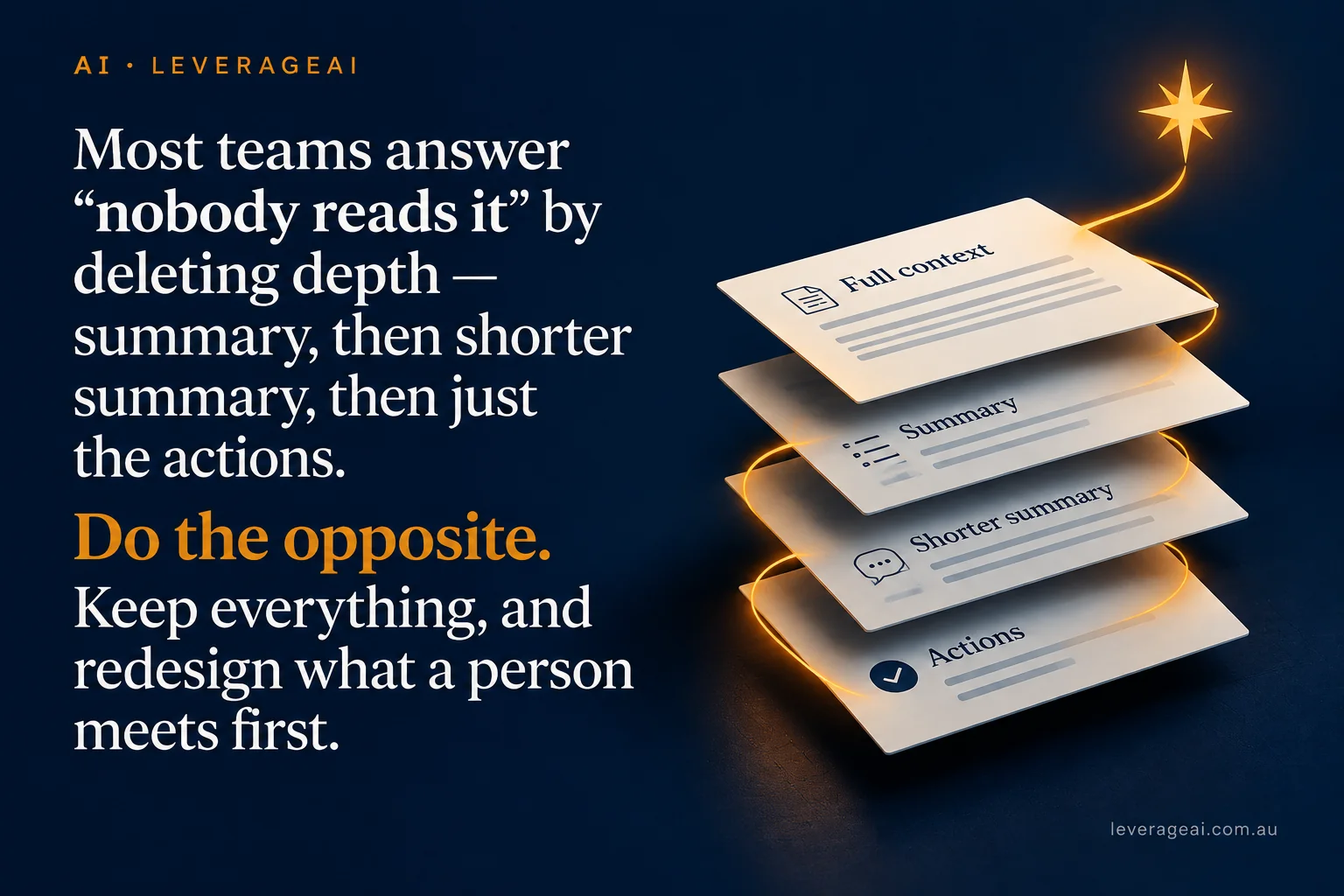
Your AI summaries aren't saving time. They're making your company forget.
It starts reasonably. An hour of discussion goes into the AI. Leadership won't read the transcript, so someone asks for a summary. Still too long. Shorter, please. Then: just give me the actions.
Three hops later you have five bullet points and no idea why any of them exist. The disagreement that shaped the decision is gone. So is the caveat the CFO raised, and the open question nobody resolved. Each round of compression reads cleaner than the last, and drifts further from what was actually said. Prettier isn't more faithful.
The diagnosis was wrong from the start. "Nobody reads it" was never about length. People don't refuse depth. They refuse to pay for it up front. They bounce off the wall of text they meet first. Delete the depth and you haven't cut the cost of understanding. You've made understanding impossible.
So do the opposite. Keep everything, and change what people meet first.
For a meeting, that looks like:
• One recognisable view per subject: the decision, the options, how the pieces relate
• Three exact quotes, attributed, where the real disagreement or commitment happened
• The open questions, marked as open
• One click back to the transcript, the recording at the timestamp, the original whiteboard photo
Five seconds tells you what happened. Thirty seconds tells you where people disagreed. Ten minutes takes you back into the room.
Compression isn't the enemy. A diagram is selective too. The enemy is compression with no route back, where the short version becomes the only surviving account.
And a to-do list extracted from a meeting isn't a commitment. Nobody agreed to it. Keep accepted work, with an owner and a done-condition, in its own view, beside the meeting's knowledge rather than instead of it.
Your AI can now write more than your people will ever read. That doesn't argue for writing less. It argues for designing the front door.
When someone asks why a decision was made six months ago, can your team still find the answer?
Discover more from Leverage AI for your business
Subscribe to get the latest posts sent to your email.