
Your marketing team isn't bad at case studies. You're handing them the wrong facts.
The usual setup: leadership says productise the practice. Marketing interviews the project manager, walks out with five accurate sentences, and writes a page nobody can sell from.
Take a billing project at a mid-size telco. The team didn't rebuild the old rating engine. They put a mediation layer in front of it, ran six weeks in parallel, and made the legacy engine optional. The rewrite the client was bracing for never happened.
The PM's recap: "On-time delivery. Risk mitigated via parallel-run. Stakeholders aligned."
All true. All useless to marketing. The PM kept what a PM needs to keep — schedule, risk, status — and the decision that made this worth buying again fell out. No amount of sharper copy brings it back. By the time sales gets it, it's "we do billing transformation," and the next client staring down a multi-year rewrite hears nothing that speaks to them.
The fix isn't asking AI to polish the recap. That just speeds up the loss.
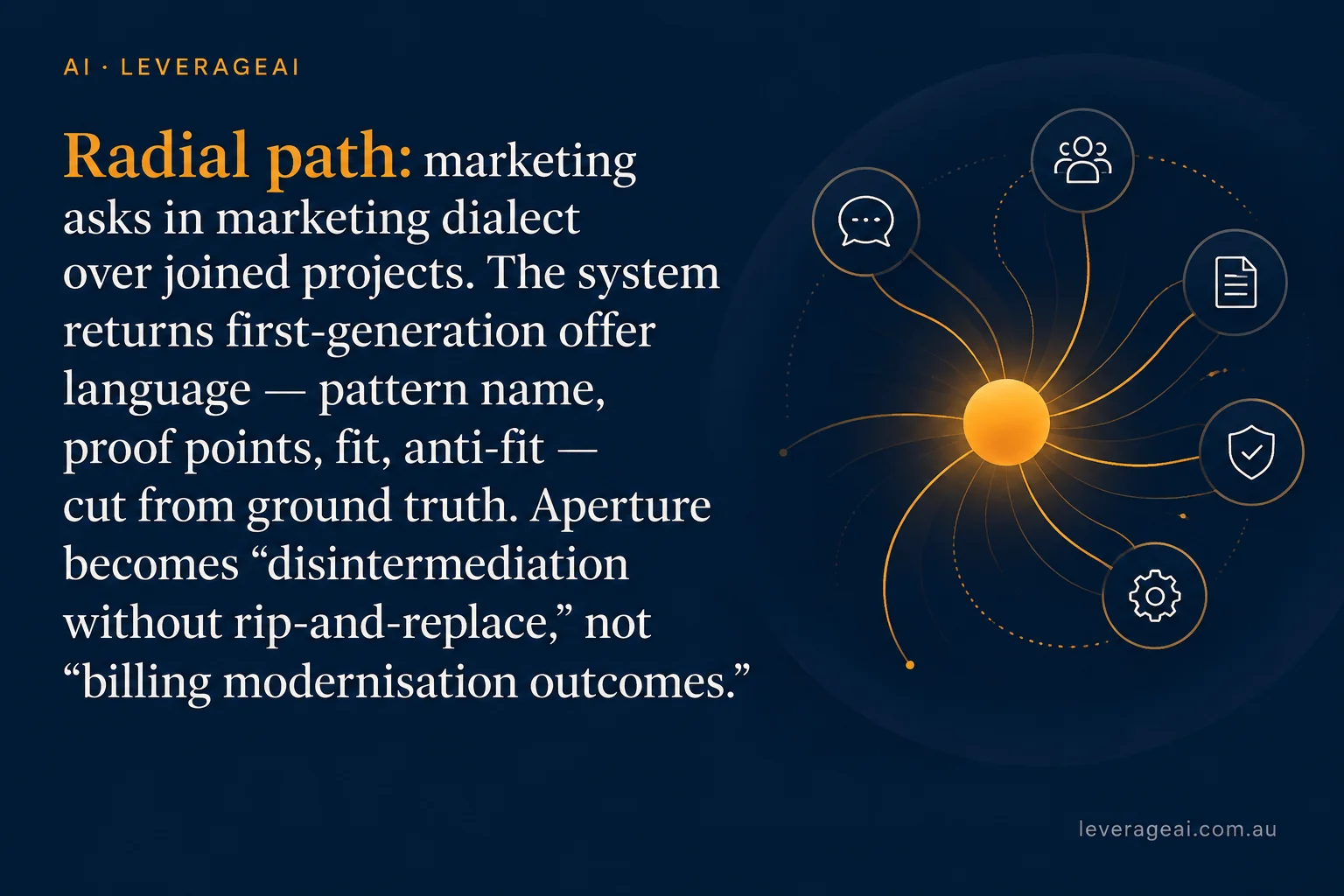
The fix is letting marketing go past the PM entirely. Join the proposal, the decision emails, the tickets and the delivery records, then let marketing ask its own questions in its own language: what did we do instead of the rewrite, and what proves it worked?
What comes back is a first-hand version, not a translation of a translation: "disintermediation without rip-and-replace — mediation first, legacy retirement optional, six-week parallel proof." That's an offer. "Helped a telco modernise billing" is a shrug.
One project doesn't prove the pattern fits every legacy system. But the narrower verdict holds: a PM recap alone cannot support an offer.
So before you send marketing to another interview, ask: who in this chain ever saw the decision that mattered?
Discover more from Leverage AI for your business
Subscribe to get the latest posts sent to your email.