
LeverageAI · Field Guide
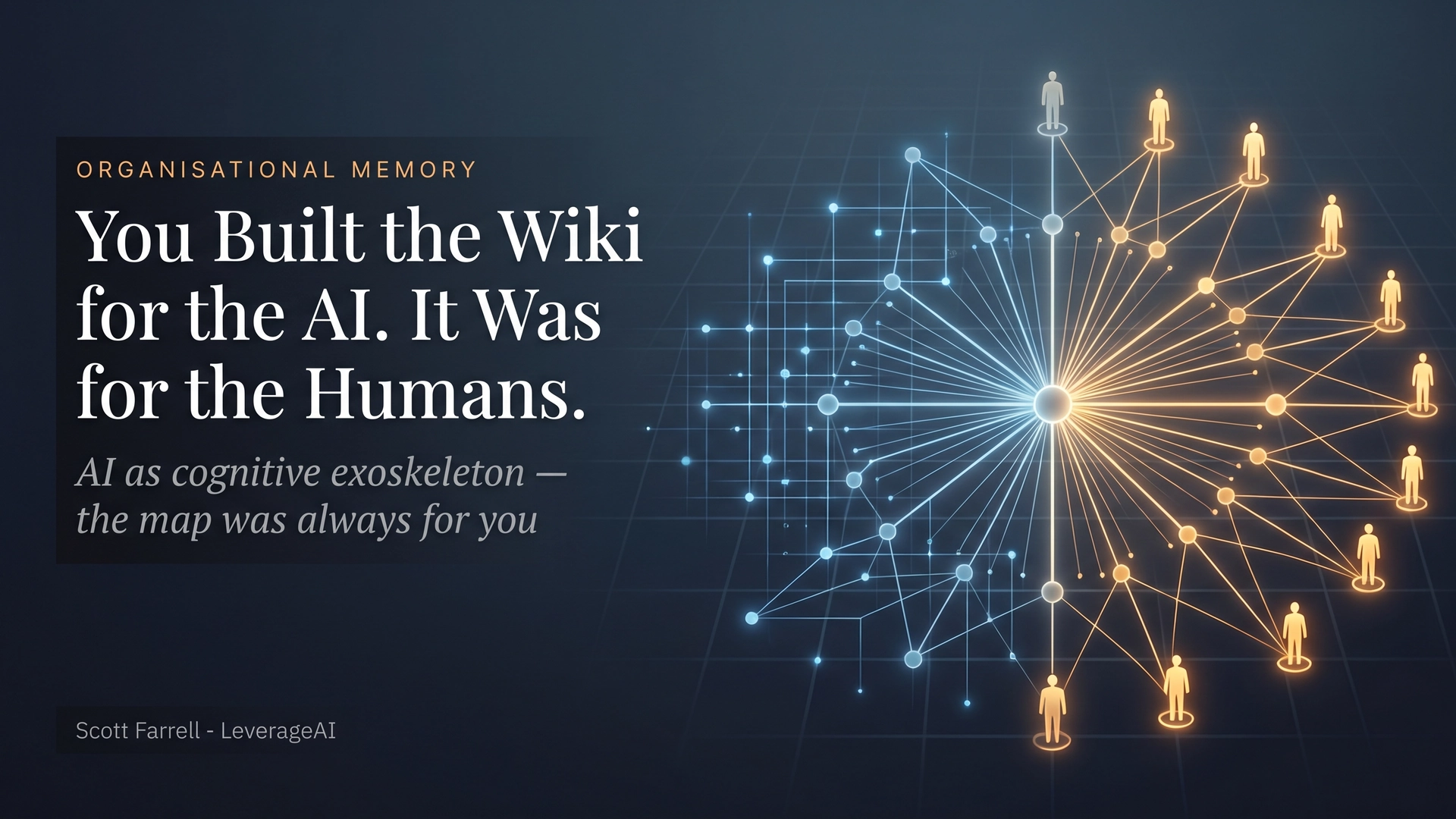
You Built the Wiki for the AI. It Was for the Humans.
The organisational wiki you built so AI could reason over your company turns out to make humans smarter about their own company — one knowledge substrate, three role-shaped cognitive exoskeletons, experts consulted for judgment instead of recall.
Scott Farrell · LeverageAI
📘 Want the complete guide?
Learn more: Read the full eBook here →
I thought the wiki was there to help AI.
Help AI understand the organisation as a map. Then help AI run workflows with grounding truth — receipts policy, deployment approach, whatever you would otherwise hardcode into a prompt that goes stale the day after you write it. That was a good reason to build it. It just was not the main reason.
The main reason walked in when a marketing person stopped booking a series of interviews and, in half an hour of conversation, articulated the repeatable shape of past projects as an offer — not a generic blog post from model priors, but something only that company could publish. The staff member stayed in marketing’s comfort zone. The AI brought ten years of intellectual property into the room. That is not “smarter automation.” That is a person wearing a cognitive exoskeleton loaded with the organisation’s actual muscle memory.
You built the wiki to make AI smarter about the org. The product is making humans smarter about their own org — with AI as the traversal engine.
The three-step ladder
Most teams climb this ladder without noticing the last rung is the prize.
- Grounding truth. Give AI a map of the organisation so answers are about your world, not the internet’s average.
- AI workflows. Let agents look up policies, assemble context, and show receipts instead of freezing facts into prompts.
- Human augmentation. Put the same substrate under ordinary knowledge work — marketing, sales, leadership — so each role walks in better prepared without being replaced.
Rungs one and two are real. Rung three is where the commercial and cultural payoff usually lives. Generic tools help individuals be flexible; they stall in the enterprise when they never learn the organisation’s work.1 The wiki is how the exoskeleton stops running on everyone else’s averages.
The split that does not move
We have written the cognitive exoskeleton pattern before: AI saturates pre-work and side-work; the human keeps the judgment call, the relationship, and the accountability. An exoskeleton amplifies the wearer; it does not replace them. Human judgment remains the load-bearing layer for strategy and taste precisely because models are strong at preparation and weak at standing behind outcomes.2
What changes with the organisational wiki is not that split. What changes is the payload. Without the wiki, the exoskeleton runs on model priors plus whatever context you paste in. With the wiki, it runs on compiled muscle memory — proposals, emails, post-mortems, delivery notes — joined so a conversation can walk them.
Across marketing, sales, and the CEO, the constant is the same:
| Who | Owns | Does not own |
|---|---|---|
| AI | Connection, translation, generalisation from the corpus | Final taste, the client relationship, accountability for the call |
| Human | Taste, relationship, accountability | Being the org’s calendar-bound retrieval layer |
Only the prep morphology changes — the shape of what gets assembled before the human acts.
Do not fork three rival “kernels” for three departments. Use role-shaped entry points into one substrate — task-biased boot profiles, not duplicated doctrine. Same graph; different walk.
Marketing: the Case Library, not the dull page
Input: “We need to productise what we did on the billing modernisation work. What is the offer?”
Wiki walk: Project pages, proposals, delivery notes, the internal email where someone framed the real move (“disintermediation without rip-and-replace”) — the deliberation that never made the client deck.
Role-shaped output: Not a finished webpage. The layer upstream of the webpage: a Case Library articulation — situation shape, move, outcome — in marketing register, grounded in what the company actually did.
That distinction is the whole product. Generic AI, writing from its priors, produces the segment-average page any competitor could publish. Corpus-grounded AI produces company-specific truth. The human still directs taste: what is on-brand, what is fair to claim, what ships. The half-hour conversation replaces the meeting series that used to yield five sentences oversimplified along the wrong dimensions.
When departments speak different languages, the fix is not more meetings; it is first-generation translation from joined ground truth — a topology problem we unpack in a sibling piece.3 Here, the point is simpler: marketing stays in marketing’s chair. The exoskeleton brings the IP.
Sales: client depth × everyone else’s work
Input: “This is my best client. Great relationship. Nothing to sell this month.”
Wiki walk: Ten years of that client’s history plus the capability map of the rest of the firm — projects the salesperson has never touched, solution shapes outside their sphere.
Role-shaped output: Real cross-sell and upsell candidates with receipts, not decorated generics. The relationship stays human. The missing piece was never charm; it was structural blindness to ~199 colleagues’ work.
The same morphology shrinks RFP chaos. Full agentic RFP orchestration is a larger story.4 The exoskeleton-only version is already valuable: one writer holds the narrative thread; the wiki surfaces deployment approach, standard change principles, prior winning language; and even the humble question — “Who was the project manager on Telstra?” — answers in one turn instead of three days of fumbling corporate systems.
Knowledge workers already lose hours every week waiting on colleagues or recreating knowledge that exists somewhere in the building.5 Using experts as the lookup service is not “collaboration.” It is a retrieval architecture with a salary and a calendar.
CEO: a parliament with your failures attached
Input: “Here is an initiative. What will finance say? HR? Marketing? Where does this die?”
Wiki walk: Prior initiatives, margin history, failed projects, post-mortems, hiring constraints, campaign outcomes — company history, not textbook risk language.
Role-shaped output: A multi-angle stress test before the real meeting. The AI Think Tank pattern — structured disagreement across lenses with visible rejection — stops arguing from generic priors and starts arguing from your past.6 The Risk brain does not say “projects like this sometimes fail.” It cites the project that did, with the post-mortem one click away.
Dialect translation may help the CEO least — they have often been the organisation’s human translation layer already. What they lack is a sparring parliament that remembers.
The split-constant table (all three roles)
| Role | Prep morphology (AI assembles) | AI owns | Human keeps |
|---|---|---|---|
| Marketing | Case Library card: situation–move–outcome as an offer articulation | Connection across projects; translation into marketing register; generalisation of reusable shape | Taste, brand judgment, what is fair to claim |
| Sales | Capability join + client history pack; RFP retrieval and expert-finding | Join of corpus capabilities to this account; translation of solution shapes; generalisation of patterns that fit | Relationship, negotiation, commitment |
| CEO | Parliament brief: finance / HR / marketing / risk angles with internal receipts | Connection across history; translation across lenses; generalisation of shape-of-failure | Decision, political capital, accountability |
Same constant. Different prep. That is the productisation story: one wiki, many exoskeletons.
Stop using experts as your RAG system
“Hey Terry, can you write the change management chapter?” sounds like teamwork. Structurally it is a retrieval query addressed to a human.
The organisation has been using its experts as a slow, calendar-bound, lossy retrieval layer. Results do not compose — you get a Frankenstein RFP nobody wants to reread — and the expert’s scarce resource was never their ability to remember the standard change principles. It was judgment and novelty: what is different this time, what to refuse, where the template lies.
When the wiki answers retrieval, experts get consulted for the work they were hired for. AI as a tool for thought is about depth, not merely speed theatre.7 Depth is what happens when Terry is asked “does this change approach still hold for a regulated client with a hostile union history?” instead of “please paste the usual chapter by Thursday.”
Double-click provenance: dignity and audit, one architecture
Trust at organisation scale is not a vibe. It is a click path.
- The answer in the conversation states a claim.
- You click into the wiki page that holds the claim and its edges.
- You click through to the bronze artifact — the actual email, the actual proposal, the actual post-mortem.
That is the same dignity constraint that works at personal scale: show the exhibit, not the verdict. At enterprise scale it becomes auditability. The person whose pivot was recorded in a 2009 internal email gets attribution with a timestamp. The risk committee gets a resolvable pointer, not a model hallucination in a suit.
The AI never asks to be believed. It shows receipts down a provenance chain. The human stays terminal judgment.
Claim: “We solved telco billing risk with mediation-first modernisation, not a rip-and-replace.” → Wiki: Case page with situation–move–outcome → Bronze: internal email framing the disintermediation pivot + client proposal PDF. Two clicks. No faith required.
What to do Monday
- Name the ladder stage you are on. Still building grounding? Still wiring workflows? Or ready to put role-shaped prep in front of humans?
- Pick one role morphology. Marketing Case Library is usually the fastest demo. Sales capability join is the fastest revenue story. CEO parliament is the fastest executive convert.
- Write the split on the wall. AI: connection, translation, generalisation. Human: taste, relationship, accountability. Refuse any design that moves accountability to the model.
- Retire one “hey Terry” retrieval. Replace it with a wiki walk plus a judgment question for Terry.
- Require double-click. No claim in a decision pack without a path to bronze.
The managerial gap that stalls AI programmes is not usually model quality.8 It is failing to redesign who does preparation, who does judgment, and what substrate both stand on.
You may have built the wiki because the agents needed a map. Keep that. Just do not miss the reveal: the map was always going to fit a human better than it fit a bot. The bot is the legs. The human is still the person who walks into the room.
References
- [1]Fortune (reporting MIT research). “AI-augmented learners and organizational learning.” — Generic tools excel for individuals but stall in enterprise use when they don’t learn from or adapt to workflows. https://fortune.com/2024/12/06/ai-augmented-learners-organizational-learning/
- [2]Harvard Business School. “AI won’t make the call: Why human judgment still drives innovation.” — Human experience and judgment remain critical for distinguishing good ideas and guiding long-term strategy. https://www.hbs.edu/bigs/artificial-intelligence-human-jugment-drives-innovation
- [3]Scott Farrell, LeverageAI. “Your Company Speaks Five Languages — and Nobody’s Translating.” — Serial telephone vs radial first-generation dialect translation from joined ground truth. https://leverageai.com.au/your-company-speaks-five-languages-and-nobodys-translating/
- [4]Scott Farrell, LeverageAI. “The Intelligent RFP: Proposals That Show Their Work.” — Knowledge evaporation and proposals that carry receipts. https://leverageai.com.au/the-intelligent-rfp-proposals-that-show-their-work/
- [5]Panopto. “Workplace Knowledge and Productivity Report” (via PR Newswire). — Knowledge workers lose 5.3 hours/week waiting for colleague knowledge or recreating existing knowledge; 42% of institutional knowledge unique to individuals. https://www.prnewswire.com/news-releases/inefficient-knowledge-sharing-costs-large-businesses-47-million-per-year-300681971.html
- [6]Scott Farrell, LeverageAI. “The AI Think Tank Revolution.” — Multi-lens deliberation with visible rejection; company-specific discovery. https://leverageai.com.au/the-ai-think-tank-revolution-why-95-of-ai-pilots-fail-and-how-to-fix-it/
- [7]Microsoft Research. “Rethinking AI in Knowledge Work: From Assistant to Tool for Thought.” — Tool-for-thought framing emphasises depth, not only speed. https://www.microsoft.com/en-us/research/articles/rethinking-ai-in-knowledge-work-from-assistant-to-tool-for-thought/
- [8]Fast Company. “Change Management is the Key to AI Success.” — “The gap between pilots that stall and programs that scale isn’t technical—it’s managerial.” https://www.fastcompany.com/91441530/change-management-is-the-key-to-ai-success
Discover more from Leverage AI for your business
Subscribe to get the latest posts sent to your email.