
AI Strategy · Organisational Communication
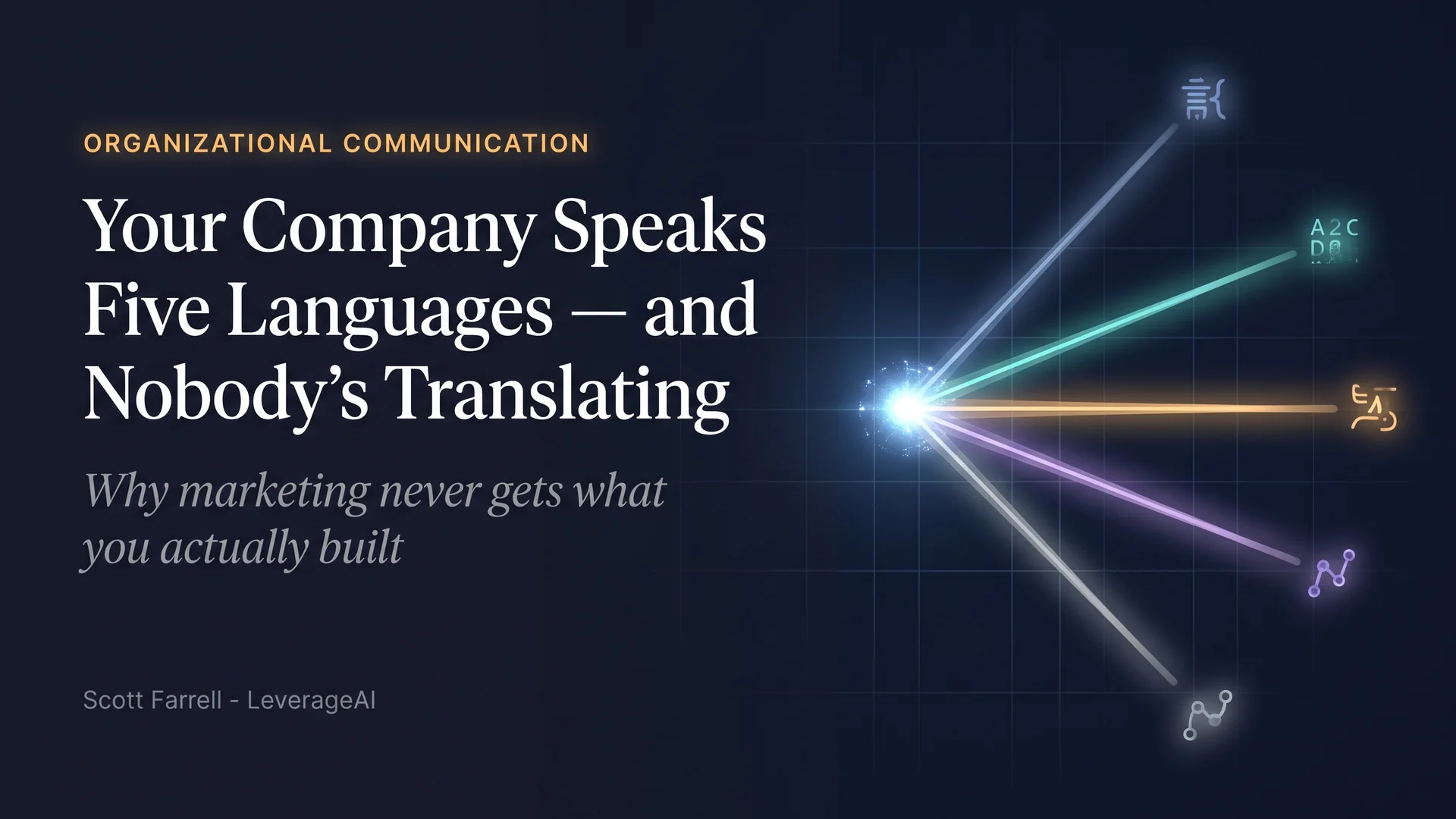
Your Company Speaks Five Languages — and Nobody’s Translating
“Marketing doesn’t get it” is a people complaint about a topology failure. Serial hops re-compress project truth along the wrong dimensions. Radial translation from joined ground truth stops the compounding.
Scott Farrell · LeverageAI
📘 Want the complete guide?
Learn more: Read the full eBook here →
Strategy comes down from the top: productise the practice. Capture reference projects. Make the offerings repeatable. Marketing does what marketing is told to do. They book meetings. They interview a project manager. They leave with five sentences.
Those five sentences are oversimplified along the wrong dimensions. They do not contain the reusable shape. They do not contain what clients actually bought. They become a dull case-study page. Sales tries to sell from it and cannot describe the solution. Someone writes a statement of work and a budget. Delivery opens the pack and asks the only honest question left: what are we trying to do, and who set this number?
Nobody asked them.
Orgs file this as a people problem. Marketing is shallow. Sales is hand-wavy. Technicals cannot communicate. Soft-skills training is scheduled. The topology stays the same.
It was never a comprehension problem. It was a lossy serial pipeline.
The serial telephone
In a consulting firm the project description does not travel once. It travels as a chain:
Technical team → project manager → marketing → website → sales → SOW → delivery.
Each hop is not a copy. It is a re-encoding. The PM hears the technical work and compresses it into status, risk, and timeline language. Marketing hears the PM and compresses that into a client-value story. Sales hears marketing and compresses that into objection-handling. Delivery inherits the SOW and tries to reverse-engineer the original work.
By the fourth hop you are reading a translation of a translation of a translation. Melvin Conway observed that organisations design systems that mirror their communication structures.1 The same law applies to offerings and case studies: a serial communication structure produces serial, degraded product descriptions.
The reverse path is the same failure running backwards. Budget and scope get set without technical input; execution is handed a shape that was never true. The mismatch at the end of the project is not a surprise. It was scheduled by the topology.
Count the hops a project description takes before it becomes external. Mid-size professional services firms often run four to six. You do not need a laboratory measurement to feel the damage — you need the hop count on one real chain.
Compression along the wrong dimensions
Humans must compress. Working memory is limited in chunks, not infinite bits.2 The PM is not lazy for reducing the technical story. Compression is mandatory. The failure is which axes survive.
Each translator preserves the dimensions they need and discards the ones they do not notice:
- Technical keeps mechanism, constraints, and what was hard.
- PM keeps schedule, risk, and stakeholder status.
- Marketing needs reusable shape, differentiation, and client-value framing — and rarely receives them intact.
- Sales needs objection paths and proof points — often already flattened.
- Delivery needs commitments and constraints — often rewritten by people who never built the thing.
This is information theory without the cosplay. Lossy compression is not neutral. It preserves some dimensions and throws others away. When the next hop re-compresses an already-lossy encoding, residual fidelity multiplies rather than adds. Most of the reusable shape is usually gone by the early hops; later hops polish the wreckage.
Serial multi-agent systems show the same structural pattern: a wrong intermediate gets treated as fact downstream and compounds rather than cancels.3 Your org chart has been running that architecture with humans for decades.
Communication cost is also inferential distance — explanation fails when the speaker assumes a shorter distance than exists.4 Each role boundary is a distance jump. Serial hops stack those distances. Hoping the PM will spontaneously preserve marketing’s dimensions is hoping the speaker knows a dialect they do not speak.
Before: the same project, five hops
Take one concrete engagement — a billing disintermediation project for a mid-size telco. Ground truth (what actually happened) includes: a pivot from “rebuild the rating engine” to “insert a mediation layer that made the legacy engine optional”; the pivot was sold internally before it was sold to the client; the reusable shape is disintermediation without rip-and-replace; the proof is three production interfaces and a six-week parallel-run.
Watch what serial hops do to that truth:
| Hop | What they write | What dies |
|---|---|---|
| Technical | “Mediation layer over legacy rating; three adapters; parallel-run for six weeks; avoided full rewrite.” | Almost nothing yet — high fidelity, wrong audience packaging. |
| PM | “On-time delivery of integration phase; risk mitigated via parallel-run; stakeholders aligned.” | Disintermediation pivot. Why it mattered. Reusable pattern. |
| Marketing | “Helped a telco modernise billing and improve customer outcomes.” | Everything specific. Now a segment-average sentence. |
| Sales | “We do billing transformation for telcos. Strong delivery record.” | Proof shape. Differentiation. Objection answers. |
| Delivery (from SOW) | “Deliver billing modernisation within fixed fee; assume greenfield APIs.” | The actual constraints. The real method. Budget now fights physics. |
That is not bad luck. That is serial topology doing exactly what serial topology does.
After: radial from one ground truth
Invert the graph. Stop treating the PM interview as the source of truth. The source of truth is the joined project corpus — proposals, emails, tickets, deliverables, post-mortems — held at full fidelity and soft-joined so the mediation pivot still connects to the internal framing email and the parallel-run evidence.5
Then every audience gets a first-generation translation straight from that ground truth, compressed along their dimensions:
- Marketing: “We productise disintermediation without rip-and-replace — mediation first, optional legacy retirement, six-week parallel proof.”
- Sales: “If the client thinks they need a multi-year rewrite, the objection path is: mediation layer, three production interfaces, fixed parallel-run window, rewrite deferred or cancelled.”
- PM / delivery: “Commitments that match the method we actually ran — not a greenfield fantasy.”
- Finance: “Margin shape of mediation-first vs rewrite; where fixed-fee is safe.”
Nobody is more than one hop from the truth. The website is no longer a translation of a translation. The SOW is no longer folklore with a number attached.
Ground truth sits joined once. Dialects are spokes. Humans keep taste, judgment, and accountability. The serial hop as a lossy intermediate is what dies.
Technology does not fix a broken process by itself — it amplifies whatever process you encode.6 Automating the serial telephone (auto-writing the case study from the PM’s five sentences) just accelerates the loss. Automating radial translation from joined ground truth is a different product class.
Register: the fourth leg of the stack
Prior work on compiling organisational residue already named three legs of the stack:
- Storage — everything useful eventually wants to be text, because text is the model’s home turf.
- Structure — text joins into a navigable graph (claims, edges, pointers), not a SharePoint landfill.
- Access — conversation is the runtime. Turn-sized claims beat document dumps.
Those three are necessary. They are not sufficient. A correct answer in the wrong dialect is still operationally wrong. Marketing does not want the technical page. Sales does not want the PM risk log. The CEO does not want a 40-page dump five minutes before the board pack is due.
The fourth leg is register — your dialect. Marketing-speak. PM-speak. Technical-speak. Sales-speak. Finance-speak.
AI’s translation value in the enterprise is not language pairs. Japanese ↔ English is table stakes. The prize is fluent register translation over your joined IP. Staff stay in their comfort zone. The system brings the organisation’s intellectual property into the room in the language of the person asking.
This is adjacent to the cognitive exoskeleton pattern — AI saturates preparation, humans keep judgment — but the per-role prep morphology is covered elsewhere.7 This piece owns the communication topology: serial versus radial, and register as the missing leg.
The organisational amnesia wedge makes the same architecture commercially obvious. Knowledge workers already lose more than five hours a week waiting for colleagues or recreating knowledge that exists somewhere else, and a large share of institutional knowledge walks out with individuals.8 A new marketing hire or salesperson arrives with complete amnesia of the last ten years. CRM crumbs are not memory. Radial register translation is how day-one staff inherit the company’s actual work in a dialect they can use.
The CEO is already translating
One counter-intuitive consequence: pure dialect translation helps the CEO least.
The CEO role has quietly included being the organisation’s human translation layer — expected to speak marketing, sales, finance, HR, and technical well enough to move initiatives through the building. They already do the serial hop in their head. Handing them “marketing-speak for this project” is not the unlock.
What helps is different: take an initiative still in formation and ask for four grounded angles — what finance will say, what HR will say, what sales will hear, what delivery will fear — argued from the company’s actual history, not generic model priors. That is still radial translation. The dialects are stakeholder lenses. The ground truth is the organisation’s past. The CEO keeps the call.
What to do Monday
- Pick one chain. One project that became a case study, a sales talk track, or an SOW.
- Write the hop list. Who compressed it, in what order, into what artefact.
- Mark the dead dimensions. At each hop, what destination-critical fact disappeared.
- Locate ground truth. Not the interview notes — the proposals, emails, tickets, deliverables.
- Produce two first-generation translations for two audiences from that ground truth. Compare to the serial artefacts. The gap is your proof.
You do not need to rebuild the whole knowledge stack before the diagnosis is useful. The hop count alone changes the filing cabinet: from “our people can’t communicate” to “our topology guarantees loss.”
Your company already speaks five languages. The missing capability is not louder meetings. It is a translator that starts from the truth — once — and speaks every dialect as a first generation.
The full field guide develops the serial-versus-radial architecture, the compression-dimensions argument, the worked before/after on one project, and register as the fourth leg of the wiki stack.
References
- [1]Melvin Conway. “How Do Committees Invent?” Datamation, 1968. http://www.melconway.com/Home/Committees_Paper.html — “organisations which design systems are constrained to produce designs which are copies of their communication structures.”
- [2]George A. Miller. “The Magical Number Seven, Plus or Minus Two.” Psychological Review, 1956. https://en.wikipedia.org/wiki/The_Magical_Number_Seven,_Plus_or_Minus_Two — working memory is limited in chunks, not bits.
- [3]Redis. “Why Multi-Agent LLM Systems Fail.” https://redis.io/blog/why-multi-agent-llm-systems-fail — sequential chains compound errors; wrong intermediates lock in downstream.
- [4]Eliezer Yudkowsky. “Expecting Short Inferential Distances.” LessWrong. https://www.lesswrong.com/s/zpCiuR4T343j9WkcK/p/HLqWn5LASfhhArZ7w — communication cost is inferential distance.
- [5]Scott Farrell, LeverageAI. “The Soft Join: SQL Discipline for Soft Data.” https://leverageai.com.au/the-soft-join-sql-discipline-for-soft-data/ — joining soft organisational data across stores without forcing a single hard schema.
- [6]Andrea Hill. “Why 95% Of AI Pilots Fail, And What Business Leaders Should Do Instead.” Forbes, 2025. https://www.forbes.com/sites/andreahill/2025/08/21/why-95-of-ai-pilots-fail-and-what-business-leaders-should-do-instead/ — “Technology doesn’t fix misalignment. It amplifies it.”
- [7]Scott Farrell, LeverageAI. “Stop Replacing People, Start Multiplying Them: The AI Augmentation Playbook.” https://leverageai.com.au/stop-replacing-people-start-multiplying-them-the-ai-augmentation-playbook/ — cognitive exoskeleton / augmentation boundary; judgment stays human.
- [8]Panopto. Workplace Knowledge and Productivity Report (2018). https://www.prnewswire.com/news-releases/inefficient-knowledge-sharing-costs-large-businesses-47-million-per-year-300681971.html — 42% of institutional knowledge unique to individuals; 5.3 hours/week waiting or recreating knowledge.
Discover more from Leverage AI for your business
Subscribe to get the latest posts sent to your email.