
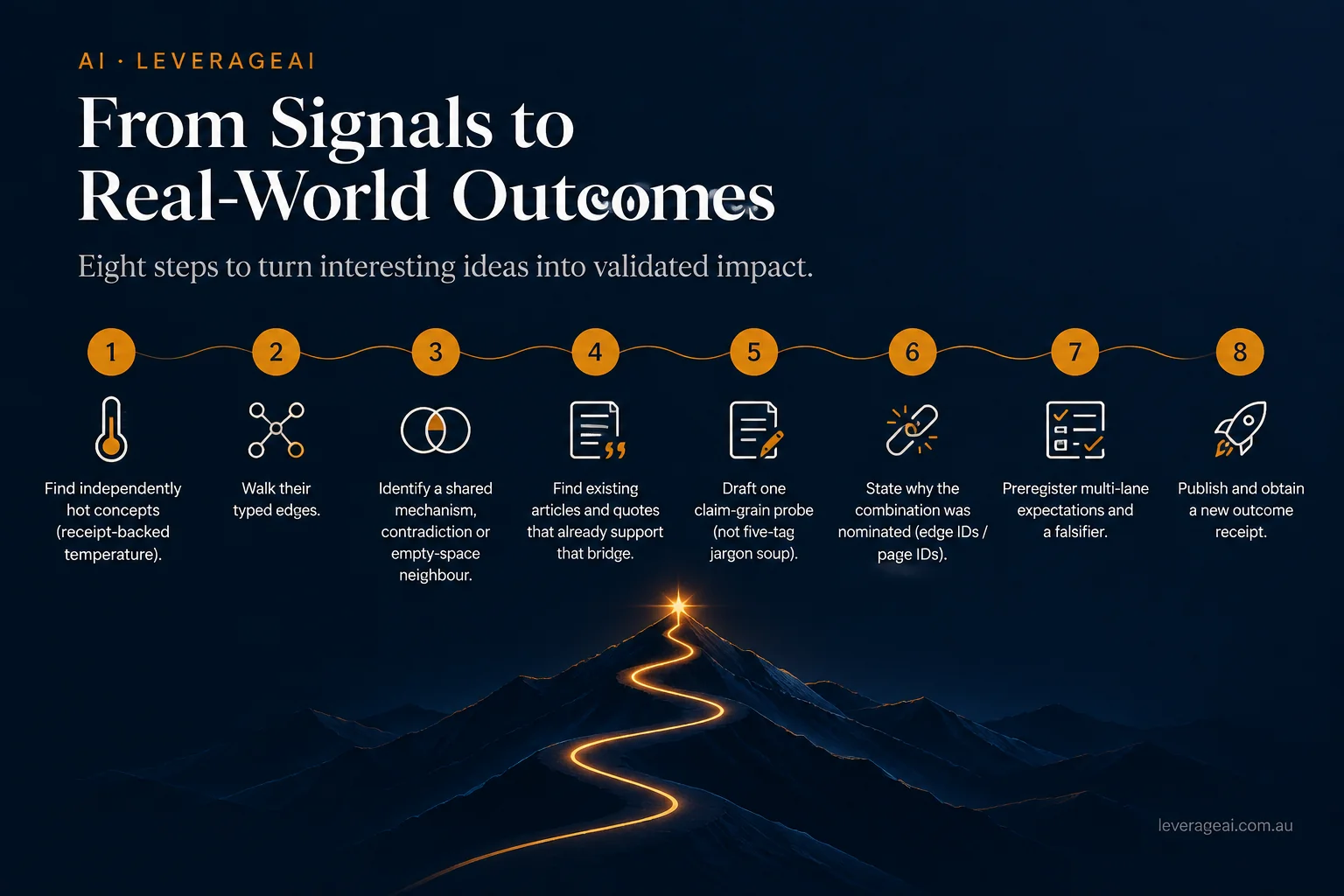
Two trending topics stapled together isn't an insight. It's a guess with reach.
The move is everywhere. AI governance is hot. Agentic workflows are hot. So a post connecting them must be worth writing.
But the heat belongs to the topics, not to the link. Popularity explains why you looked. It says nothing about whether the connection is real.
What earns a bridge is something specific: a shared mechanism, a contradiction, or a gap that sits between the two and that neither topic covers. You also need material you can already point to that supports it. Without that, it's vibes.
Then comes the discipline almost everyone skips. Before you publish, narrow it to one claim. Not five buzzwords in a trench coat. One sentence that could be wrong. Write down why you picked this combination, what response you expect, and what result would count against you.
Skip that step and every reaction becomes a win. Big engagement means the idea landed. Silence means a bad day for the algorithm. You've learned nothing, and you'll place the same bet next week.
Be honest about the limit, too. Audience response tests your prediction about reception. It doesn't prove the claim is true. A viral wrong idea is still wrong.
It's the same failure that kills AI pilots. There's no baseline and no falsifier, so the story gets written after the fact. Content just fails more cheaply.
When did you last decide, before posting, what result would prove you wrong?
Discover more from Leverage AI for your business
Subscribe to get the latest posts sent to your email.