
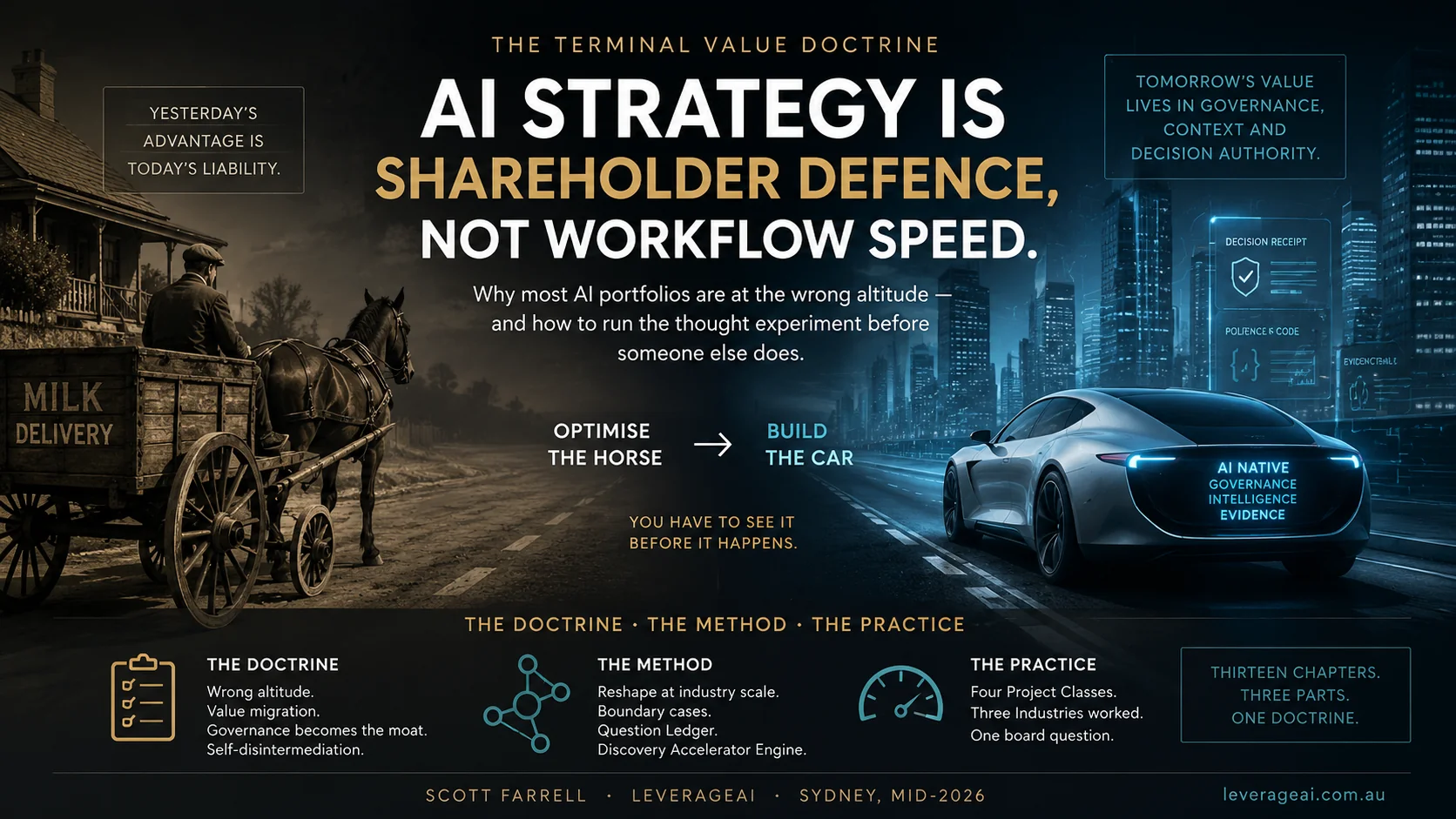
The Terminal Value Doctrine
Stop optimising the horse.
How to run a thought experiment on your own industry before someone else does — and why your AI portfolio is sitting at the wrong altitude.
Sydney, May 2026
~14 min read
📘 Want the complete guide?
Learn more: Read the full eBook here →
The three claims
- Wrong altitude. Most AI portfolios are selecting for workflow ROI when they should be selecting for terminal-value defence — what protects future shareholder worth when cognition, software and generic advice become cheap.
- The method is a thought experiment. Push one structural variable — AI intensity in your industry — to the boundary case. Watch which assumptions behind your terminal value break. This is structural reasoning, not forecasting.
- Then self-disintermediate. If an AI-native startup could destroy part of your business case, build that competitor inside your own company first. Harvest the old model; migrate the value; construct the successor.
§1 · The ProvocationYou don’t breed better horses after Henry Ford opens the factory
Most enterprise AI strategies are accidentally conservative. They use a revolutionary technology to preserve the current operating model. Boards approve “use-case backlogs,” CIOs roll out copilots, business units chase 5–10% gains on workflows that humans were already doing competently — and everyone reports back to the board that the AI programme is “on track.” The decks look serious. The pilots ship. The transformation never arrives.
The reason is altitude, not effort.
If you respond to Henry Ford by investing in better horse breeding, every step you take is competent: stronger animals, healthier feed, faster routes, smarter farriers, better stable analytics. You can build the best horse-and-cart milk fleet your district has ever seen. And still be finished. Because the value did not migrate to better milk carts. It migrated to trucks, then refrigeration, then supermarkets, then a household routine in which the milkman simply does not exist.
That is the mistake most boards are making with AI right now. They are optimising the horse.
The data is unambiguous. McKinsey’s 2025 State of AI puts the proportion of organisations achieving meaningful enterprise EBIT impact from AI at roughly 6%.1 BCG’s Build for the Future work finds only 5% of companies “future-built” and capturing AI value at scale; the rest see little or no material return despite heavy investment.2 PwC’s 2026 Global CEO Survey is the bluntest of all: 56% of CEOs report no financial impact from AI to date — neither revenue growth nor cost reduction.3 Deloitte 2026 finds only 34% of organisations are using AI to deeply transform; the rest are redesigning individual processes or sitting at the surface.4
These numbers do not say AI is failing. They say that productivity AI is broadly proven and broadly disappointing — and that the rare cluster of high performers shares one trait that almost no one else has: they treat AI as a business-model question, not a workflow question.
“Unlike previous technology waves, gen AI doesn’t create value through basic adoption. ROI comes from reimagining how work gets done and how a company competes.”Bain & Company · Unsticking your AI transformation
The right question, then, is not “where can we put AI to work?” The right question is the one almost no one in the org chart is paid to ask:
What will still make this company valuable when software, analysis, coding, content, reporting and basic advice become cheap?
That is the terminal-value question. And it is now the only AI strategy question that matters.
§2 · The MechanismHorizon compression and the AI fog
Traditional enterprise planning assumes the future is somewhat forecastable. You model cash flows for a few years and then assume a terminal value: the business keeps compounding because its assets, processes, customer base, software, brand and operating model remain meaningfully valuable. That assumption was always partly a fiction. AI just made it fragile.
Oliver Wyman’s CEO Agenda 2026 documents the shift in the data. CEOs now devote half of all planning time to horizons under one year — up from 43% the year before.5 Compressed horizons are not a CFO preference; they are a structural response to a world in which AI-driven uncertainty compounds geopolitical uncertainty. The credible forecast window for AI-exposed industries has contracted from 5–10 years to 1–3.
But shorter horizons are only half the problem. The other half is that the solution space is expanding. Every month, more business architectures become technically possible: agentic commerce, custom internal software built in days rather than years, continuous regulatory monitoring, AI-mediated customer discovery, personalised products at scale. McKinsey now models agentic commerce orchestrating up to $1 trillion of US retail by 2030.6 Sapphire Ventures notes that the AI-native SaaS cohort is compressing the journey from launch to $100M ARR from 5–10 years to 1–2.7
So boards face a particular kind of fog: the visible horizon is closer, and the map behind the fog is larger. Less time, more possibility, less clarity. That is the operating condition for terminal-value strategy.
Anthropic’s Mythos Preview in April 2026 made the shape of the fog vivid. Mythos was not trained to specialise in cybersecurity, but it autonomously discovered and exploited zero-day vulnerabilities across major operating systems and browsers in testing.8 Reuters’ follow-up in May moderated the panic but confirmed the substance: vulnerability discovery has materially improved; the bottleneck has shifted to validation and remediation.9 The lesson is not “AI is dangerous.” The lesson is that AI capability can leap vertically inside a single domain without warning. The frontier is not a smooth curve, and your industry’s financial model might be one spike away from re-pricing.
This is why the planning method has to change. You cannot forecast through the fog. You can only stress-test which assumptions behind your value are load-bearing — and which are about to fail.
§3 · The MethodPush the variable to the boundary case
The method comes from a much older discipline. Physicists call them gedanken — thought experiments. Lucretius hurled a spear at the edge of space to prove the universe was unbounded. Galileo dropped two tied cannonballs to prove that gravity could not depend on weight. Einstein imagined himself in free-fall and recovered the equivalence principle. Newton fired a cannon ball faster and faster until it became an orbit. None of these were forecasts. All of them were structural tests. The thinker picks one variable, pushes it to an absurd extreme, and watches which assumptions still hold at the limit.
I wrote earlier this year about applying the same move to everyday arguments — the partnership where the human selects the boundary-case pivot and the AI supplies the formal vocabulary, the equations, the citations, the line that ends the discussion. I called it The Reshape. This article is its terminal-value variant: same method, industrial scale.
For corporate strategy, the variable you push is AI intensity — the joint product of capability, cost, adoption and permission to act. At low intensity, AI is a productivity tool. At medium intensity, it’s a workflow accelerator. At high intensity, it replaces categories of software, services, reporting, analysis, content, support, coding and basic advice. At the limit, the industry changes shape.
The boundary-case questions look like this:
- What if software development cost falls by 90% in 18 months — which of our SaaS platforms become replaceable, which internal systems become rebuildable, which vendor relationships strand?
- What if every customer arrives with their own AI agent that compares, negotiates and complains on their behalf — what happens to our pricing, marketing, loyalty, and information asymmetry?
- What if competent generic advice becomes free — what part of our advice is still bought?
- What if AI governance becomes mandatory, auditable and board-accountable — who in our industry can move fastest while staying compliant, and who gets locked out because their AI cannot be authorised, evidenced or audited?
- What if a well-funded AI-native startup rebuilt our industry from scratch with no legacy systems, no channel conflict and no margin to protect — which of our customers would it take first, and which of our margins would it treat as inefficiency?
These are not predictions. The point of a boundary case is not to claim the limit will arrive exactly as imagined; it is to expose which of your assumptions only work when AI doesn’t. If your business survives the boundary case, your terminal value is robust. If it doesn’t, you’ve found the structural risk.
“AI doesn’t create advantage by making tasks faster. It creates advantage when intelligence flows across an ecosystem, compounding over time.”Vivaldi Group · Competing in the AI Systems Economy
§4 · The ThreatAI does not automate work. It migrates value.
The most dangerous error in current AI strategy is to mistake automation for the real threat. It isn’t. The real threat is value migration.
The horse-and-cart milkman wasn’t beaten by a faster milk cart. He was made irrelevant by a different value architecture: refrigeration, trucks, supermarkets, road logistics, packaged goods, and a changed household routine in which buying milk became a self-service errand. By the time the milkman noticed, the value had moved from local delivery routes to centralised supply chains and retail shelf space. He was no longer inefficient. He was no longer in the category.
AI does the same thing to industries. It does not only make today’s work cheaper. It changes which work is required at all — and where the profit pool sits.
A law firm is not destroyed by “AI lawyers.” It is destroyed by contract platforms, automated negotiation, compliance engines and customer behaviour that demands fewer legal interactions in the first place. A consulting firm is not destroyed by “AI consultants.” It is destroyed by internal strategy engines, synthetic market research, AI-run transformation offices and clients no longer needing armies of juniors. A SaaS company is not destroyed by a better SaaS competitor; it is destroyed because customers can now generate the workflow software they need cheaply enough that the category itself weakens. A call centre is not destroyed by an AI phone agent. It is destroyed because the upstream product, billing and service journey is redesigned so that fewer calls exist.
This is already in the data. Menlo Ventures’ 2025 State of Generative AI in the Enterprise finds AI-native startups have already captured 63% of the AI application market — up from 36% a year earlier — earning nearly two dollars for every one earned by incumbents.10 Activant Capital’s analysis of the legacy SaaS response is worse than that: Workday sees single-digit percentage adoption across its primary AI SKUs, and fewer than 4% of Salesforce’s customer base is paying for Agentforce.11
BCG and Moloco’s Consumer AI Disruption Index, published in January 2026, surveyed top marketing leaders: 67% expect major disruption to the consumer journey, with seventeen consumer-facing verticals already scored for vulnerability.12 Retool’s 2026 Build vs. Buy report says 35% of enterprises have already replaced at least one SaaS tool with a custom AI build, and 78% plan to build more in 2026.13 Generic software is being repriced from a strategic asset into a stranded one in front of our eyes.
The board’s question is not “will value migrate?” The board’s question is where, and how do we move first?
§5 · The MapThree asset classes for an AI-native portfolio
The cleanest way to brief a board on terminal value is to classify the company’s existing capital into three buckets. This is not an accounting exercise. It’s a strategic one.
Stranded assets — decline as AI improves
Legacy SaaS customisation. Brittle workflow automation. Manual reporting factories. Generic content production. Routine analysis. Low-context advisory. Staff structures built around moving information between systems. Standardised products that compete on undifferentiated workflow. These are not worthless today. But each year, their terminal value contracts. Retool’s data and Menlo’s market-share numbers say the contraction has already started.
Convertible assets — valuable if transformed
Legacy systems, historical data, customer interaction archives, internal playbooks, support tickets, policy manuals, operational artefacts. These are behavioural specifications waiting to be observed, tested and regenerated. My AI Legacy Takeover work argues the specification is the durable asset; the code regenerates as models improve. A 12–18-month rebuild used to be too expensive to consider. With overnight coding agents and characterisation testing, it now isn’t.
Compounding assets — appreciate as AI improves
Test harnesses. Decision receipts. Policy-as-code. Authority infrastructure. High-quality domain context. Retrieval architecture. Reusable playbooks. Governance patterns. Customer-specific intelligence. Strategic learning loops. This is where terminal value now lives. McKinsey’s 2026 moats work names exactly these categories — built-in audit trails, explainability, data lineage tracking, bias monitoring, in-the-loop controls — as the strategic moat in regulated domains.14 BCG finds future-built companies generate three-year total shareholder returns roughly four times higher than AI laggards.15
The portfolio question becomes a triage. How much of our capital is stranded? How much is convertible, and on what timeline? Where do we have compounding assets, and how do we deepen them faster than competitors?
§6 · The ResponseSelf-disintermediation: kill your own business case first
Incumbents have advantages that AI-native startups do not have: customers, brand, distribution, data, operational knowledge, regulatory position, trust, capital, contracts, procurement access. The trouble is, those advantages only matter if the incumbent is willing to turn them against its own old model. If it waits, the startup defines the new category. The incumbent then spends the next decade defending margin, headcount, systems and politics from the old world. That is how terminal value evaporates.
So the strategic response is uncomfortable but simple. It is the Self-Disintermediation Doctrine:
If an AI-native competitor could destroy part of your business, build that competitor inside your own company first.
That move has three parallel motions, not a binary choice between “stay” and “burn it down”:
- Harvest the old model. Keep the horse fleet profitable while it still works. Don’t vandalise today’s cash flow or unnecessarily destroy customer trust. But stop treating the current model as the future.
- Migrate toward the new value pool. Find where value is moving once cognition, software and coordination get cheap. That may be trust, governance, regulated execution, integration, distribution, proprietary workflow knowledge or personalised service at scale. Begin allocating capital to it.
- Construct the AI-native successor. Separate it from the old organisation enough that it is not strangled by old KPIs — but connected enough to use the incumbent’s advantages: customers, data, brand, contracts and regulatory knowledge. That is how incumbents should fight startups. Not by asking the horse division to invent the car and then being surprised when it requests a better saddle.
The shareholder communication writes itself once you have the structure: we are not abandoning value; we are migrating it. The old profit pool is still being harvested, but capital is being deliberately redirected toward the AI-native profit pool that will replace it.
That is the grown-up version. Not panic. Not reckless reinvention. Controlled self-disintermediation.
§7 · The ArtefactThe Question Ledger
Here is where most boards still get stuck. Even after they accept the doctrine, they cannot trust the conclusion — because the conclusion is generated by AI, by consultants, or by the same internal team that produced last year’s strategy. The board cannot tell whether the answer is the best one available, or merely the most fluent.
The fix is to change what the board reviews. Not the answer. The question space.
In our Discovery Accelerator work, we call this the John West Principle — “it’s the fish we reject that makes us the best.” A reasoning system that can show you what it considered and why it rejected each option is a partner; a system that only shows you the chosen answer is just an answer generator. Boards already understand this intuitively when they read McKinsey decks: the comfort comes not from the recommendation but from the list of alternatives that were rejected and why.
Terminal-value strategy requires the same artefact, one level deeper. Not just what answers did you reject, but what questions did you fail to ask. Because in the AI fog, the visible horizon is closer and the solution space is larger — which means the most dangerous failure is not a bad answer but an unasked question.
The Question Ledger is a structured artefact that records:
- The questions asked, with the vague terms stripped out and the structural variable named.
- The boundary case tested for each question — and the current operating point of the company.
- The answer summary, the alternatives rejected, the evidence used and the confidence level.
- The gap status — what hasn’t been asked yet, where the search is shallow, where uncomfortable questions were avoided.
- The revisit trigger — what new evidence would re-open the question.
It is not a strategy deck. A deck is rhetoric. A Question Ledger is evidence — that the search was systematic, that uncomfortable questions were not suppressed, that the conclusion was not cherry-picked, and that the board can challenge the process, not just the prose.
The discipline matters because every fluent strategy answer can be challenged at the question layer. You have not pushed software cost far enough. You have not asked what happens when every customer has an AI agent. You have not tested how shareholder resistance reacts to migration. You have not modelled the startup with no legacy cost base. Those are the productive challenges. They move disagreement from vague objection into structured improvement.
§8 · The PortfolioFour project classes — and a kill list
Once the doctrine is in place and the Question Ledger has surfaced the structural risks, AI projects sort themselves into four classes. They do not all get the same treatment.
| Class | What it does | Verdict |
|---|---|---|
| Horse Optimisation | Makes the current process more efficient. “Reduce manual reporting by 20%.” | Tolerate, don’t celebrate. |
| Horse Replacement | Replaces a current human task. Politically fraught, often regulated, frequently fragile in customer-facing contexts. | Avoid as flagship. |
| Car Discovery | Identifies the future model. “What would an AI-native startup build, and what customer promise would it make?” | Sponsor at board level. |
| Car Construction | Builds the AI-native successor. The governed execution layer that delivers personalised, compliant, evidence-backed service at a scale the old operating model could not support. | Double down. |
That gives a sharp kill/fix/double-down filter. Kill projects that mostly do “same process, fewer minutes” — especially those that are customer-facing, real-time or politically threatening to staff before the governance layer is built. Fix projects that have genuine strategic potential but live in the wrong lane (start by moving the intelligence upstream so AI prepares the case and a human handles the live interaction, until governance and physics catch up). Double down on projects that create compounding assets: specs, tests, domain models, data provenance, policy-as-code, authority graphs, evidence receipts, reusable playbooks and internal cognition infrastructure.
If you want a one-line filter for a portfolio review: does this project make the company more valuable in an AI-native world, or merely make an obsolete operating model run faster? The answer determines whether the project belongs in next year’s budget or this quarter’s kill list.
The deployment physics underneath — which AI lanes are safe to ship into and which are boss fights — is covered in the Lane Doctrine. Terminal Value selects the altitude; Lane Doctrine filters for deployability.
§9 · The MoatWhy governance is now a productive asset, not a cost
Most companies still treat governance as a tax on AI. The board signs off a policy, the legal team writes a register, the risk committee meets quarterly. That is the wrong frame.
As AI capability rises, the value of letting it act rises with it — but so does the danger of letting it act without control. So the bottleneck shifts from “can the model do it?” to “can we safely authorise, constrain, evidence and execute it?” The companies that can answer yes are the ones that can deploy AI where competitors can’t.
The regulatory direction underwrites this. The EU AI Act’s GPAI obligations have been active since August 2025; the full regime applies from August 2026, with high-risk classification rules from August 2027.16 NIST’s AI Risk Management Framework has a GenAI Profile that procurement, security and legal teams now cite by name, and ISO/IEC 42001 has become the AI management system standard most enterprise buyers expect.17 Australia’s National AI Plan, while voluntary at the moment, sits on top of explicit Australian Government commentary that the existing regulatory system is “unfit for purpose” for AI’s distinct risks.18
That regulatory weight is creating something that hasn’t existed before: governance arbitrage. Mid-2026 evidence already shows it in action — organisations with mature AI governance frameworks accelerate innovation, hold projects in production longer, and gain customer trust that competitors are still trying to buy.19 McKinsey explicitly names this as a strategic moat: built-in audit trails, explainability, data lineage tracking, bias monitoring and human-in-the-loop controls are now defensible assets, particularly in finance, healthcare and identity, where trust is the gatekeeper to adoption.20
“In the AI era, competitive advantage no longer comes from having the best model. It comes from building infrastructure that compounds value over time.”McKinsey · From AI Table Stakes to AI Advantage
This is the part of the doctrine that is most counter-intuitive to executives steeped in efficiency thinking. Governance infrastructure is hard to build, context-specific and slow to copy — which is exactly what makes it a moat. The companies that build the runtime authority and evidence layer now are buying optionality that the laggards cannot purchase later at any price.
That is where terminal value now lives.
§10 · The Board QuestionWhat we would not rebuild today
Strip the doctrine to its sharpest interrogation and the conversation becomes a single question. The board should run it once a quarter, in a room without slides:
If we could rebuild our company today, with cheap cognition, cheap software and mandatory AI governance, what would we not rebuild?
That question is brutal. It exposes dead process. It exposes vendor lock-in. It exposes fake differentiation. It exposes expensive coordination. It exposes governance gaps. It exposes stranded software. It exposes places where the company is optimising yesterday’s constraints. And the second question follows immediately: which AI projects move us toward the rebuilt company, and why are they not the ones we approved last quarter?
That becomes the portfolio. Not a list of use cases. Not a Copilot rollout schedule. Not a workflow automation backlog. A capital-allocation plan whose first criterion is whether each project defends or migrates terminal value — and whose Question Ledger proves the search was honest.
Closing reveal
The doctrine is written. The engine exists.
Everything described in this article — the boundary-case search, the question-space map, the structured rebuttals, the rejected-future logs, the gap audits — is exactly the work that a multi-agent reasoning system is suited to. Not as a magic strategist, but as a disciplined search engine over possible futures.
That engine has been built. The NegaMax Discovery Accelerator we run at LeverageAI implements the architecture from our Discovery Accelerator and AI Think Tank work: a director layer that frames the boundary cases, a council of specialised engines that argue from operations, revenue, risk and people lenses, and a chess-style search that explores at roughly a hundred candidate futures per minute — surfacing the rebuttals and rejection rationales that constitute the Question Ledger.
You don’t need to take the doctrine on faith. You can run it. The terminal-value thought experiment your board is avoiding is the work this engine was built to do.
References
- [1]
McKinsey & Company. “The State of AI: Global Survey 2025.” — “Respondents who attribute EBIT impact of 5 percent or more to AI use and say their organization has seen ‘significant’ value from AI use — our definition of AI high performers, representing about 6 percent of respondents — report pushing for transformative innovation via AI, redesigning workflows, scaling faster…”
https://www.mckinsey.com/capabilities/quantumblack/our-insights/the-state-of-ai - [2]
Boston Consulting Group. “Build for the Future 2025.” — “Only 5% of companies are realizing AI’s full value at scale. 60% see little to no material return despite heavy investment.”
https://www.bcg.com/publications/2025/are-you-generating-value-from-ai-the-widening-gap - [3]
PwC. “29th Global CEO Survey 2026.” — “56% of CEOs report no financial impact from AI to date — neither revenue growth nor cost reduction. Only 12% of CEOs report achieving both increased revenues and reduced costs from their AI initiatives.”
https://www.pwc.com/gx/en/news-room/press-releases/2026/pwc-2026-global-ceo-survey.html - [4]
Deloitte. “The State of AI in the Enterprise 2026.” — “One-third (34%) of surveyed organizations are starting to use AI to deeply transform — creating new products and services or reinventing core processes or business models. Another third (30%) are redesigning key processes around AI. The remaining third (37%) are using AI at a more surface level.”
https://www.deloitte.com/us/en/what-we-do/capabilities/applied-artificial-intelligence/content/state-of-ai-in-the-enterprise.html - [5]
Oliver Wyman Forum. “The CEO Agenda 2026.” — “CEOs now devote half of all planning efforts to horizons of less than one year, up from 43% in 2025, as 96% report increased board involvement in at least one area.”
https://www.oliverwymanforum.com/ceo-agenda/how-ceos-navigate-geopolitics-trade-technology-people.html - [6]
McKinsey & Company. “From AI Table Stakes to AI Advantage: Building Competitive Moats.” — “As AI agents increasingly mediate network interactions (for instance, by searching, comparing, and transacting on behalf of users), discovery shifts from human browsing to algorithmic decision-making. Agentic commerce could orchestrate up to $1 trillion in US retail by 2030.”
https://www.mckinsey.com/capabilities/quantumblack/our-insights/from-ai-table-stakes-to-ai-advantage-building-competitive-moats - [7]
Sapphire Ventures. “2026 Outlook: 10 AI Predictions Shaping Enterprise Infrastructure.” — “Achieving $100M in ARR over 5–10 years used to be the gold standard in SaaS. The best-in-class AI-native companies are now compressing that timeline into 1–2 years.”
https://sapphireventures.com/blog/2026-outlook-10-ai-predictions-shaping-enterprise-infrastructure-the-next-wave-of-innovation - [8]
Anthropic. “Claude Mythos Preview System Card.” — “Claude Mythos Preview demonstrated a striking leap in cyber capabilities relative to prior models, including the ability to autonomously discover and exploit zero-day vulnerabilities in major operating systems and web browsers.”
https://www-cdn.anthropic.com/08ab9158070959f88f296514c21b7facce6f52bc.pdf - [9]
Reuters. “Fears of Unfettered Hacking Spurred by Anthropic’s Mythos AI Model Overstated.” May 20, 2026. — “Experts who have used the model in controlled environments have reported substantial improvement in vulnerability discovery, and banking industry IT staffs are working to fix scores of system weaknesses…”
https://www.reuters.com/business/fears-unfettered-hacking-spurred-by-anthropics-mythos-ai-model-overstated-2026-05-20 - [10]
Menlo Ventures. “2025: The State of Generative AI in the Enterprise.” — “Startups have pulled decisively ahead. This year, according to our data, they captured nearly $2 in revenue for every $1 earned by incumbents — 63% of the market, up from 36% last year when enterprises still held the lead.”
https://menlovc.com/perspective/2025-the-state-of-generative-ai-in-the-enterprise - [11]
Activant Capital. “Selling AI-Native Service, Now.” — “Legacy incumbents are no further ahead in the AI adoption race than new entrants. Workday sees only single-digit percentage adoption across its primary AI SKUs. Less than 4% of Salesforce’s customer base is paying for Agentforce.”
https://activantcapital.com/research/selling-ai-native-service-now - [12]
Boston Consulting Group & Moloco. “Consumer AI Disruption Index.” January 2026. — “In a survey of top marketing leaders, 67% say they expect major disruption to the consumer journey, and nearly all are bracing for meaningful shifts ahead.”
https://www.bcg.com/press/21january2026-marketing-leaders-expect-ai-driven-disruption-consumer-behavior - [13]
Retool. “2026 Build vs. Buy Report.” — “35% of teams have already replaced at least one SaaS tool with a custom build and 78% expect to build more custom internal tools in 2026. Every SaaS category is under replacement pressure.”
https://retool.com/blog/ai-build-vs-buy-report-2026 - [14]
McKinsey & Company. “From AI Table Stakes to AI Advantage.” — “The strategic moat develops when regulatory compliance is embedded in the solution development process and the technology stack: built-in audit trails, explainability, data lineage tracking, bias monitoring, and human-in-the-loop controls.”
https://www.mckinsey.com/capabilities/quantumblack/our-insights/from-ai-table-stakes-to-ai-advantage-building-competitive-moats - [15]
Boston Consulting Group. “AI Transformation Is a Workforce Transformation.” — “Only about 5% of organizations have managed to reap substantial financial gains from AI. Crucially, that segment also shows stronger financial performance overall and three-year total shareholder returns that are roughly four times higher, on average, than AI laggards.”
https://www.bcg.com/publications/2026/ai-transformation-is-a-workforce-transformation - [16]
Bird & Bird (Two Birds). “AI Act: From Timelines to Tensions.” — “August 2025: Obligations for GPAI providers, governance structures, and penalties begin to apply. August 2026: Full application of remaining provisions of the AI Act. August 2027: Application of classification rules for high-risk systems.”
https://www.twobirds.com/en/insights/2025/ai-act-from-timelines-to-tensions–a-mid-2025-round-up - [17]
FutureAGI. “AI Agent Compliance and Governance 2026 Guide.” — “Compliance for AI agents was a roadmap item in 2024. By 2026 it is the gating procurement step. The EU AI Act has binding compliance dates active. NIST AI RMF has a GenAI Profile that procurement, security, and legal teams reference by name. ISO 42001 is the AI management system standard most enterprise buyers expect.”
https://futureagi.com/blog/ai-agent-compliance-governance-2026 - [18]
SafeAI-Aus. “Current Legal Landscape for AI in Australia.” — “In December 2025 the National AI Plan confirmed that, for now, Australia will rely on existing laws and sector regulators, supported by voluntary guidance and a new AI Safety Institute, rather than introducing a standalone AI Act or immediate mandatory guardrails.”
https://safeaiaus.org/safety-standards/ai-australian-legislation - [19]
GuidePoint Security. “Establishing AI Governance as a Competitive Advantage.” 2026. — “Organisations with mature AI governance frameworks accelerate innovation and increase customer trust. 45% of organizations with high AI maturity keep AI projects operational for at least three years.”
https://www.guidepointsecurity.com/wp-content/uploads/2026/02/AI_Governance_WP_Final.pdf - [20]
McKinsey & Company. “From AI Table Stakes to AI Advantage.” — “In high-stakes domains such as finance, healthcare, and identity, trust is a strategic moat because it functions as a gatekeeper to adoption.”
https://www.mckinsey.com/capabilities/quantumblack/our-insights/from-ai-table-stakes-to-ai-advantage-building-competitive-moats
Discover more from Leverage AI for your business
Subscribe to get the latest posts sent to your email.