
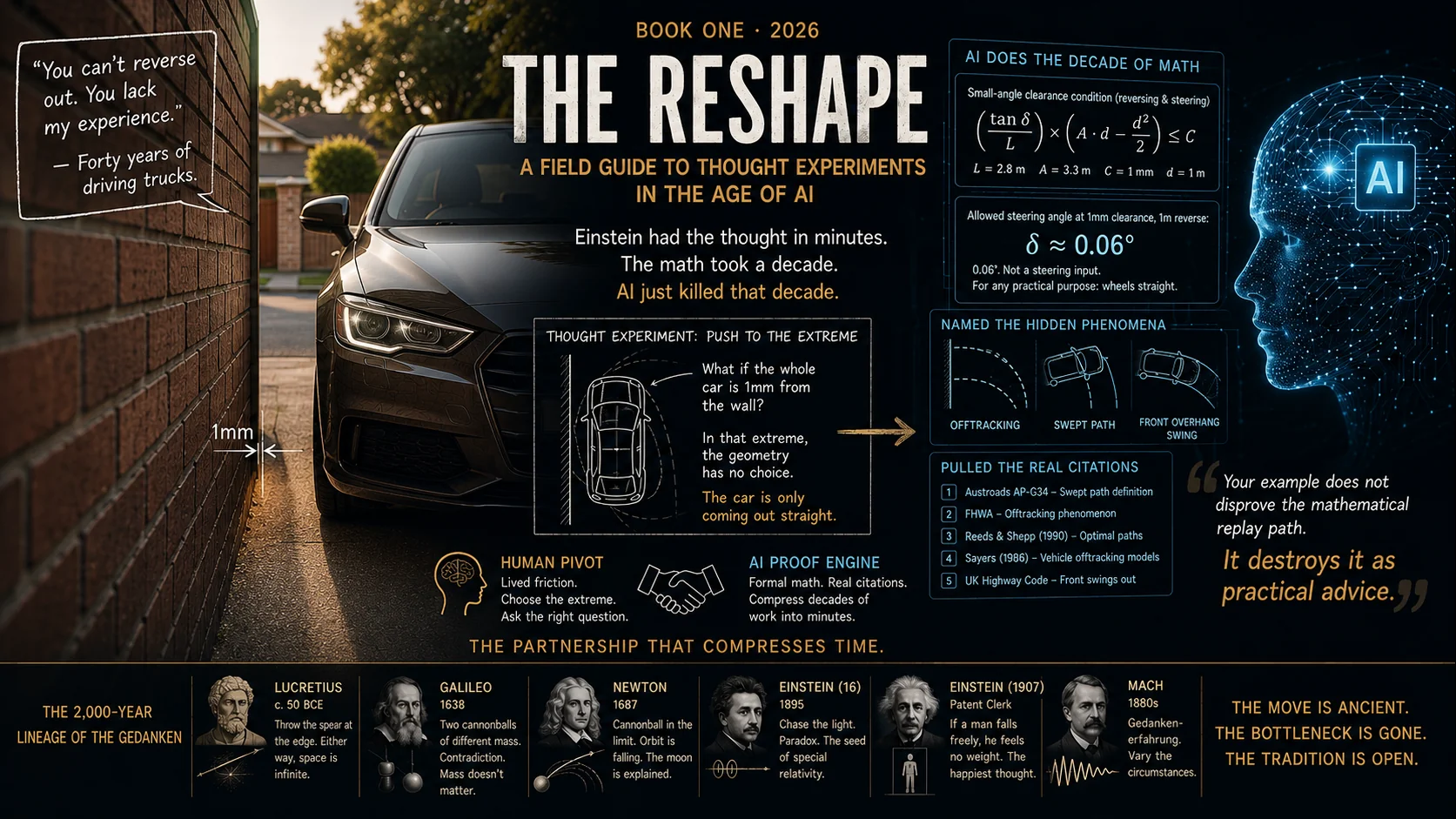
Book One · 2026
The Reshape
A Field Guide to Thought Experiments in the Age of AI
Einstein had the thought in minutes.
The math took a decade.
AI just killed that decade.
~12 min read · May 2026
📘 Want the complete guide?
Learn more: Read the full eBook here →
My mate has driven trucks, cranes and everything in between for forty years. He told me I couldn’t drive. He said that if I had driven into the garage, I could obviously reverse out — and the reason I couldn’t was that I lacked his experience. We were standing in my driveway. His car was overhanging it. There was a continuous brick wall down the left of mine, all the way to the road. The panels at risk were mine.
I won the argument in thirty minutes. With a thought experiment. With an AI. And with a 1mm wall that doesn’t exist.
The wall I imagined into being was not the real garage wall. It was a sharpened version of it — one where the whole left side of the car sat exactly 1mm from a continuous brick face. In that imagined extreme, the geometry has no choice. Any rotation of the car spends clearance somewhere. With a 1mm gap, even a 0.1° yaw on a 4.5-metre car moves an end of the body about 8mm — eight times the gap. The car is only coming out straight. There is no other manoeuvre.
The wall is imaginary. The proof is not.
The wall is imaginary. The proof is not. And the partnership that produced the proof is something almost nobody is using yet.
This piece is about that partnership. Not “AI as thought partner” — that framing is too symmetric, too polite. The real shape is asymmetric, and once you see it, you cannot un-see it.
The pivot is the move only the human can make
The argument with my mate had the structure of every argument in the history of disagreements between confident people: he was extrapolating from pattern memory, and I had a feeling the pattern didn’t apply. He had thousands of reversed vehicles in his hands. I had a brick wall and panels.
The first AI conversation, before the pivot, was rich and fluent. The language model produced lovely paragraphs. It described the kinematic bicycle model. It cited Ackermann steering geometry. It noted that yes, “in principle”, a car’s low-speed path is geometrically reversible if you reverse the steering inputs in the correct order. That was fluent. That was true. That settled nothing.
Fluency is not proof. The mate was not going to be moved by a paragraph that said “in principle” and “the kinematic bicycle model”. He needed the kind of answer where the geometry of the situation forced his hand.
So I made the pivot:
“I like to take the problem to the extreme, to see if it holds. What if I swept the car to 1mm on the left wall — and the whole car, front and back, is 1mm from the bricks? This is actually reasonably easy to achieve going in. I guarantee that car is only coming out straight.”— Author, turn 19 of the conversation transcript
This is the move. Not “give me the answer”. Not even “reframe the question”. A specific, third move: push one variable to an absurd extreme until the geometry of the situation forces a structural answer. The 1mm wall is not an analogy. It is a sharpened version of the real problem in which the hidden constraint becomes the only constraint.
The AI cannot supply this move. Not in 2026. Perhaps not for a while. The AI has no skin in my driveway. It does not know which extreme is the interesting extreme — the one that exposes the live constraint and ignores the dead ones. The pivot comes from lived friction: from the panels at risk, the bricks on the left, the mate at the corner of my eye. That is not a prompt-engineering skill. It is something older and quieter.
The pivot is the move only the human can make.
What the AI did in the next thirty minutes
Once the pivot was on the table, the AI did something I want you to look at carefully — because this is the part most users of AI never see.
It named the hidden phenomenon. The vague feeling I’d had — “the back of the car sort of takes a shortcut” — became a specific engineering concept: offtracking. The “whole body matters, not just the tyres” intuition became swept path. The “if I steer to make the back go right, the nose lurches into bricks” feeling became front overhang swing. These are not metaphors. They are the actual technical vocabulary used by Austroads and the US FHWA when designing intersections for trucks.1,2
Then the AI did the math.
(tan δ / L) × (A·d − d²/2) ≤ C
Then it plugged in real numbers. Standard passenger car: L = 2.8 m, A = 3.3 m, C = 1 mm, d = 1 m. Solved for the maximum allowed steering angle.
δ ≈ 0.06°
0.06°. That is not a steering input. That is roughly the angular precision of an automotive engineering lab, on a chassis dynamometer, with calibrated equipment. It is well below human steering error, well below tyre scrub, well below the slope of a Sydney driveway. It is, for any practical purpose, “wheels straight”. The car is only coming out straight.
Then it surfaced a beautiful structural insight I hadn’t even asked for. The useful sideways movement of the rear scales as the square of reverse distance; the dangerous nose swing scales as the linear distance. So early in the manoeuvre — exactly when you need rear clearance — the geometry is at its worst. The nose-swing wins early. The back is genuinely “lazy”. My intuition had a name and an exponent.
Then it pulled the citations. Not the consumer-blog citations the first pass had used. Real ones:
- Reeds & Shepp, 1990, Optimal Paths for a Car that Goes Both Forwards and Backwards — the foundational paper on path planning for car-like robots. Published in Pacific Journal of Mathematics 145(2).3
- Michael W. Sayers, 1986, Vehicle Offtracking Models, Transportation Research Record 1052 — the technical reference describing the rear-axle path as the general tractrix of the front-point path. “Tractrix” is the literal mathematical name for the curve my mate calls “the back of the car cutting the corner”. 1986. Settled science.4
- Austroads AP-G34, the Australian road design standard, defines swept path as “the area covered by the outermost and innermost points of the vehicle during a low-speed turn”. The vocabulary matches.1
- UK Highway Code, sections 159–203, codifies the practical version: when reversing and turning, “the front of your vehicle will swing out”. The rule is written into the country’s driving law.5
Then it produced the line that ended the argument:
“Your example does not disprove the mathematical replay path. It destroys it as practical advice.”— AI, turn 24 of the transcript, with the citations attached
And finally, when the mate’s “I’ve driven trucks for forty years” came up, the AI produced the line I will use for the rest of my life on this kind of conflict:
“You might be a better driver than me, but this isn’t about confidence. It’s a swept-path problem. If your car removes the only safe path and the brick wall removes the front swing, then the manoeuvre may not exist. I’m not testing that theory with my panels. Move your car.”— synthesised from AI turns 28 & 30; the version I quoted to him verbatim
Thirty minutes. From “you can’t drive” to a derived steering tolerance of 0.06°, a 1986 paper on tractrix curves, and a sentence that ended the argument calmly. Nobody was insulted. The geometry just spoke.
Einstein’s eight years
Here is where most people will get the wrong end of the stick. They will say: “Nice story. AI is good at math. News at eleven.”
That is not the claim.
The claim is this. Einstein had the elevator thought experiment — “if a man falls freely, he would not feel his weight” — sitting in his patent office chair in Bern in 1907. He later called it “the happiest thought of my life”.6 The gedanken took about as long to have as it takes to read this sentence.
The general theory of relativity, in which that thought is formalised as the equivalence principle and the curvature of spacetime, was published in 1915. The field equations require Riemannian geometry and tensor calculus — branches of mathematics that Einstein did not know in 1907. He had to learn them. He had to find collaborators (Marcel Grossmann) who could help him learn them. He filled notebooks. He produced false starts. He came back to the problem year after year.
Eight years.
That is the cost of formalising one Einstein-class gedanken in the era before formalisation engines.
The thought is a Tuesday afternoon. The proof is a decade.
Einstein had the thought in minutes. The math took eight years. AI just compressed that decade for anyone who can supply the right thought.
This is not a metaphor about AI being “fast”. This is a literal claim about the historical bottleneck on one specific category of human reasoning. The thought experiment — what Mach called Gedankenerfahrung, “experience in thought”7 — is the move that produced special relativity, general relativity, the cleanest cosmological argument of the ancient world, the law of falling bodies, and Newton’s understanding of orbit. The lineage didn’t run out of thinkers. It ran out of mathematicians willing to spend a decade per insight.
AI is the first tool in human history that is plausibly competent at compressing that decade — provided the human supplies the pivot. In the 1mm wall conversation, what would have been an undergraduate engineering project (derive a small-angle clearance condition from kinematic constraints, prove it dimensionally, find the relevant literature) collapsed into thirty minutes of conversation. That is not “AI is fast”. That is the formalisation cost of a single thought experiment going from years to half an hour.
I am not as clever as Einstein. On most problems I will never be. But on this problem, with this partner, I just did an Einstein-class move on a Monday morning. That is the new literacy. And almost nobody is using it.
The 2,000-year tradition you just joined
Lest this sound like a story about one cute pivot in one driveway, here is the lineage. Each of these is the same structural move: take a vague argument, push a variable to a limit, let the geometry of the situation force a structural answer.
The lineage of the gedanken
Throws a spear at the alleged edge of the universe. Either the spear flies through (so there is no edge) or it bounces (so there is something on the other side — also not an edge). Either way: space is infinite. Argument over by line 987 of the poem. The earliest documented use of the boundary-case move in the Western canon.8
Two cannonballs of different mass dropped from a tower. If heavier falls faster, then a heavy ball tied to a light ball must fall slower than the heavy ball alone (the light ball drags it) AND faster (combined mass is greater). Contradiction. Therefore mass cannot determine fall rate. No tower required. A pure proof-by-contradiction gedanken.
A cannon fired harder and harder from a mountain top. In the limit, the Earth curves away as fast as the ball falls. Orbit IS falling. The moon stops being mysterious. The same limit-case move, this time producing classical mechanics.9
“If I pursue a beam of light with the velocity c, I should observe such a beam of light as an electromagnetic field at rest though spatially oscillating.” Maxwell’s equations say what he’d see can’t exist. The germ of special relativity, contained in one paradox.10
“If a man falls freely, he would not feel his weight.” The happiest thought of his life. The seed of general relativity. Formalisation cost: eight years of tensor calculus he had to learn from scratch.6
Names the technique Gedankenerfahrung — experience in thought. Articulates the method: “By varying the circumstances (continuously, if possible) the range of validity of an idea related to these circumstances is increased.” Mach is the philosopher who turned a habit of physicists into a recognised epistemological technique.7
Six entries. Two thousand years. The same move, repeatedly, producing the deepest results in physics.
And every single one of those people, with the partial exception of Mach, was the first-class mathematician of their generation. Lucretius had Roman geometry. Galileo had pre-calculus arithmetic. Newton invented calculus partly to formalise the cannon-ball insight. Einstein learned Riemannian geometry because the gedanken demanded it. The math was always the bottleneck.
It just isn’t anymore.
Name the partnership
The two halves of the move have different names because they are different kinds of work.
The first half — the pivot — is the human’s. It requires lived friction (the panels at risk, the bricks on the left, the mate at the corner), domain taste (which variable is the live constraint?), and a willingness to push a model until it either breaks or hardens. It is not a prompt-engineering skill. It is the older skill of problem-shaping — of asking what is really at stake here.
The second half — the proof — is the AI’s. It requires the ability to hold many constraints in working memory, to recognise a sharpened problem as an instance of a formal class (kinematics, geometry, optics, thermodynamics, queueing), to derive the math, to surface the relevant literature, and to write the line that ends the argument. This is what AI is unusually good at in 2026, given a well-shaped problem.11
The asymmetry is the whole point.
This is the part nobody told you when “AI as thought partner” became a slogan. The framing was too gentle. The reality is sharper and weirder: the AI is a decade-of-math compressor, and the only remaining scarce skill is the human pivot. Bringing the problem to AI in the correct shape is the power.
This is also why the prompt-engineering cottage industry — “10 prompts to…” — is going to look quaint very fast. Prompt quality is downstream of problem shape. If your problem is well-shaped, almost any prompt works. If your problem is badly shaped, no amount of prompt engineering rescues it. Prompt engineering treats the symptom; problem engineering treats the cause.12
Experience can blind. Geometry doesn’t.
It would be cheap to leave the mate as a foil. He isn’t. He has driven more vehicles in more conditions than I ever will. His pattern memory is real expertise — the kind of expertise Kahneman and Klein call “intuitive”: fast, embodied, often right inside its training distribution.13
What experience doesn’t give you is the ability to see the boundary case where the pattern breaks. That is a different cognitive operation. Cognitive scientists have a name for what happens when prior experience blocks a better framing: the Einstellung effect.14 Chess players see the familiar pattern and stop searching for the better move. Doctors anchor on the obvious diagnosis. Truck drivers reverse out of garages they have never reversed out of.
The mate’s experience told him: if you drove in, you can reverse out. The boundary case asks a different question: can a rigid body yaw inside a near-zero-clearance corridor without contact? Those are not the same question. One is answered by pattern memory; the other by geometry. Pattern memory loses when the pattern is extrapolated outside the conditions that trained it.
This is not anti-expert. It is pro-geometry. Expertise is fast and right inside its distribution. Outside that distribution, the gedanken is the test.
And the gedanken used to be the slow half of the move, because the formalisation took eight years.
Not anymore.
The new literacy
I want to be careful here. I am not claiming AI makes everyone Einstein. I am not claiming AI makes me Einstein. I am claiming something narrower and more practical:
A normal person, using thought experiments plus a 2026 frontier AI, can now reach first-principles clarity on bounded problems that would previously have required an engineer, a paper search, a drawing board — and several months.
That is a categorical change in what you can do on a Tuesday afternoon, and almost nobody is using it.
What does “using it” look like in practice? Not “ten prompts to better thinking”. The much smaller, much harder discipline of noticing when you have a stuck argument that has a structural answer hiding in a boundary case, and reshaping the argument until the geometry shows.
The signal that you have one of those problems is usually some combination of:
- You and someone confident keep going in circles, and neither pattern-matches your way out.
- You have a strong intuition that “something is wrong with this”, but cannot name it.
- The case is concrete and physical (or close to it — geometry, economics, queueing, control systems).
- Pushing one variable to “nearly zero” or “nearly infinity” changes the shape of what is allowed.
That last one is the tell. If your problem has a variable you can push to an absurd extreme, and the extreme changes what is structurally possible, you are looking at a gedanken. Pull it.
The meta-prompt
Here is the seven-line version of the move you can paste into any frontier model. It is not magic. It is the move named so the model knows what kind of work you are asking for.
- Problem: <describe the real-world issue, with the constraints that matter physically>
- Claim being tested: <state the argument someone is making>
- My intuition: <state your rough feeling and why it pushes back>
- Identify the hidden assumption in the claim.
- Push one variable to an extreme boundary case, Einstein-style. Tell me which variable you chose and why.
- Tell me whether the claim still holds at the boundary. If it fails, name the formal mechanism, field, equation, or prior work involved.
- Translate the result back into practical advice. Give me the line that ends the argument.
This is more demanding than “think step by step”. It asks the model to do something specific: find the decisive test case. Frontier models in 2026 are very good at this when asked. Most users never ask.
The meta-prompt is the smallest thing in this piece. The biggest thing is the underlying frame: the human pivot makes the boundary case; the AI does the decade of math behind it. Carry that frame; the prompts take care of themselves.
What I keep wanting to say to the mate
The mate is upset with me. He hears “I think I’m smarter than you.” That is not the claim, and I would defend it if it were because it would be a stupid claim. He has reversed more vehicles than I ever will.
The actual claim is harder to hear, but truer:
It isn’t that I am smarter. I have access to modern tools, modern thinking, modern perception. I am not blinded. I am awakened.
It is the same difference as the difference between a person with a telescope and a person without one. The telescope-user is not “better-eyed”. They are differently equipped. Andy Clark, in his 2025 Nature Communications essay on generative AI and the extended mind, calls this the next step in a long human pattern of hybrid thinking systems — cognition that incorporates non-biological resources as part of itself.15 Notes, sketches, calculators, maps, search engines — all of them part of the loop. AI is just an unusually interactive new entry in that line.
The line I would use to close the driveway argument has nothing to do with whose IQ is higher and everything to do with what kind of work we are doing:
“You might be a better driver than me. But this isn’t a confidence problem. It’s a swept-path problem. I’m using tools to analyse the geometry, and I’m not risking my car to protect your assumption.”
That is calm. That is true. And it leaves room for both of us to be doing real work of different kinds.
The Reshape
The pattern has a name. Call it The Reshape. Not a prompt-engineering trick. A practice: using AI to sharpen, formalise, and solve problems rather than just answer them. The 1mm wall is the first named move within it — boundary-case compression — and the parent framework, Pre-Thinking Prompting, names the four sub-moves (Strip, Stretch, Stress, Stage) that get you there.16 The conceptual lineage, what I have called Cognitive Time Travel, says AI compresses implication chains so you can inspect future work states before you build them.17 This piece is the operational version of that: literal time compression, of the kind Einstein needed eight years for, available to anyone with a Tuesday afternoon.
You don’t need any of these names. You need the move.
Once a week, pick one stuck argument — at work, at home, in your driveway. Push one variable to an absurd extreme. Bring the sharpened version to a frontier model with the meta-prompt above. Watch what happens in the next thirty minutes.
You are joining a 2,000-year tradition. The tradition was bottlenecked on formalisation. The bottleneck moved. The tradition is open.
The closing line is not mine. It is what the AI said to me, verbatim, at the end of the conversation that produced this article. I am quoting it because it is the cleanest one-sentence statement of the new literacy I have seen, and because it was generated by the thing it describes:
“AI does not replace thinking. It rewards people who can think clearly enough to give it the right problem.”
References
- [1]Austroads (2025), Guide to Road Design Part 4A: Unsignalised and Signalised Intersections (AP-G34). “swept path is the road area covered by the outermost and innermost points of the vehicle during a low-speed turn; turning templates plot wheel paths and the paths traced by other relevant vehicle/body points.” austroads.gov.au/publications/road-design/ap-g34
- [2]US Federal Highway Administration, Comprehensive Truck Size and Weight Study, Chapter 6. “Offtracking is the phenomenon in which the rear wheels of a turning vehicle do not follow the same path as the front wheels; the effect grows with axle spacing and tighter turns.” fhwa.dot.gov/policy/otps/truck/wusr/chap06.cfm
- [3]Reeds, J. A., & Shepp, L. A. (1990). “Optimal Paths for a Car That Goes Both Forwards and Backwards.” Pacific Journal of Mathematics, 145(2), 367–393. The foundational paper on shortest-path planning for car-like robots with bounded turning radius, including forward and reverse segments and cusps. msp.org/pjm/1990/145-2/pjm-v145-n2-p06-p.pdf
- [4]Sayers, M. W. (1986). “Vehicle Offtracking Models.” Transportation Research Record, 1052, 53–62. “At low speed, the rear wheels track inside the path taken by the front wheels; the transient rear-axle path is the general tractrix of the front-point path.” onlinepubs.trb.org/Onlinepubs/trr/1986/1052/1052-011.pdf
- [5]UK Government, The Highway Code, sections 159–203 (Using the Road). “When reversing and turning, be aware that the front of your vehicle will swing out as you turn.” gov.uk/guidance/the-highway-code/using-the-road-159-to-203
- [6]Encyclopædia Britannica, Gedankenexperiment. “I was sitting on a chair in my patent office in Bern. Suddenly a thought struck me: If a man falls freely, he would not feel his weight. I was taken aback. This simple thought experiment made a deep impression on me. This led me to the theory of gravity.” — Einstein, 1922 lecture, on his 1907 insight. britannica.com/science/Gedankenexperiment
- [7]Stanford Encyclopedia of Philosophy, “Thought Experiments” (Fall 2018 edition). “Mach defines experimenting in terms of its basic method of variation and its capacity to destroy prejudices about nature… At the centre of thought experimenting is a Gedankenerfahrung, an experience in thought.” See also Mach’s variation principle: “By varying the circumstances (continuously, if possible) the range of validity of an idea is increased.” plato.stanford.edu/archives/fall2018/entries/thought-experiment/
- [8]Stanford Encyclopedia of Philosophy, “Thought Experiments” — on Lucretius. “One of the most beautiful early examples of thought experimenting (in Lucretius, De Rerum Natura 1.951–987) attempts to show that space is infinite: if there is a purported boundary to the universe, we can toss a spear at it. If the spear flies through, it isn’t a boundary; if the spear bounces back, then there must be something beyond the supposed edge of space — a cosmic wall that stopped the spear, a wall that is itself in space. Either way, there is no edge of the universe; space is infinite.” plato.stanford.edu/entries/thought-experiment/
- [9]Stanford Encyclopedia of Philosophy, “Thought Experiments” — on Newton’s cannon ball. “In his Principia, Newton provides a wonderful example showing how the moon is kept in its orbit in just the same way as an object falls to the earth. He illustrates this by means of a cannon shooting a cannon ball further and further. In the limit, the earth curves away [as fast as the ball falls].” plato.stanford.edu/entries/thought-experiment/
- [10]Norton, J. D. “Chasing the Light: Einstein’s Most Famous Thought Experiment.” University of Pittsburgh, Center for Philosophy of Science. “If I pursue a beam of light with the velocity c (velocity of light in a vacuum), I should observe such a beam of light as an electromagnetic field at rest though spatially oscillating.” — Einstein on the paradox at age 16. sites.pitt.edu/~jdnorton/Goodies/Chasing_the_light/
- [11]Microsoft Research, “Rethinking AI in Knowledge Work: From Assistant to Tool for Thought” (2024). “AI as an assistant is about speed and efficiency: finishing tasks more quickly. AI as a tool for thought is about depth.” microsoft.com/en-us/research/articles/rethinking-ai-in-knowledge-work-from-assistant-to-tool-for-thought/
- [12]Wei et al., “Chain-of-Thought Prompting Elicits Reasoning in Large Language Models” (NeurIPS 2022); Zhou et al., “Least-to-Most Prompting Enables Complex Reasoning in Large Language Models” (ICLR 2023). Empirical evidence that structured intermediate reasoning improves LLM performance on complex problems; decomposition consistently outperforms monolithic approaches. arxiv.org/abs/2201.11903 ; arxiv.org/abs/2205.10625
- [13]Kahneman, D., & Klein, G. (2009). “Conditions for Intuitive Expertise: A Failure to Disagree.” American Psychologist, 64(6), 515–526. “Expert intuition is reliable when the environment is sufficiently regular and the person has had enough clear feedback to learn the patterns. Subjective confidence is not a reliable indicator of judgement accuracy.” pubmed.ncbi.nlm.nih.gov/19739881/
- [14]Bilalić, M., McLeod, P., & Gobet, F. (2014). “The Einstellung Effect.” Frontiers in Psychology, 5:679. “The Einstellung effect occurs when prior experience or domain-specific knowledge interferes with solving the current problem because the familiar pattern blocks a better framing.” frontiersin.org/journals/psychology/articles/10.3389/fpsyg.2014.00679/full
- [15]Clark, A. (2025). “Extending Minds with Generative AI.” Nature Communications, 16, Article 4886. “Generative AI fits naturally into the extended-mind tradition: human cognition has always used external resources, and generative AI is a new, unusually interactive cognitive extension.” nature.com/articles/s41467-025-59906-9
- [16]Farrell, S. “Pre-Thinking Prompting: Why Your AI Outputs Fail (And How to Fix Them).” LeverageAI, 2025. The parent framework. Separates problem understanding from problem solving via the four moves: Strip, Stretch, Stress, Stage. leverageai.com.au/pre-thinking-prompting-why-your-ai-outputs-fail-and-how-to-fix-them/
- [17]Farrell, S. “Cognitive Time Travel: Great AI Is Like Precognition.” LeverageAI, 2025. AI is not merely faster; it gives access to future work states by compressing, parallelising and simulating work. Explicitly connects this to Einstein-style thought experiments at the conceptual level. This article is the operational version: time-compression made literal. leverageai.com.au/cognitive-time-travel-great-ai-is-like-precognition/
Scott Farrell writes about AI-augmented cognition and runs LeverageAI in Sydney. The Reshape is a series: this is the first named move (boundary-case compression). The full conversation transcript that this article is drawn from is available on request — every quote, every equation, every citation in the article above is traceable to that source.
Companion frameworks: Pre-Thinking Prompting, Worldview Recursive Compression, Cognitive Time Travel, Cognitive Exoskeleton.
Contact: scott@leverageai.com.au · leverageai.com.au
Discover more from Leverage AI for your business
Subscribe to get the latest posts sent to your email.