Your AI search tool only finds what you ask for. The best evidence never gets asked for.
A while back I was reminiscing out loud about an old project, about a strategic pivot I was quietly proud of because it had genuinely been my idea.
I wasn't asking anything. I wasn't looking for proof.
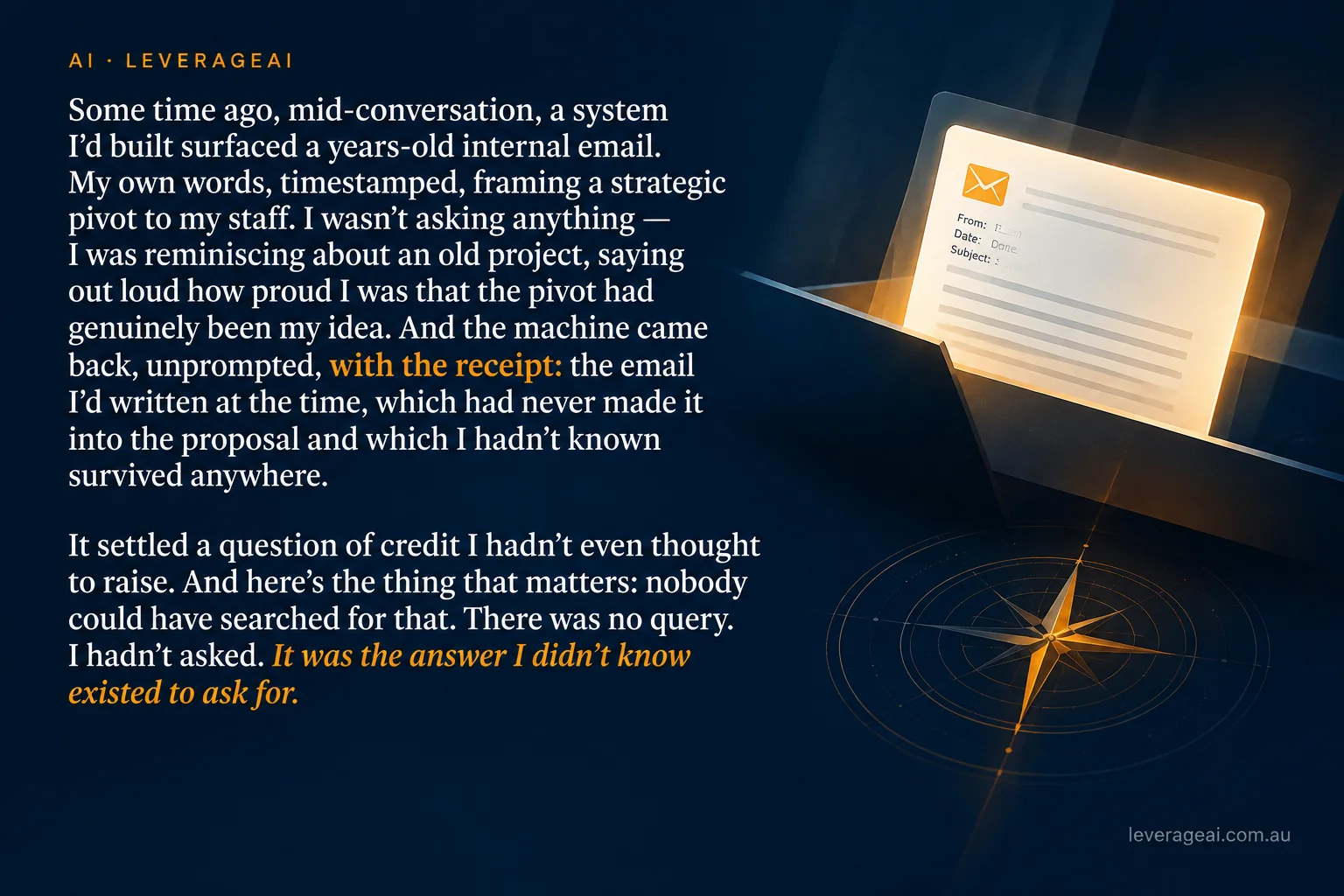
A system I'd built came back, unprompted, with a years-old internal email. My own words, timestamped, framing that pivot to my staff at the time. It never made it into the proposal. I didn't know it still existed anywhere.
It settled a question of credit I hadn't even thought to raise.
Notice what it didn't do. It didn't agree with my memory. It handed me a record I could check.
And that email wasn't unsearchable. It was unasked for. Nothing about telling the story gave me a reason to go looking. No query, no search box, no prompt.
That's the blind spot in how most teams judge AI retrieval. We test it on questions we already know to ask. Did it find the policy? Did it summarise the contract? Fine. But the evidence that changes a decision is often the evidence nobody thought existed.
So picture the same capability in a live meeting. Someone mentions in passing that a fixed-price deal "should be straightforward." Nobody stops to search. Meanwhile something quietly checks your past work and finds the 2019 project that overran on exactly those terms.
That's the design idea, not the event I lived. And it only works with discipline. A system that interrupts every time it finds something related is just noise with a better index. Most of the time, the right output is nothing.
The value isn't answering faster. It's answering the question that was never going to be asked.
What would your organisation find if something went looking without being told to?
Discover more from Leverage AI for your business
Subscribe to get the latest posts sent to your email.