
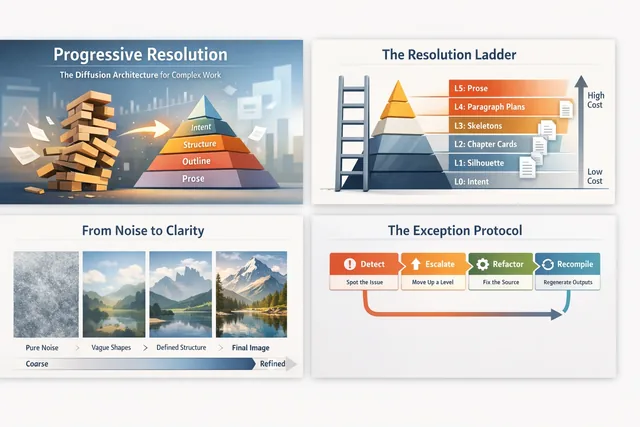
Progressive Resolution: The Diffusion Architecture for Complex Work
Why your complex documents keep falling apart—and the architecture that prevents it
You're not failing at editing. You're committing too early.
You know the feeling. You're deep into Chapter 7 of a proposal, an ebook, or a strategy document when you realize something is structurally wrong back in Chapter 3. You fix Chapter 3. But now Chapter 4 doesn't flow. You adjust Chapter 4, and suddenly Chapter 6 contradicts the new framing. What started as one fix has become a game of Jenga—each correction threatening to topple the whole structure.
Most people blame their editing skills. Or they blame the AI that generated the draft. But the real problem is architectural: you made high-resolution commitments (polished prose) before your low-resolution structure (intent, claims, evidence plan) was stable.
There's a better way. It's called progressive resolution—and it's the same architecture that makes image diffusion models work.
The Jenga Problem
Complex documents behave like coupled systems. Touch one beam, and the roof creaks. The mistake most workflows make is treating a manuscript like a linear tape when it's actually a multi-scale object—more like a map than a scroll.
The cascade happens because you're making decisions at the wrong resolution. When you write polished prose for Chapter 3 before you've stabilized whether Chapter 3 should even exist, you're building on sand. Every downstream section inherits your assumptions. Every upstream reference becomes a dependency.
The cost of late changes in software development tells the same story:
The Systems Sciences Institute at IBM documented this decades ago, and it remains true: fixing an error found after product release costs four to five times as much as one uncovered during design, and up to 100 times more than one identified in the maintenance phase.1
Documents work the same way. Fix a structural problem while you're still at the outline stage, and it's a five-minute adjustment. Fix the same problem after you've written 30 pages of prose, and you're facing hours of cascading rework.
What Image Diffusion Teaches Us
The insight comes from an unexpected place: how AI generates images.
Stable Diffusion and similar models don't draw pictures left-to-right, pixel-by-pixel. They start with pure noise—the lowest possible resolution—and progressively refine. First, vague shapes emerge. Then structure. Then detail. Then texture. At each step, the model stabilizes the current resolution before advancing to the next.
"This denoising process aims to iteratively recreate the coarse to fine features of the original image." — Paperspace, Generating Images with Stable Diffusion2
The key mechanism is that diffusion models never commit to pixel-level details until the overall composition stabilizes. They preserve semantic structure first—meaning and relationships—before rendering fine-grained details.3
This prevents mode collapse (generating the same thing repeatedly) and ensures coherent, high-quality outputs. The architecture refuses to go high-resolution until low-resolution is stable.
Writing should work the same way.
The Resolution Ladder
Think of complex work as having resolution layers—like image resolution, but for meaning and commitment:
| Layer | What It Contains | Cost to Change |
|---|---|---|
| L0: Intent | Why you're writing, for whom, what success looks like | Very low |
| L1: Whole-Doc Silhouette | One-page summary: thesis, major moves, what's out of scope | Low |
| L2: Chapter Cards | Each chapter's purpose, key claims, dependencies, evidence needs | Medium |
| L3: Section Skeletons | Headings, bullet arguments, transitions—not prose yet | Medium |
| L4: Paragraph Plans | Each paragraph's job, what evidence it uses | Higher |
| L5: Prose + Citations | Actual sentences, polished writing | Highest |
The rule: Don't advance to a higher resolution until the current layer passes its stabilization gate.
At L2 (chapter cards), you don't need final quotes—but you do need an evidence budget. What kind of evidence does this chapter require? Do you have it? If not, create an explicit research task. Don't advance resolution until it's satisfied or you redesign the chapter to not require it.
This is how professional writers actually work, whether they name it or not. They protect the core intent, stabilize structure, then write prose.
The Software Parallel
This isn't a new idea. It's the same architecture that makes software development tractable.
Compilers prove the pattern: source code → intermediate representation → assembly → machine code. Each layer stabilizes before advancing. You don't jump from high-level logic to raw machine instructions.4
The mapping to documents is almost comical:
| Software | Documents |
|---|---|
| Requirements / Spec | Intent + Audience |
| Architecture / System Design | Whole-Doc Silhouette |
| Module Design / Interfaces | Chapter Cards |
| Function Design | Section Skeletons |
| Implementation | Prose |
| Tests | Coherence Checks |
The data backs this up. Projects with clear requirements documented before development started were 97 percent more likely to succeed.5 Waterfall projects (linear, locked structure) experience a 49% failure rate compared to iterative approaches at 10-11%.6
But note: this isn't waterfall. Waterfall locks structure early and doesn't let you change it. Progressive resolution iterates at each layer until stable, then advances. When AI makes regeneration cheap, you can revise specifications as often as needed—the opposite of waterfall's rigidity.6
The Metacognitive Controller
Progressive resolution needs a supervisor: something that decides what resolution layer to work at, and when to back up.
Think of it as two loops:
- Do Loop (object-level): Generate the next artifact at the current resolution
- Think Loop (meta-level): Ask: Are we still solving the right problem, at the right resolution, with the right constraints?
The Think Loop's job isn't to "be smart." It's to control resolution, scope, and commitment. It runs checks:
- Does this layer still satisfy intent?
- Are dependencies consistent?
- Is evidence planned for claims at this layer?
- Did we introduce scope creep or contradictions?
If any check fails, you don't keep drilling down—because you'd be baking a flawed plan into expensive prose.
The Exception Protocol
When something breaks—missing evidence, contradiction, can't explain cleanly—you need an explicit protocol. Local patching is usually the wrong move because it creates hidden inconsistency debt.
The meta move is:
Detect: Signal that a constraint failed (claim can't be supported, concept doesn't explain cleanly, scope creep)
Escalate: Move up one or more resolution layers to where the problem is representable compactly
Refactor: Fix the upstream representation (structure, claims, definitions, intent)
Recompile: Regenerate downstream artifacts that depended on the old assumptions
That's the Jenga antidote: don't glue the wobbling block; rebuild the layer above it.
This works because you're not editing a scroll—you're recompiling from structured state. If Chapter 1 changes, you update the chapter card, mark dependent sections stale, rerun resolution passes for those nodes, and regenerate prose only where needed. Compilers handle upstream changes the same way: they don't rewrite the universe; they rebuild affected targets.
Why This Matters for AI-Assisted Work
AI makes this architecture both more necessary and more powerful.
More necessary because LLMs suffer coherence degradation in complex tasks. Research shows an average 39% drop in performance when tasks span multiple conversation turns rather than single prompts.7 Without external structure to maintain global coherence, AI-generated content drifts—locally plausible, globally inconsistent.
More powerful because AI makes regeneration cheap. When recompilation costs approach zero, the calculation inverts: fixing the specification and regenerating becomes faster than patching outputs.
Progressive resolution also solves the context window problem. A low-resolution global draft (L1 silhouette + L2 chapter cards) fits in context permanently. It's your "persistent context header"—the identity of the whole piece. High-resolution prose is the "swap-in working set"—loaded only for the current section.
This is how you get long-form coherence without pretending you can fit an 80-page document in a prompt. The low-resolution layers let you "see the future"—the complete plan—while only loading high-resolution detail as needed.
Putting It Into Practice
Here's how to apply progressive resolution to your next complex deliverable:
1. Start at L0: Lock Intent
Before anything else, answer: Why am I writing this? For whom? What does success look like? What's explicitly out of scope? Don't advance until this is stable.
2. Draft at L1: The One-Page Silhouette
Write a single page that captures the whole piece. Thesis. Major moves. Key claims. Evidence inventory (what you have, what you need). This is your diffusion "noise"—the blurry silhouette that will sharpen.
3. Stabilize L2: Chapter Cards
For each major section, create a card: purpose, claims, dependencies (what it assumes from earlier sections), evidence requirements. Run a gate: Does each card serve intent? Are dependencies consistent? Are evidence needs met or explicitly tasked?
4. Build L3: Section Skeletons
Headings, bullet arguments, transitions. Still not prose. This is where you catch structural problems cheaply. If a section doesn't flow from its predecessor, fix the skeleton—don't write prose and hope it works out.
5. Generate L4-L5: Prose
Now, and only now, write polished sentences. Because you've stabilized structure, your prose has constraints. It knows what claim it's making, what evidence it's using, and what comes next.
6. Run the Exception Protocol
When something breaks at L5, don't patch at L5. Ask: What resolution layer contains this problem? Back up, refactor, recompile. The time you "lose" going back is a fraction of the time you'd lose cascading fixes through finished prose.
The Paradigm Shift
Progressive resolution changes how you think about complex work:
- Old model: Writing is linear. Outline → draft → edit → polish.
- New model: Writing is diffusion. Coarse → fine, with stabilization gates and the ability to back up.
The old model treats documents as tapes. The new model treats them as compiled artifacts—regenerable from structured specifications.
This isn't just "plan better." Planning is one resolution layer. The insight is that each layer needs to stabilize before you advance, and when problems arise, you back up to the right layer instead of patching at the wrong one.
That's why your complex documents keep falling apart. Not because you're bad at editing. Because you're committing too early—making expensive decisions before cheap ones are stable.
Stop playing Jenga. Start thinking in resolution.
Apply This Framework
Progressive resolution is part of a broader system for AI-assisted complex work. For more on managing context windows as tiered memory, see Context Engineering. For the economics of regeneration vs. patching, see Stop Nursing Your AI Outputs.
References
- Celerity. "The True Cost of a Software Bug." — "The Systems Sciences Institute at IBM has reported that 'the cost to fix an error found after product release was four to five times as much as one uncovered during design, and up to 100 times more than one identified in the maintenance phase.'" celerity.com/insights/the-true-cost-of-a-software-bug
- Paperspace. "Generating Images with Stable Diffusion." — "This denoising process aims to iteratively recreate the coarse to fine features of the original image." blog.paperspace.com/generating-images-with-stable-diffusion/
- Picsellia. "Exploring Stable Diffusion." — "It preserves the semantic structure of the input data. This leads to more coherent and consistent images, where the generated content aligns with the original input and maintains its intended meaning." picsellia.com/post/exploring-stable-diffusion-revolutionizing-image-to-image-generation-in-computer-vision
- Wikipedia. "Intermediate representation." — "Use of an intermediate representation such as this allows compiler systems like the GNU Compiler Collection and LLVM to be used by many different source languages to generate code for many different target architectures." en.wikipedia.org/wiki/Intermediate_representation
- The Register. "268% higher failure rates for Agile software projects." — "One standout statistic was that projects with clear requirements documented before development started were 97 percent more likely to succeed." theregister.com/2024/06/05/agile_failure_rates/
- CoreStory. "Specification-Driven Development as an Enabler of Agile Methodology." — "Waterfall projects experience a forty-nine percent failure rate compared to agile projects' ten to eleven percent failure rate... When artificial intelligence can generate implementations from specifications in minutes rather than months, the cost of iteration approaches zero." corestory.ai/post/specification-driven-development-agile-methodology-reducing-iteration-cost-in-ai-assisted-software-engineering
- Anthony Alcaraz, LinkedIn. — "All examined LLMs exhibit significant performance degradation in multi-turn interactions. The 'LLMs Get Lost' study demonstrates an average 39% drop in performance when tasks span multiple conversation turns rather than single prompts." linkedin.com/posts/anthony-alcaraz-b80763155_without-external-knowledge-graphs-to-provide-activity-7329485920779304960-qw5t