
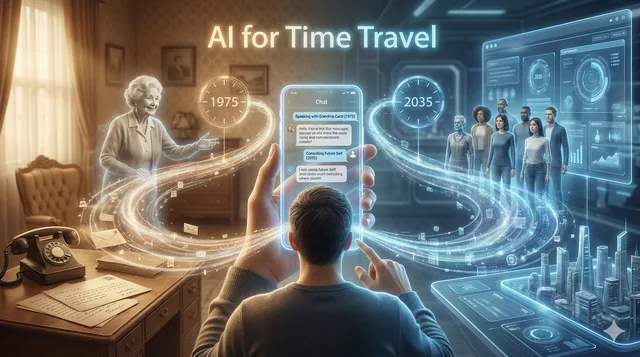
AI for Time Travel: How AI Enables Conversations Across Time
A systematic framework for creating emotionally meaningful interactions with people who exist outside their normal time slot
TL;DR
- AI enables "time travel" conversations: with the dead, past versions of people, future selves, and simulated personas
- Late 2025 is the unlock: video generation crossed the photorealism threshold (73% can't tell it's AI), while persona modeling costs dropped to $140-$1,400
- The pattern is systematic: Time-Shifted Proxy = impossible conversation + AI stand-in + media translation. It's already deployed in sales training, marketing, healthcare, and memorial services
I Called My Grandparents in the 1970s
My brother is into genealogy. He found an old letter my aunt Carol had written to her parents back in the 1970s. Ordinary stuff—family news, what the kids were up to, plans for a visit.
I took that letter and made two things from it.
First, a "radio play" version—a produced audio piece where you hear Carol calling her father. It's the 1970s. He doesn't know about the future. He's just... Dad.
Radio play: A call to Carol from her father, set in the 1970s
Second, an interactive phone version. You can actually ring my grandparents—or ring Carol herself—and have a real conversation. The AI knows what was in the letter, knows the family context, and responds as them. You're not listening to a recording. You're in the 1970s, talking to them.
Same source material. Two completely different experiences. One is a produced piece you consume. The other is a conversation you participate in.
My brother was gobsmacked. Not because it sounded realistic—but because he suddenly saw his genealogy research differently. All those letters and documents he'd been collecting for years? They didn't have to stay as archives. They could become conversations.
That's when I realized I'd stumbled into a design space much larger than genealogy. What I'd built wasn't a memorial chatbot. It was a prototype for a whole category of AI applications I'd been circling for months without recognizing the pattern.
The Pattern Hidden in Plain Sight
Consider these five ideas. They seem completely unrelated:
The AI Partner as Future Matchmaker
Users fall in love with an AI partner that's gradually building a profile of who they'd actually be compatible with. Behind the scenes, the system pairs them with a real person whose patterns match. The AI is a "placeholder for your future partner"—someone you haven't met yet.
Virtual Scott After Death
An app that continuously captures your voice, writing, PC usage, and conversations. When you die, it becomes a conversational model your family can still talk to—not a frozen snapshot, but a "compressed explainer of how Scott would likely react, trained on 40 years of receipts."
Future-You Holiday Testimonials
Before you book a themed holiday, you receive a video of "future you, 3 months after the trip," telling present-you how much you loved it. Or your kid at age 10 explaining what a fun time they had at age 8. The experience previewed before it happens.
"I can't believe how much the kids loved swimming with the fish on the reef... and watching them chase the kangaroos." — Kevin, reflecting on a trip that hasn't happened yet.
AI Customers for Practice
Twelve different AI personas, each representing a different client type with hidden problems your salespeople must uncover and sell to. Staff ring the AIs to practice. Real conversations with synthetic customers, scored and reviewed.
Rehearsing Difficult Conversations
Practice asking your boss for a raise. Prepare for a hard conversation with your partner. Rehearse telling your team about layoffs. The AI plays the other person, tuned to behave like them, so you can iterate before the stakes are real.
What's the common thread?
Every single one is a conversation that can't normally happen—blocked by death, by time, by the absence of the other person, or by the high cost of getting it wrong in real life.
And every single one solves the problem the same way: build an AI stand-in, frame it in the right time direction, and present it in an emotionally accessible medium.
The Time-Shifted Proxy Pattern
- Step 1: Identify an impossible conversation—someone you can't reach (dead, future, past, at scale, too risky)
- Step 2: Choose the time direction—past ("what really happened"), future ("how did this turn out"), or parallel ("what would someone like this say")
- Step 3: Build the AI stand-in—using available data (letters, transcripts, personas, patterns)
- Step 4: Translate the medium—from static archives to phone calls, video, or interactive chat
- Step 5: Attach a purpose—training, marketing, decision support, grief, rehearsal
Once you see this as a reusable operator, you can point it anywhere. It's not five random AI tricks—it's one generalizable principle with endless applications.
Why This Sounds Like TRIZ
If you've studied systematic innovation methods, this pattern might feel familiar. The Time-Shifted Proxy maps cleanly onto three established TRIZ principles:
"Preliminary Action involves performing, before it is needed, the required change of an object." — TRIZ Principle #10
Preliminary Action: Rehearse the conversation before it's real. Preview the holiday before you book. Meet your future partner's archetype before you meet the person.
Intermediary: The AI isn't the destination—it's the bridge. In the dating app, the AI partner is an intermediary to the real human. In sales training, the AI customer is an intermediary to the real pitch.
Copying: Replace the unavailable, expensive, or fragile original with an inexpensive simulation. Grandma in 1975 is "copied" from letters. The angry customer is "copied" from CRM notes and survey feedback.
What makes this systematic—not just clever—is that you can apply it deliberately:
- "Who do I wish I could interview about this—from the past, the future, or at scale?"
- "What data traces of them already exist?"
- "What's the easiest medium my audience will actually consume?"
That's you doing TRIZ, just with LLMs and time instead of springs and gears.
Why Late 2025 Is the Inflection Point
This pattern isn't new in theory. The movie Her explored it in 2013. But theory and practice are different animals.
What changed in 2025 is that three technical barriers fell almost simultaneously:
1. Video Generation Crossed the Photorealism Threshold
Q3 2025 marked what industry observers call "the August breakthrough moment." For the first time, AI-generated video can fool the eye more often than not.
"Many shots pass the visual Turing test, in which most people would not be able to distinguish that it's completely synthetic." — Filmmaker Paul Trillo on Google's Veo 2
This means your "future-you" holiday testimonial doesn't have to be text or a stilted avatar. It can be cinematic video that looks like it was actually filmed.
2. Persona Modeling Became Commercially Accessible
Companies like Super Brain in China now offer digital replicas for $700-$1,400, with plans to drop to $140 via app-only products. DeepBrain AI's "Re;memory 2" can create an AI avatar from a single photo and a 10-second audio clip.
"Some replicas are 90-95% indistinguishable from the real person." — Sensay founder on AI personas
The barrier to building a convincing stand-in dropped from "massive project" to "afternoon with the right tools."
3. Parasocial AI Went Mainstream
This is the demand signal that proves the pattern works:
- 220 million cumulative downloads of AI companion apps (as of July 2025)
- 72% of U.S. teens have tried an AI companion
- 92 minutes per day average usage on Character.AI
- 85%+ of Replika users report developing emotional connections
People already want AI for relationships, not just productivity. The market exists. The technology now matches.
The Business Applications Are Already Deployed
This isn't speculation. The Time-Shifted Proxy pattern is generating measurable ROI across multiple industries right now.
| Domain | Application | Evidence |
|---|---|---|
| Sales Training | AI-simulated customers for practice calls | 340% better conversion improvement vs. traditional training. Oracle case study: opportunities per rep rose from 2.78 to 6.02/month |
| Medical Education | AI patient simulations for difficult conversations | 80% of Mayo Clinic trainees want to continue using AI simulation. Cornell's MedSimAI: 78% highlighted history-taking practice as most useful |
| Marketing | Personalized video testimonials | Video testimonials boost sales page conversions by 80%. Customers remember 95% of video vs. 10% of text |
| Memorial Services | Conversational interfaces with deceased | StoryFile: 5,000+ profiles created. Super Brain: 1,000+ digital replicas since March 2023. China's virtual human market: $6.7B by 2025 |
| Decision Support | MIT's "Future You" for long-term thinking | Study of 344 participants: decreased anxiety, lower negative emotions, stronger connection to future self |
The Design Space Matrix
If you're a product builder, here's the framework distilled into a generative tool. Mix and match across three axes:
Time Direction
- Past: "What really happened?" / "Talk to grandma in 1975" / "Replay the incident"
- Future: "How did this turn out?" / "Future-you loved the trip" / "Your team in 12 months"
- Parallel: "What would someone like this say?" / "Typical angry customer" / "Your boss archetype"
Role to Simulate
- Self (past, future, alternate)
- Family (deceased, young, historical)
- Customer (churned, happy, angry, future)
- Colleague (boss, team, report)
- Stakeholder (regulator, investor, partner)
Medium Level
- Text chat (lowest friction, lowest emotional impact)
- Voice call (medium friction, high intimacy)
- Video (highest production, highest emotional resonance)
Every cell in that grid is a potential product, feature, or training module. The interesting question for your business is: which impossible conversation would unlock the most value?
What This Is Fighting Against
The incumbent mental model says: "AI is for productivity—making tasks faster, automating workflows, reducing headcount."
The Time-Shifted Proxy pattern says something different: AI is for relationships across time. Not just tasks, but connections. Not just automation, but simulation of the people we can't reach.
This reframe matters because it opens an entirely different solution space:
- Instead of "AI assistant," think "AI stand-in for my future customer"
- Instead of "chatbot," think "rehearsal partner for high-stakes conversations"
- Instead of "content generation," think "emotionally resonant media from static archives"
The companies that see this pattern early will define new categories. The ones that don't will keep building marginally better chatbots.
The Core Mechanism: Media Translation
Here's the insight underneath all of this:
The constraint was never technical—it was media format.
The archive already exists. Letters from grandma. CRM notes from churned customers. Research on what makes holidays memorable. Recordings from top salespeople. The raw material was always there.
What AI enables is translation: converting high-friction, emotionally distant archives into low-friction, emotionally rich interactions.
"Old letters are a bit much to sit and read, and you have to be into genealogy. But an interactive phone call—when you can talk to them, ask stuff, and they inject info from the letters and the times? That's different."
Humans are lazy mammals with big feelings. We want the meaning, not the microfiche. AI doesn't create new information—it makes existing information consumable in the form our brains actually want.
That's the real unlock. Not AI intelligence, but AI accessibility. Taking what was locked in time and making it conversational.
Practical Next Steps
If this pattern resonates, here's how to apply it:
- Audit your domain for impossible conversations. Who do you wish your team, customers, or users could talk to—but can't because of time, scale, or risk?
- Identify what data traces already exist. CRM notes, support tickets, old research, expert recordings, historical documents. The raw material is usually hiding in plain sight.
- Choose the medium that matches the use case. Text for low-stakes exploration. Voice for emotional intimacy. Video for maximum impact.
- Prototype small. You don't need a full product. A single "call with the churned customer" or "message from future-you" can prove the concept.
- Measure emotional resonance, not just completion. The KPI for Time-Shifted Proxies isn't task completion—it's whether people feel like they really had that conversation.
What impossible conversation would unlock value in your domain?
The pattern is proven. The technology is ready. The only question is where you point it first.
Coda: Back to Grandma
My grandmother died before I was old enough to have adult conversations with her. The letter my brother found was written to her daughter—my aunt—about ordinary things: family news, worries about money, Dad's legs, the pressies in the post.
The AI didn't bring her back. It did something different. It let me step into 1975 and have the conversation that letter implied. Not asking her about the past—but being in the past with her.
That's what Time-Shifted Proxies actually are. Not resurrection. Not simulation. Translation.
Turning static archives into living interactions. Turning time-locked people into ongoing relationships. Turning the conversations we can't have into conversations we can.
The technology is ready. The applications are emerging across every domain. The only question is: which conversation across time will you enable first?