
Your voice bot isn't failing because AI is slow. It's failing because you're making one brain do everything at once.
Human conversation operates at roughly 200 milliseconds between turns. That's three times faster than it takes most people to name an object—too rapid for conscious deliberation. Yet we expect AI voice agents to perform CRM lookups, policy checks, multi-step reasoning, and response generation in that window.
The result? Awkward silences. Wrong answers. Customers saying "hello? are you there?" before hanging up.
Most of these failures aren't accuracy problems caught in the lab. They're latency and integration issues discovered only in production. The system works in demos. It dies in real calls.
The fix isn't waiting for faster models. It's restructuring how your system thinks.
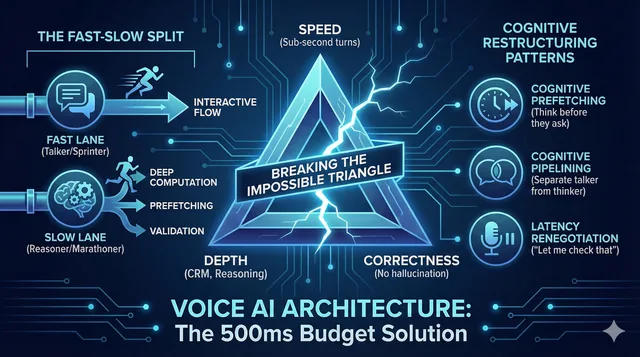
The Impossible Triangle
Voice AI architects face a brutal constraint. You're trying to hit three things simultaneously:
- Speed — Sub-second turns or the conversation feels broken
- Depth — CRM lookups, order history, policy rules, actual reasoning
- Correctness — Don't hallucinate, don't leak data, don't mislead
Traditional architectures force you into the worst version of this triangle:
| To Maximize | You Sacrifice |
|---|---|
| Speed | Depth (shallow, context-free responses) |
| Depth | Speed (multi-second silences) |
| Correctness | Both (conservative, vague answers) |
The sequential pipeline—STT to LLM to TTS—accumulates latency at every stage. Even with the fastest available components, you're looking at 800-2000ms total processing time. The math doesn't work.
Speech-to-speech models like OpenAI's Realtime API skip the pipeline entirely—audio in, audio out, 200-600ms latency. Problem solved?
Not quite. These models trade cognitive capacity for speed. The parameters spent on audio encoding/decoding are parameters not spent on reasoning. The result: weaker tool calling, more hallucinations, less reliable accuracy in noisy environments. As Andrew Ng notes, "voice models tend to have weaker reasoning capabilities compared to text-based models." For anything requiring CRM lookups, policy checks, or multi-step reasoning, the pipeline approach—properly architected—still wins.
"Research shows that each additional second of latency reduces customer satisfaction scores by 16%—a three-second delay mathematically guarantees a negative experience."
— Chanl AI, The 16% Rule
So what breaks the triangle?
Three architectural patterns that decouple conversational responsiveness from heavy cognition.
Pattern 1: Cognitive Pipelining
The core insight: the part that talks doesn't need to think, and the part that thinks doesn't need to talk fast.
Run two agents in parallel:
Fast Lane (The Sprinter)
- Tiny, cheap model—or no model at all
- No tool calls, minimal API dependencies
- Heavy reliance on cached context and recent conversation
- Job: Keep the conversation flowing. Make low-regret moves. Ask clarifying questions.
Slow Lane (The Marathoner)
- Bigger models, heavy tool usage
- CRM queries, order lookups, knowledge search
- Runs in parallel threads/workers
- Has read access to the evolving conversation
- Job: Do the real digging. Validate. Fetch. Reason.
The slow lane writes results back into a form the fast lane can use—injected as if they were tool responses. By the time the user asks their next question, the fast agent has fresh context it didn't have to wait for.
Google DeepMind calls this the "Talker-Reasoner" architecture, explicitly inspired by Kahneman's dual-process theory. System 1 handles rapid, intuitive responses. System 2 handles deliberation, planning, and multi-step reasoning.
"The Talker component is designed to handle rapid, intuitive conversational responses. Meanwhile, the Reasoner component focuses on deeper, logical reasoning, tool usage, and multi-step planning."
— Synced, on Google DeepMind's Dual-Agent Architecture
You've essentially decoupled the latency of turn-taking from the latency of actual cognition.
Pattern 2: Cognitive Prefetching
Web developers learned this decades ago: the best optimization is doing the work before the user asks for it.
The moment you have user identity—login, recognized phone number, auth token—kick off background jobs:
- Summarize last N interactions
- Pull current orders, tickets, invoices
- Fetch entitlements, flags, SLAs
- Pre-compute a "customer snapshot": what they usually care about, any open issues, recent activity patterns
The customer hasn't told you their problem yet. You haven't asked the first question. But you've already pulled all their records and summarized them.
You can be even more aggressive. 70-80% of callers show up for the same small set of things: Where's my order? What's this charge? My service is broken. I want to cancel.
Prefetch the default bundle before the first sentence is finished. Last orders. Last invoices. Service status. Recent tickets. If you're wrong, you wasted some cycles nobody saw. If you're right, the response feels magical.
This is the AI equivalent of CDNs, database read replicas, and edge caching. You're time-shifting cognition to where latency tolerance is high (before the question) to reduce latency where tolerance is low (during the conversation).
Perceived time versus wall-clock time. The customer experiences instant answers. Your system spent a minute preparing them.
Pattern 3: Latency Renegotiation
Watch a human call center agent. They constantly renegotiate timing expectations:
- "Just a moment while I pull up your account."
- "Give me a second, I'm checking that now."
- "Mm-hm... right... okay, let me see..."
That's not politeness. It's a latency management protocol. You're saying: "I'm going to be quiet because I'm working."
Most voice bots ignore this completely. They try to stay in "instant answer mode" the whole time, which forces them to use tiny models with shallow context, or block awkwardly while tools run, or bluff with half-baked answers.
For a bot, latency renegotiation looks like:
- Fast micro-turn: "Got it, let me check your recent invoices."
- Safe filler: "I'm just pulling those up now..."
- Background crunch: Slow workers fetch and summarize
- Precise response: "Invoice 123 was issued on April 14th, currently showing as paid via card ending 1234."
You can also introduce provisional answers:
"It looks like your last payment was in April—I'm just confirming that against your full account history now."
Then refine:
"Confirmed, April 14th, $247 via the card on file."
Or correct:
"Actually, I've just seen an update—your most recent payment was in May."
That's human. We do this constantly: "Off the top of my head I think it's X, but let me double-check."
You've turned "one shot to be perfect" into a fast guess that keeps the interaction alive, followed by a slower validation that can refine or correct.
Putting It Together
Stack the three patterns:
- Identity triggers prefetching — Heavy summarization and data pulls start before "How can I help?"
- Fast lane handles turn-taking — Tiny model manages conversation flow, acknowledgments, clarifications
- Slow lane digs in parallel — Multiple workers fetch, validate, and reason
- Latency renegotiation buys time — Explicit conversational moves create space for processing
- Results inject into context — Slow lane outputs appear as tool results for fast lane to use
The user hears:
"Hi Sam, good to hear from you. How can I help today?"
(Prefetch already running in background)
"I'm calling about invoice 123..."
"Sure, let me look up invoice 123 for you."
(Invoice list already cached from prefetch; just grabbing details)
"Invoice 123 was issued on April 8th for $1,247. It's currently showing as unpaid, due on the 22nd. I can see you have a card on file—would you like me to process that payment now?"
Sub-second response. Deep context. Correct information. The triangle solved.
Why This Works When It Works
The pattern succeeds because it attacks the right constraint.
Model speed isn't the bottleneck. Even 100ms model inference doesn't help when CRM APIs take 2 seconds. The latency is in the plumbing, not the brain.
Parallel beats sequential. A well-designed concurrent pipeline can halve perceived latency by overlapping operations that would otherwise execute one after another.
Humans already do this. Every call center agent manages timing expectations, gives provisional answers, and does lookup work while talking. We're just teaching machines the same protocol.
Prefetching trades cheap cycles for expensive moments. Background computation before questions are asked is nearly free. Real-time computation during conversation is brutally constrained. Move work from the expensive zone to the cheap zone.
What You Give Up
This isn't free. The fast-slow split adds architectural complexity:
- Two (or more) agent orchestration instead of one
- Shared context management between lanes
- Race condition handling when slow results arrive mid-utterance
- More infrastructure to monitor and debug
Prefetching requires prediction. You're betting on what users will ask. When you're wrong, you've spent cycles on data nobody needed. The economics usually work—80% prediction accuracy on high-frequency queries pays for itself—but you need the instrumentation to know.
Latency renegotiation requires explicit conversation design. Your bot needs a repertoire of "buying time" phrases and the judgment to use them appropriately. Too many and it feels like stalling. Too few and you're back to awkward silence.
None of this is trivial. But the alternative—waiting for models to get 10x faster while competitors ship—isn't a strategy.
The Bottom Line
Voice AI has a structural problem that faster models won't solve. The 500ms conversational constraint is biological, not technical. You can't make humans wait longer.
The answer is cognitive restructuring:
- Cognitive Pipelining — Fast talker, slow thinkers, running in parallel
- Cognitive Prefetching — Heavy work before questions are asked
- Latency Renegotiation — "Let me check that" as a first-class design pattern
The voice AI that works isn't the one with the biggest model. It's the one that knows when to talk, when to think, and how to do both at once.