
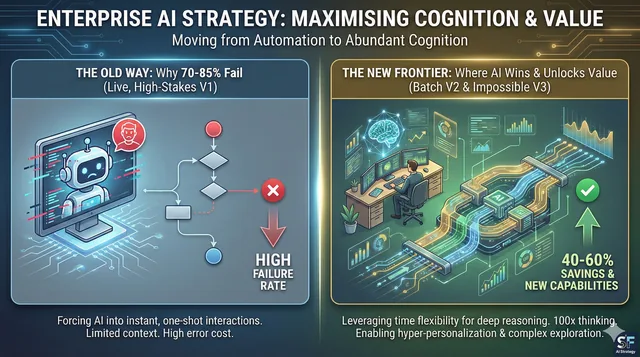
Maximising AI Cognition and AI Value Creation
Why most AI projects fail, where they actually win, and the new frontier of "impossible-before" thinking
Key Takeaways
- 70-85% of AI projects fail because companies deploy AI where it's weakest: live, high-stakes, one-shot interactions
- AI wins in batch contexts—ticket queues, overnight analysis, anywhere with time flexibility delivers 40-60% cost savings
- Version 3 is the real opportunity: not automating current work, but enabling thinking that was previously impossible due to human coordination limits
The Uncomfortable Truth About AI Failure
Let me tell you about an AI project that cost $2.3 million and delivered nothing.
A mid-sized insurance company—let's call them Acme—decided they needed an AI chatbot. Their board had seen the headlines. Competitors were announcing AI initiatives. The CEO wanted something impressive to show at the next shareholder meeting.
So they hired consultants, bought platforms, trained models, integrated systems. Nine months later, they launched.
Within six weeks, they quietly pulled it offline.
The chatbot frustrated customers. It couldn't handle the nuance of insurance questions. When it made mistakes—which was often—customers had no graceful path to a human. Complaints spiked. Net Promoter Score dropped. The project became a cautionary tale told in hushed tones at industry conferences.
Acme isn't unusual. A 2025 MIT study systematically reviewed over 300 publicly disclosed AI initiatives and found that 95% showed zero return on investment. According to S&P Global, 42% of companies abandoned most of their AI projects this year—up from just 17% in 2024.
RAND Corporation's analysis confirms the pattern: AI projects fail at twice the rate of non-AI technology projects.
The diagnosis from researchers is remarkably consistent: companies force AI into existing processes unchanged, expecting magic. What they get is expensive failure.
But here's what makes this interesting: some companies report $10.30 in value for every dollar invested in AI. Klarna's AI assistant contributed $40 million in annual benefit. What's the difference?
The difference is where they deploy—and understanding why AI is fundamentally asymmetric.
The Asymmetry Nobody Talks About
Imagine two scenarios.
Scenario A: A customer opens a live chat. They're frustrated about a billing discrepancy. They need an answer in the next 30 seconds, and if the answer is wrong, they'll screenshot it and post it on social media.
Scenario B: That same customer submits a support ticket. The expectation is a response within 4 hours. Someone (or something) can review the customer's entire account history, cross-reference similar cases, check policy documents, and draft a thoughtful response.
These scenarios have completely different success criteria. And AI performs completely differently in each.
The Latency-Accuracy Trade-Off
In Scenario A—the live chat—AI gets one shot to be right. To be reliable, you need:
- A strong model (expensive, and increased latency)
- Thinking models for complex reasoning (adds seconds to minutes—trading speed for accuracy)
- Rich context pulled from multiple systems (latency)
- Guardrails for safety, compliance, brand tone (more latency)
- Maybe a second-pass checker (even more latency)
Add all that up, and research shows real-time AI systems have higher false positive rates due to limited context and the need for snap decisions. The infrastructure costs are substantial. And even then, the chatbot fails to resolve issues 63% of the time.
Meanwhile, a human support agent:
- Already understands the internal tools through years of tacit knowledge
- Can click around the CRM, pattern-matching intuitively
- Adjusts in real time when the customer clarifies "no, that's not what I meant"
- Recovers gracefully from being slightly wrong with social intelligence
"72% of respondents reported that interaction with a chatbot is a 'complete waste of time.' 78% were forced to connect with a human after failing to resolve their needs through automation."
— Forbes, citing UJET research
In low-latency, high-stakes, high-ambiguity contexts, humans still win on accuracy, judgment, and social handling.
But flip to Scenario B—the ticket queue—and the economics reverse completely.
Where AI Actually Wins
When AI has time flexibility, everything changes:
- It can read the customer's entire history without latency pressure
- It can cross-check multiple systems and run multi-step reasoning
- It can try multiple approaches and select the best response
- It can escalate to humans when uncertain rather than guessing
- And critically: customers already expect minutes or hours, not seconds
"Batch processing typically reduces infrastructure costs by 40-60% compared to real-time systems, with savings increasing at higher volumes."
— Zen van Riel, AI Engineering
This isn't a minor difference. It's a structural asymmetry that determines whether AI projects succeed or fail.
The Deployment Framework: A 2x2 That Actually Works
You can map every AI use case onto two dimensions:
- Latency tolerance: Does the response need to be instant (seconds), or is there flexibility (minutes, hours, overnight)?
- Consequence of error: Is a mistake cheap to fix, or expensive/regulated/embarrassing?
| Low Latency (seconds) | High Latency (minutes/hours/overnight) | |
|---|---|---|
| High Error Cost | Human-led, AI-assisted | AI does work, human signs off |
| Low Error Cost | AI copilot mode | Prime AI territory |
The bottom-right quadrant—high latency tolerance, low error cost—is where AI dominates:
- Ticket queues: AI triages every ticket, resolves simple cases autonomously, drafts responses for complex ones
- Overnight batch jobs: Transaction analysis, CRM scoring, anomaly detection across every row—not just samples
- Report generation: Research, summarization, quality checks at scale
- Internal operations: Document processing, data reconciliation, compliance checks
The left side of the matrix—where responses must be instant—is where humans lead. But even here, AI has a role: not answering, but preparing. More on that later.
The Three Versions of AI Value
Most AI conversations stop at "automation." That's only the first version—and often the weakest.
1 Same Work, Fewer People
Classic automation. Replace a human task with AI. This is the most common deployment pattern, and it has the highest failure rate.
Why? Because you're competing with humans at what humans do reasonably well, in contexts optimized for human cognition. The 70-85% failure rate lives here.
Version 1 can work—but only in the right quadrant of the deployment matrix. Klarna's AI assistant "replaced" 700 agents, but notice: it handles ticket-style interactions, not live real-time support. It's batch-adjacent.
2 10-100x More Thinking at the Same Problems
This is where the economics start to shine. Instead of one analyst sampling 50 transactions, AI checks every transaction. Instead of triaging 100 tickets per day, AI triages 10,000.
The promise of cheap cognition: "Once the plumbing is in, marginal cost per extra 'thinking task' trends toward cents instead of dollars."
Companies achieving Version 2 report $3.70-$10.30 return per dollar invested. They're not replacing people—they're applying 100x more cognitive work to existing problems.
3 Thinking That Was Previously Impossible
Here's where it gets interesting. What if cheap cognition doesn't just accelerate current work—but makes new work rational to attempt?
Consider the typical enterprise strategic project: 10 cross-functional people, 3 months of workshops and meetings, optimizing for political acceptability under time pressure, settling for "good enough" because coordination overhead is crushing.
What if you could bypass that entirely?
Version 3 is the frontier. It's not automation—it's unlocking work that was never feasible before.
Hyper Sprints: Replacing Committee-Think
Research on group decision-making reveals an uncomfortable pattern.
"When time is limited, less knowledge is shared and decisions are more the result of negotiating between prior preferences. Groups with similar compositions are likely to reach similar conclusions. There is a risk that, rather than critically evaluating options, groups may conform and make poor decisions through 'group think.'"
— ANZSOG research on committee effectiveness
This is committee-think: optimizing for consensus and political acceptability under time pressure, rather than genuine exploration of possibilities.
Now imagine a different approach: the hyper sprint.
- Take a problem you'd normally hand to a cross-functional group for 2-3 months
- Run thousands of AI calls overnight
- Explore multiple frames, scenarios, and constraints systematically
- Generate an audit trail of what was considered, rejected, and why
- Human experts review in the morning and adjust the search for the next sprint
You're not asking AI to magically know the answer. You're asking it to systematically explore more possibilities than humans would ever have time for—like chess engines exploring move trees.
Humans are terrible at exploring large idea spaces under time and social pressure. AI is good at it, as long as humans shape the scoring and constraints.
This is possible now because of extended thinking—AI models that can allocate more compute to reasoning, trading latency for depth. Research shows that inference-time compute can make a small model outperform a 14x larger model on complex tasks.
"A task that might take a team of developers three weeks becomes a problem the agent iterates through 200 times between midnight and 6am."
— LeverageAI research on hypersprints
Committee-think optimizes for consensus under pressure. Hyper sprints optimize for search coverage and idea quality, with politics coming after you've seen the landscape.
Marketplace of One: When Personalization Becomes Rational
Here's another Version 3 example that's already reshaping industries.
Historically, we segment customers because it's too expensive to treat each one individually. Policies, campaigns, support flows—all designed for "average customer in segment X."
This was rational when cognition was expensive. Managing per-customer complexity would have required armies of analysts.
McKinsey estimates that's the opportunity. But until now, capturing it was economically insane.
With AI, you can design per-customer:
- Offers and pricing (dynamic, based on individual behavior and context)
- Service levels and communication style (matching preference patterns)
- Risk rules and escalation paths (personalized thresholds)
- Content and recommendations (true 1:1, not "people like you also bought")
"AI doesn't optimize for average—it adapts to context. Every interaction can be unique. The cost structure has flipped. Customization used to be expensive. Now recomputing per-customer costs less than maintaining one-size-fits-none."
— LeverageAI research
Companies leveraging AI-driven hyper-personalization are seeing 62% higher engagement and 80% better conversion rates compared to traditional segment-based approaches.
That's not automation. That's a new class of product and service design—work that simply didn't exist before because it wasn't economically rational to attempt.
AI as Cognitive Exoskeleton
There's a pattern that works across all three versions: AI does the pre-work, humans own the moment.
Remember the left side of our deployment matrix—where responses must be instant? That's where humans still lead. But AI has a crucial role: not answering, but preparing.
In live contexts where AI struggles with the latency-accuracy trade-off, flip the mental model:
- AI mines the CRM for truly relevant past interactions and summarizes them
- AI infers what the customer probably cares about, given history and current message
- AI pulls in knowledge base articles, policies, and similar resolved cases
- AI surfaces a rich cockpit: context, suggested actions, draft responses, risks to watch for
The human is then:
- Faster (less clicking and searching)
- More accurate (better context than they'd find alone)
- Still the one doing judgment and relationship handling
Medical studies validate this approach. AI assistance increases diagnostic sensitivity from 72% to 80%—not by replacing doctors, but by augmenting them.
Anthropic's research found that multi-agent systems with human orchestration outperform single-agent autonomous systems by 90.2% on complex tasks.
From: "AI answers the customer" (fragile, one-shot, high failure rate)
To: "AI does everything leading up to the moment where the human answers" (robust, augmentative, plays to each party's strengths)
You're not forcing AI into the brittle, one-chance-to-be-perfect live-chat role. You're using it as a cognitive exoskeleton around the human—amplifying their capabilities rather than trying to replace their judgment.
The Real AI On-Costs
One more thing separates successful AI projects from failures: acknowledging the real cost structure.
"$1/hour AI" is fantasy if you ignore the on-costs. The true AI expense list looks suspiciously like hiring a department:
- Toolchain & infra: Retrieval systems, vector stores, orchestration, observability platforms
- Ops & monitoring: Logs, alerts, dashboards for detecting drift and anomalies
- Governance & risk: Policies, model selection criteria, approvals, audit records for regulators
- Model & prompt maintenance: Workflows decay, products change, prompts need updating
- Change management: Training staff, updating SOPs, handling organizational politics
Research shows that successful AI organizations invest 70% of resources in people and processes—not just technology. They expect 2-4 year ROI timelines, much longer than typical 7-12 month software payback periods.
"AI does make cognition cheaper at scale. But only if you treat it like genuine capability with ongoing costs—not like a magic SaaS feature you tick on in settings."
The organizations failing at AI are the ones who expected it to be plug-and-play. The ones succeeding treat it like building a new organizational capability—because that's what it is.
A New Question for AI Project Selection
Most organizations start their AI journey with the wrong question:
"Where can we put a chatbot?"
Better question:
"Where do we waste human thinking time on work that's slow, repetitive, or queued up?"
That's where Version 2 wins—applying 10-100x more cognition to existing problems.
Best question:
"What thinking have we never even attempted because the coordination overhead was too high?"
That's Version 3—the frontier where AI looks less like a gimmick and more like infrastructure.
The organizations getting 10x returns from AI aren't smarter about technology. They're smarter about deployment. They've stopped asking "where can we automate?" and started asking "what becomes rational when cognition is abundant?"
That shift—from Version 1 thinking to Version 3 thinking—is the difference between AI as expensive experiment and AI as transformative capability.
What's one project you've never attempted because it would take too many people, too much coordination, or too long a timeline?
That might be your Version 3.