
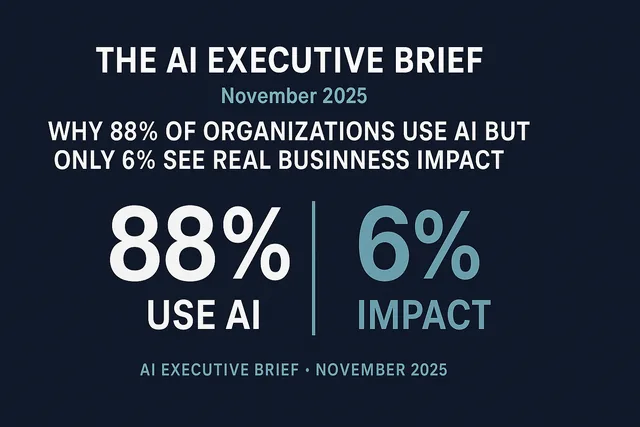
The AI Executive Brief: November 2025
Why 88% of organizations use AI but only 6% see real business impact—and what separates the winners from pilot purgatory
Three years into the generative AI era, a paradox has emerged. Nearly nine out of ten organizations now use AI regularly. Yet only a tiny fraction—about 6%—report meaningful bottom-line impact. The data reveals something counterintuitive: the bottleneck isn't AI capability. It's organizational ambition and transformation courage.
This brief synthesizes findings from McKinsey's November 2025 Global Survey on AI—1,993 respondents across 105 countries—alongside supporting research from Bain, BCG, and Deloitte. The goal isn't to add to the noise about AI's potential. It's to surface the specific patterns that distinguish organizations capturing real value from those trapped in endless experimentation.
The State of Play: November 2025
AI adoption has become nearly universal. The share of organizations using AI in at least one business function jumped from 78% last year to 88% today. Generative AI specifically has gone from novelty to standard practice. AI agents—systems capable of autonomous action across workflows—are now being explored by 62% of organizations, with 23% already scaling agent deployments.
But adoption and impact are proving to be very different things.
"While 70% of enterprises succeed with pilots, integration with legacy infrastructure, poor cross-functional collaboration, and governance gaps prevent 80% from reaching production."
— AIM Research Council
Only 39% of respondents attribute any level of EBIT impact to their AI use. Most of those reporting impact say it accounts for less than 5% of their organization's EBIT. The gap between "using AI" and "benefiting from AI" has never been starker.
Pilot Purgatory: The 62% Stuck in Experimentation
The industry has a name for this phenomenon: pilot purgatory. Nearly two-thirds of organizations remain in experimenting or piloting phases, unable to scale their AI initiatives into operational reality.
The pattern is predictable:
- Month 1: Excitement. "We're piloting AI!" Demos look promising. Stakeholders are enthusiastic.
- Month 3: Complexity reality. Edge cases emerge. Integration proves harder than expected. Performance is inconsistent.
- Month 6: Expansion stall. The pilot works for its narrow use case, but scaling requires infrastructure rebuild, security review, compliance approval, data pipeline overhaul. "Let's evaluate before expanding."
- Month 12: Quiet cancellation. The pilot is still running—10 users, limited scope. No production roadmap exists. The project is quietly shelved.
The Platform Trap
Organizations that treat AI pilots as throwaway prototypes—fast demos with hard-coded configs and manual data exports—consistently fail to scale. One documented case: $450K spent before cancellation at Month 7. The same organization's second attempt, designed for production from day one with proper infrastructure, scaled smoothly and achieved 50% cost savings on subsequent projects through platform reuse.
The 6% Profile: What High Performers Do Differently
McKinsey's definition of "AI high performers" is precise: organizations attributing 5% or more of their EBIT to AI use and reporting "significant" value from AI initiatives. This group represents about 6% of respondents.
What separates them isn't better AI tools. It's fundamentally different organizational behavior.
1. They Pursue Transformation, Not Just Efficiency
The most striking finding: high performers don't just optimize—they transform. They're 3.6 times more likely to say their organization intends to use AI for enterprise-wide transformative change.
The efficiency-only approach is the default. 80% of organizations set cost reduction as an AI objective. But high performers layer on growth and innovation objectives at dramatically higher rates. They're not just trying to do the same things cheaper—they're trying to do different things entirely.
"Efficiency is table stakes. Transformation comes from using AI for growth and innovation simultaneously."
2. They Redesign Workflows, Not Just Tasks
Perhaps the most important finding in the entire survey: high performers are 2.8 times more likely to have fundamentally redesigned workflows around AI.
"This intentional redesigning of workflows has one of the strongest contributions to achieving meaningful business impact of all the factors tested."
— McKinsey Global Survey on AI, November 2025
The distinction matters. Most organizations bolt AI onto existing processes—automating steps, adding chatbots, speeding up familiar workflows. High performers ask a different question: If we were starting today with AI capabilities, what would this process look like?
"You can't automate your way to transformation. You have to rethink the work itself. True gen AI impact requires detailed, zero-based process design: mapping where you are today and reimagining how the work could operate with AI embedded from the ground up. It's the process redesign—not the technology—that creates most of the value."
— Bain & Company
The Violin-as-Hammer Problem
Automation made sense for every previous technology wave: assembly lines, ERP, CRM, RPA. Each made existing processes run better. None questioned whether the processes should exist. AI is different. AI doesn't just execute faster—it understands context. AI doesn't just follow rules—it adapts. Using AI to grease cogs is using a violin as a hammer.
3. Senior Leaders Own It Personally
High performers are 3 times more likely to strongly agree that senior leaders demonstrate ownership of and commitment to AI initiatives. This isn't delegation to CIOs or "AI committees." It's personal, visible, active engagement from the CEO level.
Why does this matter so much? Because transformation requires breaking organizational boxes.
"Middle management can pilot AI. They can't transform the organization. Transformation crosses boundaries: budget reallocations across departments, process changes affecting multiple teams, cultural shifts requiring visible leadership, strategic bets defining company direction. Anyone below the CEO hits walls."
— Enterprise AI Research
The phrase that captures it: "Pilots fit in boxes. Transformation breaks them. Only the CEO can break boxes."
4. They Invest Meaningfully in Change Management
Organizations that invest properly in change management are 1.6 times more likely to report AI initiatives exceeding expectations.
What "meaningful investment" actually means:
- Budget: 20-25% of total project cost allocated to change management (not squeezed from contingency)
- Timeline: T-60 days before launch through T+90 days after
- Dedicated roles: Change manager and training coordinator (not "someone's side project")
- Structured activities: Role impact analysis, training-by-doing, feedback loops
The inverse finding is sobering: 87% of organizations that skip change management face more severe people and culture challenges than technical hurdles. The algorithm works. The humans refuse to use it, misuse it, or quietly sabotage it.
The Compensation Trap
If AI doubles expected throughput—process 2x claims per day, handle 2x customer inquiries—KPIs and compensation must update. Otherwise, you've created unpaid overtime with a side of resentment. Research shows 31% of employees admit to some form of AI sabotage when AI increases expectations without compensation adjustment.
The AI-Native Benchmark
While incumbents struggle with pilot purgatory, a new class of AI-native companies is demonstrating what's possible when you build from scratch around AI capabilities.
Cursor, an AI-powered development environment, went from $1M to $100M ARR in 12 months—and hit $1B ARR with only 300 employees. That's $3.3M in ARR per employee. For comparison: Salesforce generates approximately $800K ARR per employee.
Lovable became the fastest software company ever to reach $100M ARR, achieving the milestone in just 8 months with 45 employees. That's $2.2M in revenue per employee.
Gamma reached $100M ARR profitably while serving 70 million users, demonstrating that AI startups can build massive valuations without burning massive cash.
These aren't outliers in the traditional sense. They're previews of a structural shift in what's possible when AI is embedded from day one rather than bolted on afterward.
"Cursor hit $100M ARR with zero marketing spend. Zero. The entire go-to-market was: Build an insanely good product. Let developers find it. Watch them tell everyone. Their conversion rate? 36%. Most freemium SaaS products convert at 2-5%."
— SaaStr Analysis
Why Most AI Initiatives Fail: The Three-Lens Problem
The 95% failure rate isn't a technology problem. It's a systemic organizational failure. Research reveals that organizations evaluate AI success through three incompatible lenses—and when misaligned, even perfect technology appears to fail.
The Three-Lens Framework
The tragedy: 75% of AI projects can't prove ROI because no baseline was established before launch. The CFO can tell you current throughput but can't prove what changed because of AI versus other factors.
"For 95% of companies, the hidden assumptions are false: that you know the problem, know the workflow, know success metrics, and know the trade-offs."
— AI Think Tank Research
The 18-Month Window
The transformation opportunity is time-bound. McKinsey's research on AI-centric software companies projects:
- Operational shifts (20-40% cost reduction) are realizable within 12 months for organizations that start now
- Value proposition shifts (new products, business models) materialize in 12-24 months
- Workforce and workplace transformation takes 24-36 months to fully manifest
The window matters because AI-native competitors aren't waiting. While incumbents debate pilot expansion, companies like Cursor and Lovable are demonstrating that entire categories can be disrupted in months, not years.
Sam Altman and other tech CEOs reportedly have a betting pool on when the first $1 billion solopreneur business will emerge—a single person leveraging AI agents to build a billion-dollar company. Whether that specific prediction comes true, the direction is clear: the efficiency gains from AI-native operations are so dramatic that smaller, faster organizations can compete with—and outperform—much larger competitors.
The High Performer Playbook: Five Actions
Based on the patterns distinguishing the 6% from the 94%, here's what the data suggests:
What High Performers Do Differently
The Bottom Line
The data is clear. AI adoption is no longer the differentiator—nearly everyone has crossed that threshold. The new divide is between organizations that treat AI as a tool to bolt onto existing processes and those willing to fundamentally transform how work gets done.
The 6% of high performers share common patterns: they pursue transformation over mere efficiency, they redesign workflows rather than just automating tasks, they ensure senior leadership ownership, and they invest meaningfully in change management.
The question for every executive isn't "Are we using AI?" It's "Are we using AI to do the same things faster—or to do fundamentally different things?"
The bottleneck isn't AI capability.
It's organizational ambition and transformation courage.
For organizations still in pilot purgatory, the path forward isn't more AI tools. It's a fundamental shift in how leadership approaches the opportunity. Pilots fit in boxes. Transformation breaks them.
The window is open. The patterns are clear. The question is whether your organization will be among the 6% who capture real value—or the 62% who remain stuck in endless experimentation.