
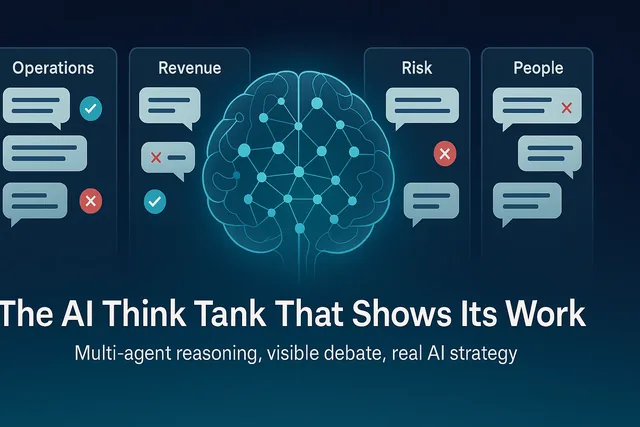
The uncomfortable truth about enterprise AI adoption, and why multi-agent reasoning with visible rebuttals is the solution nobody's talking about.
It's Monday morning, and your CEO walks into the executive meeting with that look—the one that says "I read something on the flight back from the conference."
"We need AI," they announce.
Heads nod around the table. Of course. It's 2025. Everyone needs AI.
Then someone—usually the CTO, sometimes the CFO—asks the question that kills the momentum:
"For what, exactly?"
Silence.
The CEO opens their mouth, closes it. Looks at the deck from the consultant you hired last quarter—90 slides, somehow less clear than before they arrived.
"We'll... we'll figure that out," they say. "Just get some pilots going."
And that's how another company joins the 95%.
According to MIT's 2025 State of AI in Business Report, something shocking is happening across enterprise AI adoption:
Despite $30-40 billion in enterprise investment into GenAI, 95% of organizations are getting zero return.
— MIT State of AI in Business 2025 Report
Read that number again. Ninety-five percent.
This isn't a small sample or a worst-case scenario. This is the state of enterprise AI in 2025.
S&P Global reports that the percentage of companies abandoning AI initiatives before production has surged from 17% to 42% year over year, with organizations reporting that 46% of projects are scrapped between proof of concept and broad adoption.
Here's what makes this crisis so interesting: the technology isn't the problem.
GPT-4, Claude 3.5, Gemini—these are remarkable systems. They can write code, analyze documents, generate insights, answer questions. The capabilities are real.
So why the catastrophic failure rate?
MIT's research points to three root causes:
But there's a deeper issue beneath all three: Companies are solving the wrong problem.
The current market treats AI adoption as a tool problem:
But these questions all assume you already know:
For most mid-market companies, those assumptions are false.
The real challenge isn't "which tool?"
It's: "What AI opportunities exist in our unique operational context? Which ones are worth pursuing? Which ones will we regret?"
That's a discovery problem, not a tool problem.
MIT's research uncovered something fascinating: 90% of employees now use personal AI tools (ChatGPT, Claude, etc.) at work, but only 40% of companies have officially adopted enterprise AI solutions.
What does this tell us?
People will adopt AI when it solves their specific problems—regardless of official policies or IT-approved tools. The discovery problem isn't "do AI tools exist?" It's "which tools solve which problems for which people in which contexts?"
When I explain the discovery problem to executives, the most common response is:
"Can't we just ask ChatGPT (or Claude, or our AI consultant) for ideas about where to use AI?"
You can. And you'll get something useful.
But here's what you won't get:
ChatGPT gives you one model's best guess based on generic business patterns. What happens when different perspectives conflict?
A single AI can't genuinely debate itself. It will pick one angle or try to satisfy all (which usually means generic advice that fits nobody perfectly).
An idea that sounds brilliant in isolation often falls apart under scrutiny:
You need something that actively tries to break ideas, not just propose them.
The most valuable insight is often: here's what we considered and killed, and why.
When a consultant recommends three AI initiatives, the real question is: "What were the other 20 you didn't recommend, and why didn't they make the cut?"
Every AI opportunity has trade-offs:
Single-agent AI tends to optimize for one dimension. Real businesses operate in multi-dimensional constraint spaces.
Andrew Ng—one of the most respected voices in AI—has published research on what he calls "agentic workflows." The findings are striking:
That's not a marginal improvement. That's nearly doubling performance.
And critically, this isn't about using a "better" model. It's about using multiple agents that iterate, reflect, and debate.
Ng identifies four patterns that make agentic workflows outperform single-pass AI:
The AI examines its own work and comes up with ways to improve it. Iteration, not one-shot generation.
The AI is given tools—web search, code execution, calculators—to gather information and validate claims.
The AI comes up with and executes a multistep plan to achieve a goal, not just generating an immediate response.
More than one AI agent works together, splitting up tasks and debating ideas to come up with better solutions than a single agent would.
That last one—multi-agent collaboration with debate—is the key to AI Think Tanks.
If you want to understand why multi-agent reasoning works for AI discovery, look at how top venture capital firms make investment decisions.
A startup pitches. Here's what doesn't happen:
Instead, they run a systematic process:
What makes top VCs great isn't just what they fund—it's what they don't fund.
The discipline of killing weak ideas early. The rigor of multi-perspective analysis. The transparency of debate.
Now imagine applying that exact same process to AI opportunities inside your company.
That's what an AI Think Tank does.
Instead of asking one AI to analyze your business and propose ideas, you deploy a council of specialized AI agents, each with a different perspective and mandate.
Each agent is primed with a specific lens and success criteria. They're not trying to agree—they're trying to find the truth through constructive conflict.
Above these specialized agents sits a Director that:
Think of it as the senior partner who designs the due diligence process—not doing all the analysis themselves, but orchestrating a team of specialists.
Underneath the visible agents is a chess-style tree search reasoning system that:
This is inspired by how AlphaGo beat the world champion at Go—not by brute force, but by strategic exploration of the most promising paths.
Let's walk through a concrete scenario.
Context: 150 employees, $20M ARR, customer support team drowning in tickets, CEO says "we need AI."
You provide:
Operations Brain: "Automate Tier 1 support entirely with AI chatbot. Save 2,200 hours/month based on Microsoft case study."
Revenue Brain: "Wait. Support calls are where we identify upsell opportunities. Our AE team uses support handoffs to expand accounts. Full automation could kill $300K/year in expansion revenue."
Risk Brain: "Also, GDPR compliance issue—customer data in support tickets can't be processed by all AI vendors. Need EU data residency."
People Brain: "And our support team finds this work meaningful. Exit interviews show 'helping customers' as top retention factor. Automate too much and we risk attrition."
Instead of accepting the first idea or averaging opinions, the system runs a structured debate:
Director: "Can we solve Operations' efficiency goal without sacrificing Revenue's expansion opportunity?"
Operations Brain (revised): "What if we automate only low-value tickets (password resets, billing questions) and route high-value tickets (product questions, account expansion signals) to humans?"
Revenue Brain: "Better. Can we also use AI to flag expansion opportunities during support calls? Give reps real-time prompts: 'This customer just asked about Feature X—they might be a candidate for Enterprise tier.'"
Risk Brain: "If we use a EU-hosted AI provider, GDPR is covered. Need to validate SLA on uptime—can't have support go dark if AI service is down."
People Brain: "Let's pilot with the team that handles low-value tickets first. They're burned out on repetitive work. Frame it as 'AI handles the boring stuff, you focus on the interesting problems.'"
Final Recommendation:
Phase 1 (Months 1-3): Deploy EU-hosted AI chatbot for Tier 1 tickets (password resets, billing questions). Expected savings: 1,500 hours/month. Monitor customer satisfaction scores—kill switch if CSAT drops below 4.2.
Phase 2 (Months 4-6): Add AI co-pilot for support reps that flags upsell signals in real-time. Train AE team to follow up. Target: maintain $300K expansion revenue while reducing support hours.
Phase 3 (Month 7+): If CSAT stable and team morale positive, expand automation to Tier 2 tickets.
Rejected Alternatives: Full automation (kills revenue), no automation (ops inefficiency persists), generic AI tool without EU hosting (GDPR risk).
Notice what just happened:
That's not "AI brainstorming." That's AI due diligence.
There's an old British advertising slogan for John West canned fish:
The campaign showed fishermen throwing back fish that didn't meet quality standards. The message: our product is great because we're ruthless about what we don't sell.
The same principle applies to AI strategy.
When you ask a consultant or AI tool for recommendations, the real value isn't just in what they recommend—it's in:
Most tools hide this. They give you 5-10 "top recommendations" and hope you don't ask about the graveyard.
An AI Think Tank does the opposite.
It shows you:
McKinsey research found that:
Showing rejected ideas isn't just good UX. It's a competitive advantage.
When you can see what was considered and killed, you:
Most AI tools are designed to be "horizontal"—one-size-fits-all solutions that work across industries, company sizes, and use cases.
Generic chatbots. Generic automation. Generic insights.
The problem? Your business isn't generic.
You have:
Research validates this:
"Generic horizontal AI models lack domain nuance. Custom AI solutions built for specific industries or even specific companies outperform generic tools 2x more often."
— Multiple industry analyses on vertical vs. horizontal AI
The narrowest vertical isn't "AI for healthcare" or "AI for manufacturing."
The narrowest vertical is a vertical of one: your company, your context, your constraints.
An AI Think Tank doesn't give you best practices from a playbook. It runs a customized discovery process over your specific reality and surfaces opportunities that generic tools would never see.
Here's what makes AI Think Tanks radically different from traditional consulting or black-box AI tools:
You see the reasoning happen in real time.
Instead of submitting a request and getting a report three weeks later, or typing into a chat and watching text stream out, imagine:
Four columns on screen, each representing a different AI "brain" (Operations, Revenue, Risk, People). As the system analyzes your context, each lane fills with:
Each idea appears as a card showing:
Cards that don't survive appear crossed out with reasons:
Sliders or buttons:
As you adjust, the reasoning re-runs and recommendations update. You see how priorities shift outcomes.
This isn't just "AI with a pretty UI." It's visible reasoning—the same principle that builds trust in:
You don't trust a conclusion just because it sounds good.
You trust it because you can see how it survived scrutiny.
If AI Think Tanks become the standard way companies approach AI adoption, here's what shifts:
When your CEO says "we need AI," the reflex is to ask:
"Which AI tool should we buy?"
But that's the wrong question. It assumes you already know:
For 95% of companies, those assumptions are false.
The right question is:
"What AI opportunities exist in our unique context—and which ones are worth the risk?"
That's not a question you answer with a vendor demo or a two-week pilot.
It's a question you answer with discovery:
AI Think Tanks don't replace implementation. They ensure you're implementing the right things.
If you're responsible for AI strategy at your company and you're facing the "we want AI but don't know what we want" problem, here's how to start thinking differently:
Stop treating AI adoption as "which tool to buy." Start treating it as "what opportunities to discover."
Next time a vendor or consultant pitches you an AI solution, ask:
"Show me what ideas you rejected and why."
If they can't answer, you're not getting strategy. You're getting a sales pitch.
Before committing to any AI pilot, stress-test it from multiple angles:
When you propose AI initiatives internally, document:
Transparency builds trust with stakeholders and protects you when things don't go perfectly ("we knew Revenue might dip short-term—that was the trade-off we accepted for long-term efficiency").
In a world where 95% of AI pilots fail, the companies that win won't be the ones with the fanciest tools.
They'll be the ones that discovered the right opportunities before they started building.
What's your experience with AI adoption? Have you seen the "we want AI but don't know what we want" problem at your company? How are you solving it?