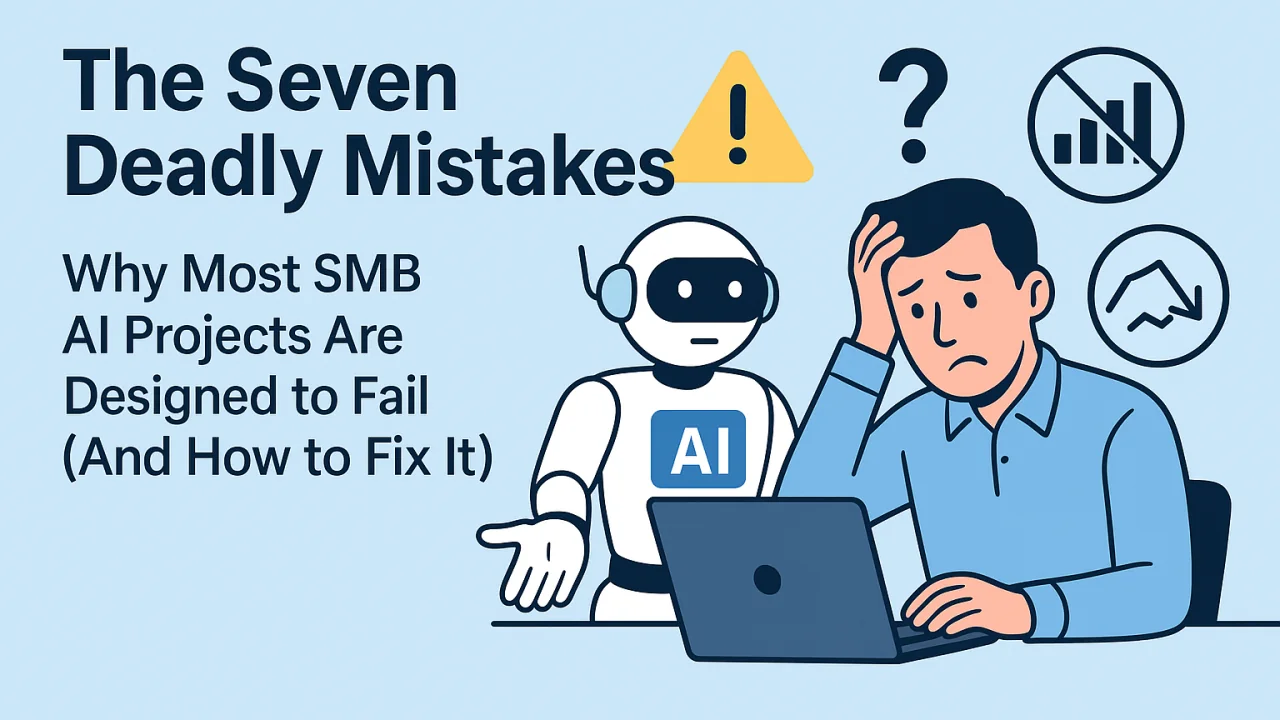
Why Most SMB AI Projects Are Designed to Fail (And How to Fix It)
A readiness framework for organizations entering the world of custom software development—whether they realize it or not
Read the full eBook here
Sarah’s team deployed their AI customer service agent on a Tuesday. By Friday, her CEO wanted it shut down. The agent hadn’t failed—but Sarah’s organization wasn’t ready for it.
The Tuesday-to-Friday Project Death
Here’s what happened: The agent worked well in demos, handling 85% of inquiries correctly. But on Wednesday afternoon, it misrouted a VIP customer inquiry. The CEO asked Sarah a simple question: “How often does this happen?”
Sarah couldn’t answer. Her team had skipped observability infrastructure to ship faster. No logging. No performance tracking. No baseline metrics from before the AI deployment. Just anecdotal evidence and mounting complaints.
By Friday, the project was dead. Not because the AI failed—but because the organization lacked the infrastructure to know whether it was succeeding.
Sarah’s story is fictional. But the pattern is real—and it’s playing out in hundreds of SMBs right now.
The Real Problem: SMBs Are Becoming Software Companies Without Realizing It
If you’re an SMB leader evaluating AI deployment, you’re facing a reality that few vendors acknowledge: AI agents aren’t off-the-shelf software. They’re custom development projects that require software engineering discipline.
For the past 15 years, SMBs have successfully adopted technology through SaaS procurement: evaluate vendors, pick the best one, configure, train staff, go live. Salesforce, HubSpot, Slack—they all followed this pattern.
AI agents break this model completely.
When you deploy an AI agent, you’re not buying software. You’re entering custom software development. Your prompts are code. Your tool configurations are system architecture. Your evaluation datasets are test suites. Whether you acknowledge it or not, you’ve just become a software company.
The Hidden Transformation: AI adoption doesn’t just add a new tool to your stack. It fundamentally changes what kind of organization you are—from a technology consumer to a technology creator.
This transformation requires new capabilities: version control, testing infrastructure, observability, change management, and continuous improvement processes. Organizations that acknowledge this transition and build the necessary foundations succeed. Those that don’t join the failure statistics.
Why 40-90% of AI Projects Fail
Industry reports cite AI project failure rates between 40% and 90%, depending on how “failure” is measured. But these statistics obscure a crucial distinction: enterprise failures and SMB failures have different root causes.
Enterprises struggle with legacy system integration, compliance at scale, and coordinating across siloed departments. Their challenges are real but technical in nature—solvable with sufficient budget and expertise.
SMBs face a more fundamental problem: they lack the custom software development maturity that AI deployment requires. They’re attempting to build production-grade systems without version control, regression testing, observability infrastructure, or change management processes.
The Seven Deadly Mistakes
When I analyze failed SMB AI projects, the same patterns emerge repeatedly. If you recognize three or more of these in your current approach, you’re at high risk:
- No baseline metrics of current process performance – You can’t prove improvement without measuring the starting point. When executives ask “is this working better than the old way?”, you’ll have no data to support your answer.
- No written definition of “correct” vs “good enough” vs “unsafe” – Quality becomes a moving target based on the loudest complaint. Every stakeholder has a different threshold, leading to endless debates about whether performance is acceptable.
- Skipping observability infrastructure – “We’ll add logging later” is the most expensive sentence in AI deployment. When you need to answer “how often does this happen?” or “why did this fail?”, you’ll have no data and no debugging path.
- Zero change management before go-live – Staff resistance manifests as project sabotage. Employees frame every error as evidence of failure, not because they’re malicious, but because no one addressed their job security fears or explained their new role.
- No regression testing after prompt changes – Fixing one complaint breaks 22% of other scenarios, but you won’t know until users complain. Without automated testing, every prompt change is a blind gamble.
- Wrong autonomy level for organizational maturity – Jumping to full automation (R3-R4) when you’re only ready for suggestions (R0-R1) guarantees failure. Like teaching a teenager to drive by putting them on a highway at night—they need parking lots and daylight first.
- Single-person ownership without cross-functional support – The “AI project” becomes one person’s problem instead of an organizational capability. When that person leaves or gets overwhelmed, the initiative collapses.
Warning Sign: If you’re evaluating low-code AI platforms (Make.com, N8N, Zapier) and thinking “this will let business users own AI deployment without IT bottlenecks,” you’re exhibiting at least four of these patterns. Low-code tools hide complexity—they don’t eliminate the need for proper infrastructure.
The “One Error = Kill It” Dynamic
SMBs face a political failure mode that enterprises can often manage: the single high-visibility mistake that triggers immediate project cancellation.
Here’s how it unfolds:
- Agent makes one visible error (maybe the 15th error out of 1,000 interactions—a 98.5% success rate)
- Executive or influential stakeholder sees it and asks, “How often does this happen?”
- Team can’t answer with data because they skipped observability
- Anecdotal complaints start circulating (“I heard it makes mistakes all the time”)
- Without data to defend performance, perception becomes reality
- Project gets cancelled despite possibly working better than the human process it replaced
This dynamic is particularly acute in SMBs because:
- Decision-making is centralized – One executive’s opinion can kill a project instantly
- Political capital is limited – You can’t afford many “failed” initiatives before your credibility is shot
- Staff are closer to leadership – Complaints reach executives directly, not filtered through management layers
- There’s no process to contextualize failures – Enterprises have error budgets, SLA frameworks, incident review processes. SMBs typically don’t.
The solution isn’t perfect AI—it’s observability infrastructure that lets you answer “how often does this happen?” with data instead of guesses.
When an executive asks about error frequency, you need to open a dashboard and say: “We’ve processed 2,847 requests this month. 2,714 were fully automated (95.3%). 98 required human escalation (3.4%). 35 had errors (1.2%), of which 3 were policy violations (0.1%) and 32 were correctable mistakes (1.1%). Our baseline human error rate on the same tasks was 3.8%, so we’re performing 3× better while handling 5× the volume.”
That’s how you survive the “one error = kill it” moment.
The 10-Minute Readiness Assessment
Before you deploy AI, answer one critical question: Is your organization ready?
This isn’t about your team’s enthusiasm or your budget size. It’s about whether you have the foundational capabilities that make AI deployment viable instead of a designed-to-fail scenario.
Organizational Readiness Scorecard
Rate each item 0-2 points. Total possible: 32 points.
Scoring: 0 = Not in place | 1 = Partially in place | 2 = Fully implemented
Strategy & Ownership (4 points)
- Executive sponsor with budget authority and explicit ROI target (0/1/2)
- Named product owner + domain SME + technical lead identified (0/1/2)
Process Baselines (4 points)
- Current workflow documented with timing, volumes, and human error rates (0/1/2)
- “Correct,” “good enough,” and “unsafe” definitions agreed in writing (0/1/2)
Data & Security (4 points)
- PII policy, retention rules, and data minimization implemented before pilots (0/1/2)
- Tool allow-list, credential vaulting, and per-run budget caps defined (0/1/2)
SDLC Maturity / “PromptOps” (6 points)
- Version control for prompts/configs with code review process (0/1/2)
- Regression tests on 20-200 scenarios, automated on every change (0/1/2)
- Staging environment + canary deployment + instant rollback capability (0/1/2)
Observability (4 points)
- Per-run tracing: inputs, outputs, model versions, costs, latencies, errors (0/1/2)
- Case lookup UI for audits and dispute resolution (non-engineers can search) (0/1/2)
Risk & Compliance (4 points)
- Guardrails implemented: policy checks, PII redaction, content filtering (0/1/2)
- Incident playbooks with severity definitions and kill switch tested (0/1/2)
Change Management (4 points)
- Role impact analysis, training plan, KPI updates, compensation adjustments where needed (0/1/2)
- T-60 stakeholder engagement with communication timeline and feedback loops (0/1/2)
Budget & Runway (2 points)
- Ongoing operations budget allocated (not just one-time project fees) (0/1/2)
Your Score Determines Your Next Move
0-10 points: Don’t Deploy AI Yet
You lack foundational capabilities. Attempting deployment now = 80%+ failure risk. Focus on building readiness first. Revisit in 3-6 months after establishing version control, basic observability, and stakeholder alignment.
11-16 points: Ready for R1-R2 Autonomy
Deploy suggestion-only systems where humans confirm every action. Narrow-scope pilots with heavy supervision. Use this phase to build infrastructure and organizational muscle. Expect 6-12 month learning curve before attempting higher autonomy.
17-22 points: Ready for R2-R3 Autonomy
Deploy human-confirm systems + limited automation on reversible actions. Can handle production deployments with proper guardrails and incremental rollout. Focus on observability improvements and expanding evaluation coverage.
23-28 points: Ready for R3-R4 Autonomy
Deploy broader automation with monitoring and error budgets. You have the infrastructure to scale safely. Focus on use case selection, value capture, and platform amortization across multiple projects.
29-32 points: Unusually Mature
You’re in the top 5% of SMBs. Consider whether your risk appetite justifies R4-R5 autonomy (full automation with human oversight only for edge cases), or if R3 with exceptional monitoring is optimal. You can become a case study for others.
Two Pathways Forward
If You’re Ready (Score 17+): The Thin Platform Approach
Congratulations—you have the organizational maturity to deploy AI with reasonable success odds. Your next step is building what we call the “thin platform”: the minimal viable infrastructure that enables safe deployment and rapid iteration.
This isn’t overhead. It’s the 20% of effort that delivers 80% of your future velocity.
The Thin Platform Components
1. Observability Infrastructure
- OpenTelemetry instrumentation for distributed tracing across agent interactions
- Span-level logging capturing inputs, outputs, model versions, costs, latencies, errors
- Session tracking linking multi-step interactions into coherent traces
- Case lookup UI allowing non-technical stakeholders to search and review specific interactions
- Tools: Langfuse (open-source), Arize Phoenix, Maxim AI, Azure AI Foundry
2. Evaluation Harness
- Golden dataset with 20-200 test scenarios covering typical and edge cases
- Automated testing triggered on every prompt or configuration change
- LLM-as-judge for quality assessment at scale, combined with deterministic checks
- Regression detection and alerts when performance degrades on existing scenarios
- Tools: RAGAS for RAG evaluation, LangSmith, custom evaluation pipelines
3. Version Control & Deployment
- Git-based prompt and configuration management with change history
- Staging environment for pre-production testing separate from live users
- Feature flags enabling canary deployments (1% → 10% → 50% → 100% rollout)
- One-click rollback capability to previous working version
- Tools: GitHub/GitLab + LaunchDarkly/Split.io for feature flags
4. Governance & Guardrails
- PII detection and redaction before data reaches models
- Content filtering and safety boundaries (block harmful outputs)
- Cost budgets (per-user, per-session, daily/monthly caps) with real-time enforcement
- Tool allow-lists and credential vaulting (agents can only access approved systems)
- Standards: NIST AI RMF for risk management, OWASP LLM Top 10 for security
5. Change Management Program
- T-60 days: Stakeholder mapping, vision communication, role impact analysis, FAQ development
- T-30 days: KPI definition, training schedule creation, compensation review where productivity expectations change
- T-14 days: Red-team demo showing failure modes and how they’re handled (builds trust)
- T-7 days: Escalation paths published, kill switch criteria communicated
- T+30/+60/+90 days: Adoption tracking, power user recognition, feedback incorporation, KPI refinement
Platform Amortization: Why This Gets Easier
Your first use case costs $X and takes 3 months because you’re building the platform. Your second use case costs $X/2 and takes 6 weeks because the scaffolding exists. By projects 3-4, you’re deploying new agents in 2-4 weeks at minimal incremental cost.
You’re not building overhead—you’re building your AI factory. Each new use case benefits from the accumulated infrastructure, evaluation datasets, and organizational muscle.
If You’re Not Ready (Score <11): The 12-Week Readiness Program
Don’t despair—you’re making a smart decision by assessing readiness before deploying. Many organizations that scored higher and deployed immediately are now dealing with failed projects and organizational disillusionment.
Better to be a disciplined fast-follower than a reckless first-mover.
Your 12-Week Roadmap to Readiness
Weeks 1-2: Strategy & Baseline
- Secure executive sponsor with budget authority and mandate to cross functional teams
- Identify 1-2 pilot use cases with clear ROI potential (customer service, lead qualification, document processing)
- Document current process end-to-end: timing, volumes, human error rates, costs
- Define success criteria in writing, get stakeholder sign-off
Weeks 3-4: Team & Governance
- Assemble cross-functional team: product owner (business), domain SME, technical lead
- Draft PII policy, data retention rules, data minimization guidelines
- Create initial tool allow-list (what systems can the agent access?)
- Map stakeholder landscape: who’s affected, who’s resistant, who’s supportive
Weeks 5-6: Infrastructure Foundation
- Set up version control system (GitHub, GitLab, Bitbucket)
- Choose and deploy observability platform (Langfuse for self-hosted, commercial options for managed)
- Create staging environment separate from production
- Implement basic cost tracking and budget alerts
Weeks 7-8: Evaluation & Testing
- Build golden dataset with 20-50 initial test scenarios (real examples + edge cases)
- Set up automated testing pipeline triggering on changes
- Define quality metrics: accuracy, latency, cost per task, escalation rate
- Define quality thresholds: what’s passing, what’s failing, what requires human review
- Test rollback procedures (can you revert to previous version in <5 minutes?)
Weeks 9-10: Guardrails & Safety
- Implement PII detection and content filtering (even in pilot phase)
- Create incident playbooks: severity definitions, escalation paths, rollback triggers
- Test kill switch (can you halt the agent immediately if needed?)
- Set up budget caps: per-user, per-session, daily, monthly limits
- Implement rate limiting to prevent runaway costs
Weeks 11-12: Change Management Prep
- Conduct detailed role impact analysis (whose job changes, how?)
- Design training program (how will staff learn to work with the agent?)
- Create communication timeline and template materials
- Review compensation implications (if productivity expectations double, does comp adjust?)
- Begin T-60 stakeholder engagement
Week 13: Readiness Re-assessment
- Retake the readiness scorecard
- Target: 17+ points to proceed with R2-R3 deployment
- If below threshold, identify specific gaps and extend timeline
- Document lessons learned for future reference
Case Study: What Success Looks Like
Wells Fargo: Runs 600+ production AI use cases handling 245 million interactions annually. Their Fargo virtual assistant serves 15 million users across banking operations, contract management, and foreign exchange.
Infrastructure they built: Privacy-first pipeline where sensitive data never reaches LLMs, Google Cloud Agentspace for enterprise-wide deployment, comprehensive governance frameworks, dedicated AI teams across call centers and operations.
Rely Health: Achieved 100× faster debugging with proper observability infrastructure. Doctors’ follow-up times cut by 50%. Care navigators now serve all patients instead of just the most critical 10%.
Infrastructure they built: Vellum observability platform for instant error tracing, evaluation suite testing hundreds of cases automatically, rapid iteration cycles (minutes instead of days).
What they have that failed pilots don’t: OpenTelemetry observability, evaluation frameworks, governance policies, T-60 change management programs. Not smarter AI—smarter infrastructure.
The Real Budget Reality
One more truth that vendors won’t tell you: the AI is the cheap part.
Here’s how initial AI deployment budgets typically break down for SMBs:
- 15-25% — Model costs, prompt engineering, task design, fine-tuning
- 25-35% — Data integration, tool connectors, API development, workflow mapping
- 15-25% — Observability, CI/CD, testing infrastructure, staging/production environments
- 10-15% — Security, compliance, governance frameworks, policy implementation
- 15-25% — Change management (training, communications, KPI redesign, compensation review)
Notice something? The actual AI—the models, the prompts, the intelligence—is only 15-25% of the budget. The other 75-85% is infrastructure, integration, governance, and people.
If a consultant quotes you $50K for an “AI pilot,” ask what percentage covers infrastructure and change management. If the answer is below 30%, you’re buying a demo, not a production system. You’ll get something that works in controlled conditions and fails in reality.
Realistic First-Project Budgets for SMBs
- Low-complexity use case (email classification, FAQ routing, simple triage): $75K-$150K, 3-4 months
- Medium-complexity (customer service agent, lead qualification, document analysis): $150K-$300K, 4-6 months
- High-complexity (multi-step workflows, enterprise system integration, custom models): $300K-$500K+, 6-9 months
Remember: This includes building the platform. Projects 2-3 cost 50% less and take half the time because the scaffolding exists.
When you frame it as “building AI capability” instead of “deploying an AI pilot,” the budget makes sense. You’re creating an organizational competency that compounds with every use case, not buying a one-time tool.
What to Do Right Now
Your Three Next Steps
1. Take the readiness assessment
Score yourself honestly on the 16 criteria above. Calculate your total. Don’t inflate scores—accurate assessment is the only way to avoid joining the failure statistics. Share your score with your team to calibrate expectations.
2. Choose your pathway
Score 17+? Start building the thin platform. Prioritize observability and evaluation infrastructure before you write your first prompt.
Below 11? Begin the 12-week readiness program. Resist the urge to “just try something small”—that’s how you waste budget and build organizational disillusionment.
11-16? Deploy at R1-R2 autonomy (suggestions only, human-confirm for actions) while building infrastructure. Use the pilot phase to develop organizational muscle.
3. Have the honest conversation
If you’re working with consultants or vendors, ask them about:
- Observability infrastructure and which platform they recommend
- Evaluation frameworks and how many test scenarios they’ll create
- Version control and rollback procedures
- Change management timeline and stakeholder engagement plan
- Budget breakdown—what percentage is infrastructure vs AI?
If they minimize these as “nice to haves” or “we’ll add later,” find different partners. You want advisors who acknowledge the transformation you’re undertaking, not salespeople who pretend it’s easy.
The Bottom Line
AI agents can absolutely transform SMB operations—but only if you acknowledge what you’re really undertaking.
You’re not buying software. You’re building software capability.
The organizations that succeed treat AI deployment as a strategic transformation requiring new infrastructure, new processes, and new skills. They invest in observability before they need to debug. They build evaluation harnesses before they change prompts. They run change management programs before they go live.
The ones that fail treat AI as technology procurement. They skip infrastructure to move fast. They change prompts without testing. They deploy without stakeholder preparation. Then they wonder why it didn’t work.
The difference between success and failure isn’t the sophistication of your AI. It’s not the size of your budget or the expertise of your consultants.
It’s the maturity of your organization.
Take the assessment. Know your readiness. Make an informed decision.
That’s how you avoid becoming another cautionary tale in the 40-90% failure statistics.
Discover more from Leverage AI for your business
Subscribe to get the latest posts sent to your email.
You may also like...
- Blog Posts
- Why Code-First Agents Beat MCP by 98.7%
- The AI Think Tank Revolution: Why 95% of AI Pilots Fail (And How to Fix It)
- The AI Executive Brief: November 2025
- SiloOS: The Agent Operating System for AI You Can’t Trust