LeverageAI Field Note
The Discovery Workshop, Not the PR Factory
Hand-curated parallel agent sessions beat fully automated pipelines for discovery work — each terminal is a reality probe, and the human’s job is noticing the collisions automation would optimise away.
Scott Farrell · LeverageAI
I was moving a little over a terabyte from a Mac to a Linux box over fast networking. rsync was doing what rsync does: a progress line, a transfer rate, a percentage climbing toward one hundred. Somewhere in that afternoon a one-character flag roughly doubled end-to-end throughput. The number on the screen did not change.
Same displayed megabytes per second. Half the wall-clock. The gain lived in the gaps the progress UI does not dramatise — the silent pauses where the delta algorithm was chewing disk between “files.”
The screen lies by omission.
That is not a poetry line. It is a field observation. And it is the shortest way into a larger argument about multi-agent work: if you only watch the metrics automation is designed to show you, you will miss the signal that only appears while the “inefficient” process is still visible.
One flag, twice the useful work
rsync’s delta-transfer algorithm is clever when the network is the scarce resource. It is less clever when the pipe is fat and the disk is doing secret homework between progress bars. The man page is blunt about --whole-file / -W: it disables the delta algorithm and sends files whole, which can be faster when bandwidth between machines outruns bandwidth to disk.1
On that transfer the displayed rate still looked like the same healthy number. What changed was the timeline under the number:
OLD (delta path)
transfer  ██████████
hidden disk work     ██████████
next file                      ██████████

NEW (-W)
transfer  ██████████
next file            ██████████
At roughly 1.15 TB, the shape of the day was not subtle: on the order of eight hours versus four, without the on-screen rate ever confessing the difference. You only get that confession by watching the whole reaction — by noticing that “100%” on one file can still be followed by a long reread before the next file starts.
Industry multi-agent systems are getting very good at the other kind of confession: orchestrated agents scoring large gains on research evals, at the cost of substantially more tokens than a chat.2 That is real progress. It is also a reminder that “more agents” is not the same question as “what is the human still for?”
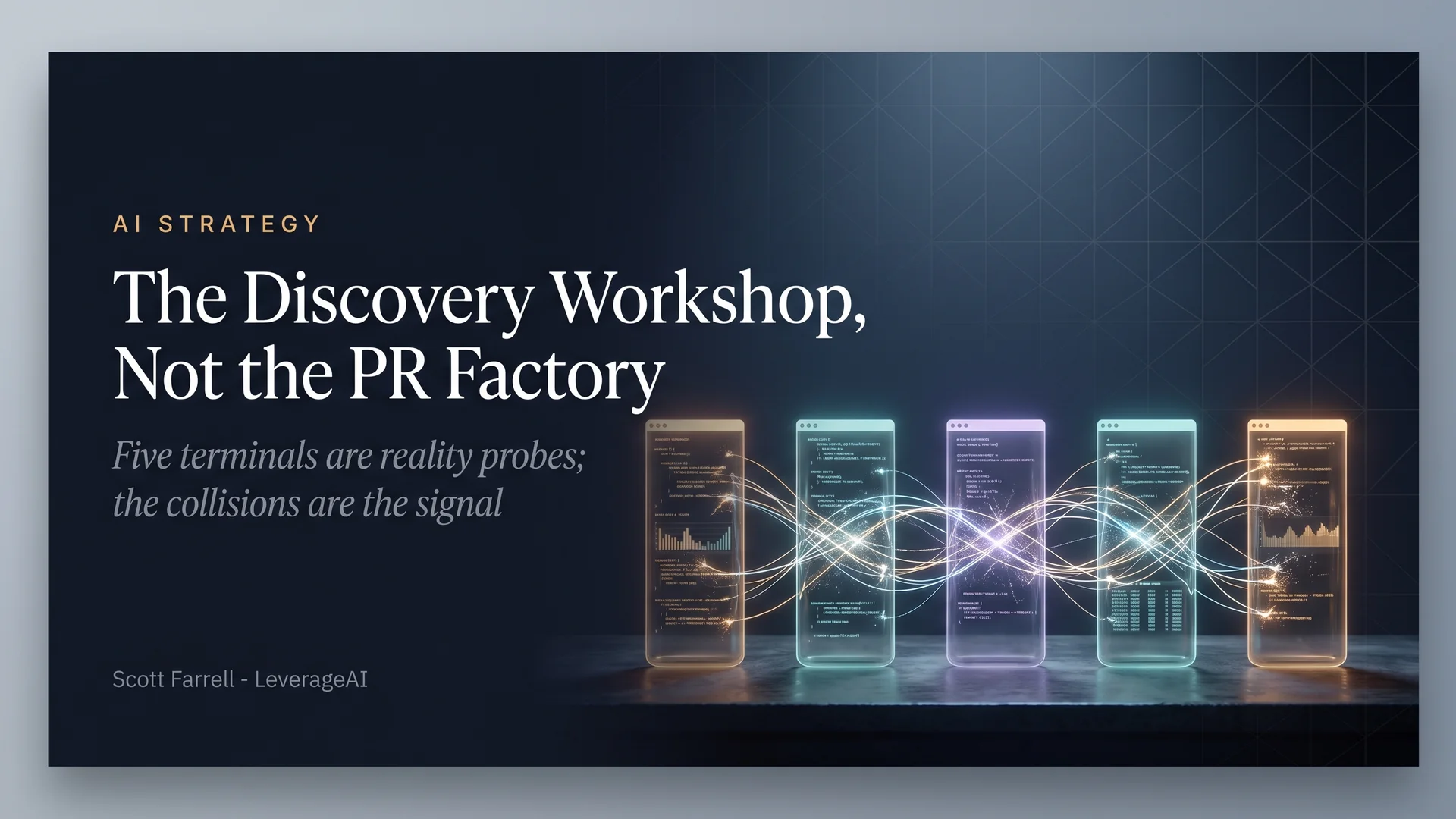
Five bubbling test tubes
On the same class of high-intensity weeks I do not run one agent. I run several at once — multiple terminal tabs, often across a laptop, a mini, and a heavy Linux box with the databases and the disk. The windows are not a ticket board.
window 1: recover an obsolete format
window 2: ingest mail into something searchable
window 3: compile a wiki
window 4: build a weird reader
window 5: chase a half-formed framework
They look like five bubbling test tubes on a bench. None of them is “Agent 1, complete ticket 482.” Each is a different push against the world. Something stalls. Something finishes too cleanly. Something writes a tool that should not have been necessary. Something surfaces a name I have not thought about in twenty-five years.
You are running parallel reality probes. The human is the cross-process bus.
I walk between them. I carry a fragment from the NSF window into a long frontier conversation. The conversation renames the problem. I walk back to the mail agent and say: do not ingest records one by one — find the natural semantic skeleton first. That change only exists because two probes interfered inside a person who was watching both.
Fully automated fleets are excellent at completing a job description. They are worse at noticing that the interesting output was never on the job description.
The Samba counterfactual
Here is the collision that the rsync afternoon actually paid for.
While the copy ran, the model’s search trace brushed Samba. Samba brushes Andrew “Tridge” Tridgell — major figure in that world, and co-creator of the rsync algorithm I was depending on. Tridgell brushes a tiny Australian computer-chess scene I was once inside: authors who had to write their own engines to enter, a handful of people, a chance meeting in Canberra. Joel Veness was in that same strange little graph. Twenty-five years later I am talking about agentic search and world models while Tridge’s algorithm moves a terabyte across the room.
That is not a productivity tip. It is a recovered edge between two parts of one life.
Now run the counterfactual the industry prefers:
copy 1.15 TB
→ agent optimises rsync
→ job completes
→ dashboard green
No watching. No “why is the disk still thrashing after 100%?” No Samba flash. No Tridge. No chess scene. No reminder that dormant personal history is still load-bearing intellectual capital.
The inefficiency produced the insight.
If your only success metric is “bytes arrived,” the automated path wins. If your success metric includes “what unexpected edge did this day reveal,” the automated path deleted the product.
The token-max week is a furnace, not a lifestyle brand
Some weeks the economics force a different posture. When a frontier model is temporarily “included” and then becomes specialist-intervention expensive, aggressive agent use can burn money at a rate that feels surreal — on the order of hundreds of US dollars in under an hour if you are not careful, still painful even when you route cheaper models for bulk work. That is not a benchmark. It is an operator’s meter.
Under that window the rational move is ugly and honest: keep feeding the furnace. Do not stop the reaction to catalogue every product of the reaction. Capture while the unusual capability is still economically available. Adjacent field notes already cover how to survive the economics with a high-taste orchestrator and cheaper specialists for token-hungry bulk.3 This piece is not that operating manual. It is about what you are doing with the windows while the heat is on.
You are not “failing to automate.” You are running a temporary discovery densification: more probes, more collisions, more frameworks named while the glass is still hot. Read-back and compounding still matter — the learning flywheel is real4 — but they are a different article’s job. Here the point is narrower: during discovery intensity, presence at the bench is not nostalgia. It is instrumentation.
Convergent tooling, divergent purpose
Watch public multi-agent practitioners long enough and the hardware rhyme becomes almost funny. Multiple machines. Terminals everywhere. Agents in parallel. A Linux box that became the real workshop without anyone quite deciding it in a strategy offsite.
Theo’s orbit and mine are a clean example. Same class of tools. Same terminal habits. Same willingness to run more than one agent at a time. I am not claiming one of us invented the setup, and I am not claiming he lacks discovery. I am distinguishing the centre of gravity.
His visible unit of production is often a software change — agent fleet against codebases, toward PRs, toward throughput. Mine is increasingly a newly understood thing — agent workshop against experiments, toward collisions, toward frameworks. Software may fall out. An ebook may fall out. A silent mail agent may fall out. The product the day is optimising for is different.
Then look at the unit of production in the abstract:
| PR factory | Discovery workshop | |
|---|---|---|
| Centre of gravity | Codebases, reviews, merges | Experiments, collisions, named insights |
| Unit of production | A software change | A newly understood thing |
| What “done” looks like | Green checks, shipped diff | A framework, edge, or mental model you did not have this morning |
| Human role | Gate and prioritise throughput | Cross-process bus; notice interference |
| Automation instinct | Remove the human from the middle | Keep the human near the windows |
| Failure mode | Slow shipping | Silent optimisation of insight out of the pipeline |
I am not claiming the factory is wrong. When the unit really is a software change, factory posture is adult. Parallel agents, adversarial checks, and dispatch discipline belong there — and the dispatch problem is owned elsewhere, in the Delegation Plane: how you capture intent and hand work off without contaminating goals already in flight.5
This article owns the other half: why you watch when the unit is understanding.
Same terminals. Same models. Opposite cognitive centre of gravity. Hand-curation is not an immature version of someone else’s automation. It is a different instrument for a different product.
A collision engine with memory
Probes alone are not enough. Without a surface that remembers, collisions dissipate as vibes.
A personal or organisational wiki — claims and edges, not a dump of chat logs — homogenises material just enough that a name from 1999 can smash into a tool from 2026. RAG helps you find a thing. A wiki puts people, projects, files, and frameworks on a shared cognitive bench where interference can happen again later, on purpose.
Tridge  collides with  rsync
NSF     collides with  “write the reader”
mail    collides with  semantic skeleton
Fable   collides with  temporary furnace economics
probe A collides with  probe B  inside Scott
That is why the workshop is not “anti-automation philosophy.” It is a production system for unexpected edges. The human notices. The conversation names. The article or field note compresses. The wiki keeps the edge addressable so the next probe can hit it.
Pipelines optimise for smooth flow. Discovery needs controlled roughness — enough shared surface for ideas to meet, and a person who is still looking when they do.
Choose posture by output type
The decision rule is almost insultingly simple:
- Factory when the unit of production is a software change.
- Workshop when the unit of production is a newly understood thing.
Most serious operators need both in the same week. The error is importing factory maturity narratives into workshop hours and calling the human “the bottleneck.” In a PR factory the human in the middle is often latency. In a discovery workshop the human in the middle is the instrument that detects cross-probe interference — the collisions a fully automated pipeline is paid to smooth away.
So when someone looks at five open agent terminals and says you have not automated enough, ask a better question: what is the product today? If it is a merge, close the romance and ship. If it is a newly understood thing, stay at the bench. Watch the rates that lie by omission. Walk the cross-process bus. Let the wiki catch what collides.
The maturity signal is not how little you watch. It is whether you can still tell which posture the work is in — and refuse to optimise away the sensor that makes discovery possible.
References
- [1]rsync documentation (Samba.org). “rsync(1) —
--whole-file,-W.” https://download.samba.org/pub/rsync/rsync.1 — “This option disables rsync’s delta-transfer algorithm, which causes all transferred files to be sent whole. The transfer may be faster if this option is used when the bandwidth between the source and destination machines is higher than the bandwidth to disk…” - [2]Anthropic Engineering. “How we built our multi-agent research system.” https://www.anthropic.com/engineering/multi-agent-research-system — Lead agent with Claude Sonnet 4 subagents “outperformed single-agent Claude Opus 4 by 90.2% on our internal research eval”; multi-agent systems “use about 15× more tokens than chats” and are valuable for open-ended research tasks.
- [3]Scott Farrell / LeverageAI. “How to Do a Month’s Work in 1 Day.” https://leverageai.com.au/how-to-do-a-months-work-in-1-day/ — Adjacent operating model: high-taste orchestrator with cheaper specialists for token-hungry bulk work (cameo only; not this article’s scope).
- [4]Scott Farrell / LeverageAI. “The AI Learning Flywheel: 10X Your Capabilities in 6 Months.” https://leverageai.com.au/the-ai-learning-flywheel-10x-your-capabilities-in-6-months/ — Compounding engagement loop; named here as sibling, not expanded into the learning-loop protocol.
- [5]Scott Farrell / LeverageAI. “The Delegation Plane: Capture Intent, Protect Goals, Dispatch Fast.” https://leverageai.com.au/the-delegation-plane-capture-intent-protect-goals-dispatch-fast/ — Sibling for how you dispatch; this article owns why you watch during discovery.
Discover more from Leverage AI for your business
Subscribe to get the latest posts sent to your email.