
AI Strategy · Knowledge Architecture
I Didn’t Ask for the Thing I Didn’t Know Existed
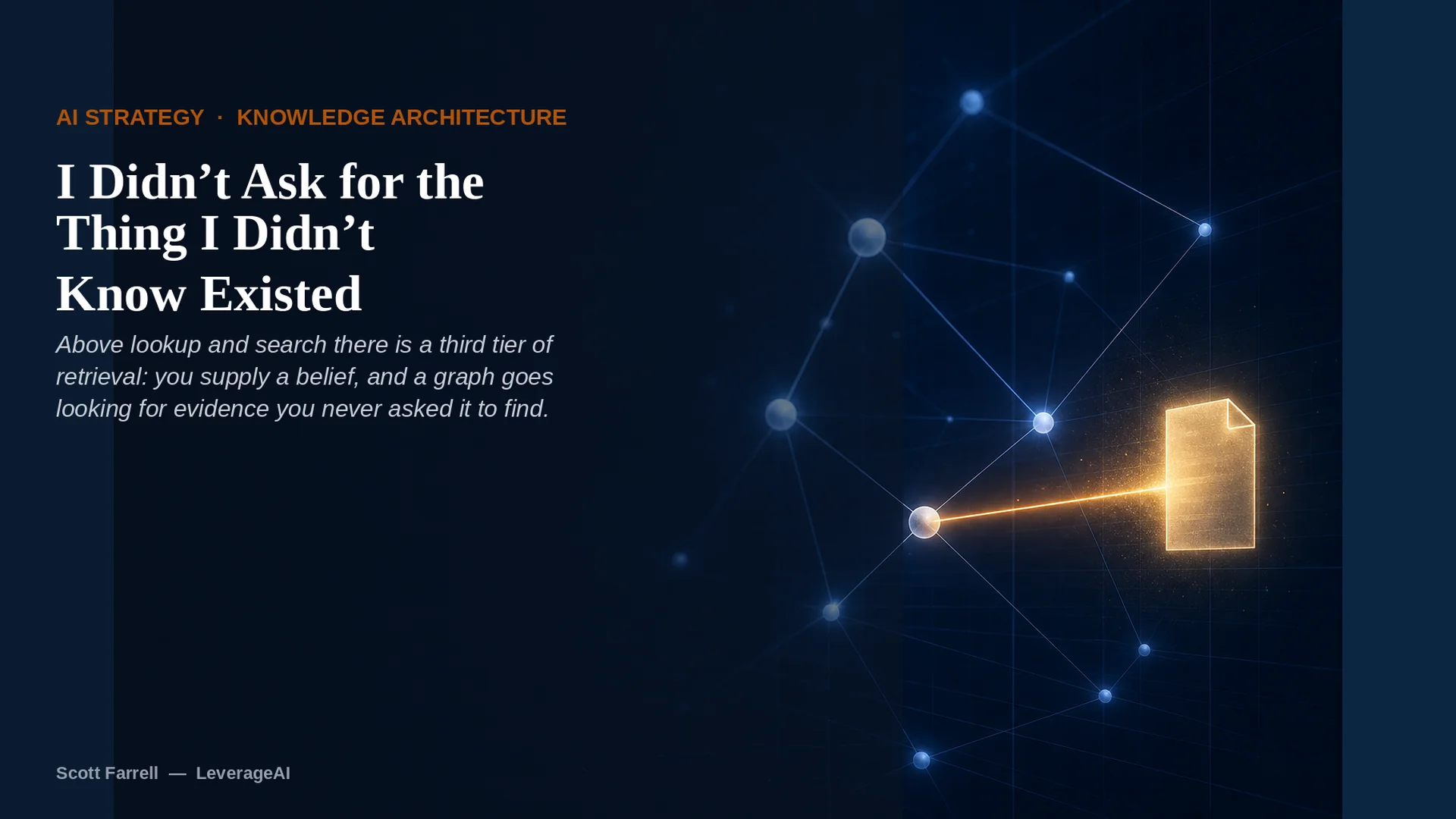
Above lookup and search there is a third tier of retrieval with no common name. You supply a belief, not a query — and a graph goes looking for evidence you never asked it to find. At organisational scale that becomes idea provenance: contested credit settled with receipts in time, trustworthy precisely because they could have gone against you.
By Scott Farrell · LeverageAI
TL;DR
- Three tiers of retrieval. Lookup: you know the artifact exists. Search: you have the question, not the answer. The third, unnamed one: you have neither — only a belief — and the system goes walking for corroboration you never requested.
- Tier three needs a graph. RAG structurally can’t reach it: no query was ever issued for a similarity match to serve. The agent has to generate the query from the graph’s neighbourhood and recognise the corroborating record when it hits one.
- At org scale it becomes idea provenance. Contested paternity, settled with timestamped receipts — and it is worth trusting because it cuts both ways: the same walk could have found nothing, or found your pivot in someone else’s name.
Here is a sentence a founder said to me, still slightly stunned by it: “I didn’t ask for the thing that I didn’t know existed.”
The setup was ordinary. He was talking, in passing, about an old project — how proud he was that the disintermediation pivot he’d found for that client had been genuinely his idea. He wasn’t asking a question. He was making a claim, the kind you make out loud to yourself. And the system he’d built — an AI walking a wiki compiled from years of his own exhaust — came back with an internal email from years earlier. His own words, timestamped, framing that exact pivot to his staff. It had never made it into the proposal. It had never been shown to the client. It was the receipt for a thought he was proud of, and he hadn’t known it survived anywhere.
He didn’t search for it. He couldn’t have. You cannot search for a document when you don’t know it exists and have no question to phrase. Something else happened — and that something is the subject of this piece, because most software sold as “search” cannot do it, and the reason why turns out to matter enormously at organisational scale.
Three tiers of retrieval
Sort retrieval by what you bring to it, and it falls into three tiers.
Lookup. You know the artifact exists and roughly where it lives. You want the Q3 deck; you go get the Q3 deck. The knowledge is in your head; the tool just fetches. This is most of what a file system or a CRM record is for.
Search. You don’t know the answer, but you know the question. “What did we quote Telstra in 2019?” You can phrase it, and a good index — keyword or vector — returns candidates. Every retrieval product on the market lives here. It is a genuinely useful tier, and it is where most people’s imagination stops, because it feels like the ceiling. If I can ask it, the system can find it; if I can’t ask it, that’s the end of the road.
But there is a tier above it, and it has no common name.
Unsolicited corroboration. You have neither the artifact nor the question. You have a belief — “the disintermediation pivot was mine, and I’m proud of it” — and the system treats that belief as a hypothesis and goes walking for evidence. You didn’t issue a query. You issued an assertion, and something in the architecture decided the assertion was checkable and went to check it. When it works, the result doesn’t feel like an answer. It feels like being handed something.
Search is a pull technology — you must already hold the question. The third tier is push you can trust: the system volunteers evidence for a claim you only made in passing.
The distinction is not pedantic. It is the whole ballgame, because the third tier is the one that returns the thing you would never have thought to go looking for — and organisations are made almost entirely of things nobody thinks to go looking for.
The query you can’t write
Here is why this tier is hard, and why the usual answer — “just add RAG” — structurally cannot reach it.
Retrieval-augmented generation works by similarity. You give it text, it embeds that text into a vector, and it returns chunks whose vectors sit nearby. It is a very good pull technology for tier two: phrase a question, get semantically-adjacent passages back. But in the founder’s moment no query was ever issued. There was no question text for a similarity match to serve. He said he was proud of a pivot. Nothing in that sentence is a search string for the email — the email doesn’t mention pride, and it may not even mention the word “disintermediation.” A nearest-neighbour lookup on the sentence he actually said would have returned other sentences about pride, not a decade-old staff email about client strategy.
To reach the email, the system had to do something categorically different: it had to generate the query itself, by walking a relationship structure. Pivot → the project it belonged to → the correspondence adjacent to that project in that time window → the one message where the idea was first framed internally. Each hop is an edge, not a similarity score. The agent compiled a search plan from the neighbourhood of the claim and recognised the corroborating record when it hit one. That is only possible if the corpus is a traversable graph of claims and edges — not a pile of chunks waiting for a query.
This is the difference between resemblance and provenance. Similarity can tell you two records look related; a real join — a natural key tying an email thread to a project to a client — tells you they belong together, deterministically, whether or not their words rhyme. Similarity re-infers a fuzzy relationship at query time; the graph already holds the exact one. That is why RAG lands in the wrong tier: it pays a tax re-guessing relationships from chunks instead of navigating relationships that were compiled in advance. None of that demotes similarity to useless — it is a fine recall net running underneath the graph. It simply cannot be the thing that reaches tier three, because tier three has no query for it to match.
So the falsifiable test is clean: if a team running pure vector search cannot reproduce the founder’s find by any phrasing of a query — because no query was ever the input — then the third tier is real, and only a graph gets you there.
The primitive has a name
The interface move underneath this is one I’ve written about before at personal scale, and it already has a name: the Edge Surfacer. It watches the cognitive neighbourhood you’re standing in, places one high-potential edge in your peripheral vision, and then it yields — so your own recognition does the remembering. It is deliberately the anti-chatbot, anti-oracle primitive: it does not lecture, it does not conclude, it puts one thing where you can see it and gets out of the way.
That yielding is not decoration; it is the point. An oracle that told the founder “yes, that pivot was yours” would have been worthless — a machine agreeing with you costs nothing. What the Edge Surfacer did instead was hand him the exhibit and let the feeling arrive on its own. The recognition was his. The system just made it reachable while the thought was still warm.
Exhibit, not verdict
This is why the moment landed emotionally rather than merely informationally, and it is worth being precise about the mechanism, because it is a design constraint, not a matter of tone.
The system obeyed what I’ve called the dignity constraint: show the exhibit, not the conclusion; store pointers, not verdicts. It did not tell the founder he was clever. It handed him a timestamped email he could click through to and read in his own decade-old words. A verdict from a machine is cheap and slightly insulting — who asked it? — but evidence you can open and inspect is something else entirely. It carries its own warrant. This is the same discipline that turns any AI sub-tool from an oracle you must trust into a witness you can check: return a claim attached to a verbatim exhibit and a resolvable pointer, never a bare assertion.
So the unsolicited push and the trust are not in tension, even though unsolicited push is normally the thing that makes a system untrustworthy — a feed pushes what benefits the platform. The difference is that this push arrives as an exhibit with an audit trail. Volunteered and checkable is a combination recommender feeds structurally never offer.
Idea provenance at organisational scale
Now take the private delight and make it a company’s problem, because that is where it earns its keep.
In organisations, idea paternity is contested and then lost. Success has many fathers; the deck gets presented by whoever’s most senior; and five years later nobody can say whose pivot it actually was. This isn’t cynicism, it’s a documented pattern. Robert Merton named it the Matthew effect in 1968: in collaborative work, “eminent scientists will often get more credit than a comparatively unknown researcher, even if their work is similar.”1 Credit flows toward status, not toward origin. The junior analyst who found the pivot watches it get reattributed upward, and there is no mechanism to correct the record — because the record was never kept in a form anyone could query.
A wiki compiled over the organisation’s exhaust is that mechanism. It settles attribution with receipts in time. The pivot was framed in an email dated before the proposal; the email has an author; the author is a node in the graph. The claim “this was my idea” becomes checkable against a timestamp that predates all the politics. And notice the deep thing here: the receipt is credible because it is un-invested. It has no stake in whose name wins. That is not the machine being noble — it is the record having been written before anyone had a reason to fight over it.
The receipt is trustworthy precisely because it cuts both ways. A witness that would also have found nothing — or found the pivot in someone else’s email — is the only kind whose confirmation is worth anything.
This is the counter-intuitive core of the whole idea, and it is worth sitting with. Most AI is sold on its willingness to agree with you — to make your work look good, to confirm your instinct, to flatter the prompt. That is exactly what makes it useless as a witness. The founder’s pride was earned twice: once in 2009 when he had the idea, and once when the record survived a clean-room audit he never requested. His own rose-tinted memory could never have given him that second feeling, and neither could an AI built to please him. Only an un-invested system rummaging through evidence he’d forgotten — a system that could have found the pivot in a colleague’s email, or found nothing at all — makes the confirmation mean something. Confirmation only carries weight if disconfirmation was genuinely on the table.
Once you see idea provenance this way, its everyday uses multiply. It is the honest answer to “what’s the reusable shape of that project?” — because the reusable judgment lived in the deliberation (the “here’s how I’m framing this and why” email), not in the shipped deliverable, and no case-study interview would ever have recovered it. It is the cure for organisational amnesia, which is a retrieval pathology, not a storage one: the company’s memory is fine — it’s all sitting in mailboxes and dead file shares — it’s the reading that was never affordable. And it lets the past be recompiled per lens rather than served from one stale cached story about what mattered — the same move a CV makes when it’s run as a query against an indexed life instead of composed from memory.
Why you can trust something that volunteers
There is one more property a trustworthy provenance system needs, and it is the tell that separates a real witness from a flatterer: it has to be able to come back with nothing, and say so cleanly.
A system that will also tell you “no receipt exists for that, and here is the boundary of what I can see” is the only kind whose positive findings are safe to believe. Reasoning about absence — “that predates my corpus,” “nothing in the exhaust supports this” — is categorically different from confabulating into a gap, and it is exactly where most retrieval systems fail, hallucinating confidently because nothing tells them a gap is there. The willingness to disconfirm and the willingness to report absence are the same virtue wearing two hats, and together they are what convert “the system volunteered something” from a red flag into a reason to lean in.
Two honest limits keep this from being magic. First, provenance can only ratify what the exhaust actually holds — if the deliberation lived only in a meeting nobody transcribed, there is no receipt to find, and the right answer is documented absence, not a manufactured one. Second, the corpus is not objective; it over-represents whatever got written down. The precise claim is that it is un-invested — it has no identity stake in the story — which is a truer and more useful property than objectivity, and one worth stating plainly rather than overselling.
The decision rule
When someone shows you a “knowledge” or “search” system, ask which tier it actually reaches.
- Can it answer a question I phrase? Table stakes — that’s tier two, and vector search does it.
- Can it act on a claim I never turned into a query — walk out from the entities I named and surface a record I didn’t know existed? That needs a traversable graph, and it’s the tier that returns the things nobody thinks to look for.
- Will it also hand me the exhibit, and will it also come back empty? If it only ever confirms, it’s a flatterer, not a witness. Trust the one that could have gone against you.
Closing: the demo nobody has seen
If you ever have to prove this to a room, don’t show them search working — everyone has seen search working. Show them the system volunteering a receipt for something the person in the chair didn’t know was written down. Show it settling a question of authorship with a timestamp that predates the argument. Nobody in the room will have watched software do that, and the reason it’s unfamiliar is the reason it matters: it’s a tier of retrieval the tools they own cannot reach, because those tools wait for a query and this one acts on a belief.
“I didn’t ask for the thing that I didn’t know existed” is not a slogan. It’s a spec. Build the corpus as a graph, make it surface one edge and yield, make it hand you the exhibit and never the verdict, and make it willing to find nothing. Do that, and the reward is idea provenance an organisation can actually trust — not because the machine is kind, but because it was willing, the whole time, to prove you wrong.
The test to carry out of here: a receipt is only worth having if the same walk could have gone against you.
References
- Merton, Robert K. “The Matthew Effect in Science.” Science 159(3810): 56–63 (1968). — The pattern by which, in collaborative work, “eminent scientists will often get more credit than a comparatively unknown researcher, even if their work is similar”; Merton framed it as a misallocation of recognition. https://en.wikipedia.org/wiki/Matthew_effect
Related LeverageAI articles (practitioner frameworks)
- Scott Farrell. “Why LLMs Can Walk a Wiki but Can’t Drive a RAG.” — An agent navigates a relationship graph edge by edge; it cannot navigate a vector store, which only answers a query it is given. https://leverageai.com.au/why-llms-can-walk-a-wiki-but-cant-drive-a-rag/
- Scott Farrell. “The Soft Join: SQL Discipline for Soft Data.” — A deterministic natural-key join returns provenance, not resemblance. https://leverageai.com.au/the-soft-join-sql-discipline-for-soft-data/
- Scott Farrell. “RAG Demoted to a Sensor.” — Similarity is one axis under the graph, not the architecture. https://leverageai.com.au/rag-demoted-to-a-sensor/
- Scott Farrell. “Healthy But Yummy: The Recognition Loop.” — The Edge Surfacer surfaces one edge then yields, so recognition does the remembering. https://leverageai.com.au/healthy-but-yummy-the-recognition-loop/
- Scott Farrell. “Witness, Not Oracle.” — Return evidence packages: claim plus verbatim exhibit plus resolvable pointer, never a bare verdict. https://leverageai.com.au/witness-not-oracle/
- Scott Farrell. “Give Your Agent a Past — Baseline Silence and Documented Absence.” — Negative-space reasoning: the agent can safely report that no receipt exists. https://leverageai.com.au/give-your-agent-a-past/
- Scott Farrell. “The Life Wiki: A Prosthetic Index for a Healthy Aging Brain.” — Amnesia is a retrieval pathology, not a storage one; swap the aging brain for the organisation. https://leverageai.com.au/the-life-wiki-a-prosthetic-index-for-a-healthy-aging-brain/
- Scott Farrell. “A CV Written from Recognition, Not Recall.” — A record is a query run against an indexed archive; the past becomes recompilable per lens. https://leverageai.com.au/a-cv-written-from-recognition-not-recall/
- Scott Farrell. “The Conversation Is the REPL.” — A graph of claims and edges is addressable at conversational granularity. https://leverageai.com.au/the-conversation-is-the-repl/
- Scott Farrell. “‘What Does the Wiki Say?’ — When Receipts Replace Tenure.” — At org scale, receipts settle what seniority used to. https://leverageai.com.au/what-does-the-wiki-say-when-receipts-replace-tenure/
Discover more from Leverage AI for your business
Subscribe to get the latest posts sent to your email.